You hear a phone number and repeat it to yourself long enough to type it into your phone. That’s temporary memory at work.
But suppose someone gives you three numbers and asks you to add them together in your head. Now you’re doing something different: you’re not only holding the information, you’re working with it.
That’s the simplest way to understand the difference between short-term memory and working memory.
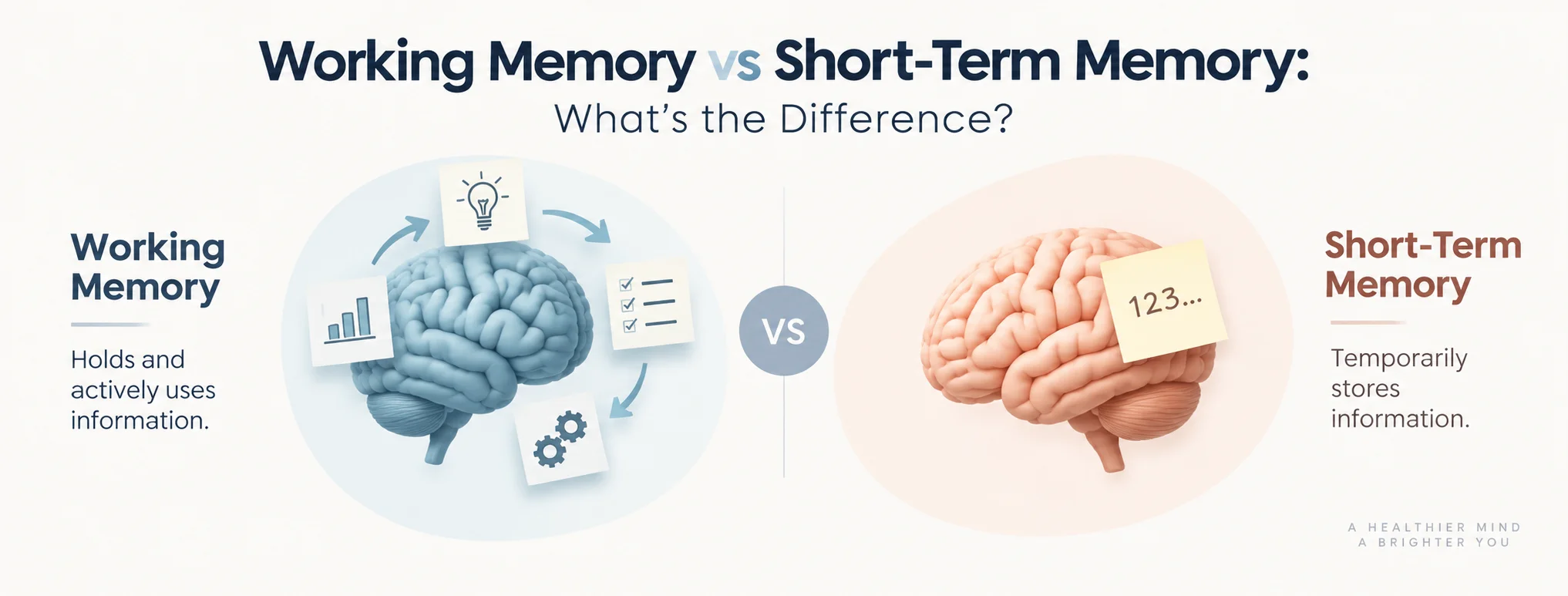
Short-term memory is generally used to describe the temporary retention of information. Working memory goes further by allowing you to hold information in mind while also manipulating, updating, comparing, or using it to complete a task.
The distinction is useful—but it’s not as absolute as it sometimes sounds. Researchers use the two terms somewhat differently, and some theories consider short-term storage to be a component of working memory.
Quick answer: Working memory vs. short-term memory
Short-term memory refers mainly to keeping a limited amount of information temporarily available.
Working memory refers to the broader mental system involved in temporarily maintaining information and using or manipulating it while you think, learn, reason, or solve a problem.
For example:
- Remembering a phone number long enough to dial it → short-term memory
- Reversing that phone number in your head → working memory
- Remembering the beginning of a sentence while interpreting its ending → working memory
- Keeping a room number in mind while walking to the room → short-term memory
- Keeping directions in mind while changing your route because of a road closure → working memory
The two systems overlap, which is why the terminology can sometimes be confusing.
What is short-term memory?
Short-term memory is the ability to keep information accessible for a brief period without needing to retrieve it from long-term memory.
Imagine someone tells you:
4827
You can probably keep those digits in mind long enough to enter them into a keypad. If you stop rehearsing them or become distracted, however, they may quickly become unavailable.
Traditional research has often described short-term memory as lasting for only a few seconds without rehearsal, although the exact duration depends on the material, task and conditions.
Examples of short-term memory
You use temporary storage when you:
- Remember a verification code long enough to enter it
- Keep a new person’s name in mind immediately after meeting them
- Remember a room number while walking toward it
- Repeat an address until you can write it down
- Keep the beginning of a sentence available while listening to the rest
- Remember a short list while moving through a store
In these situations, the main demand is keeping information available.
How much information can short-term memory hold?
This is where one of the most common memory myths appears.
You may have heard that humans can hold “7 ± 2” items in short-term memory. That idea comes from George Miller’s influential 1956 work.
But it shouldn’t be treated as a universal limit.
Later research has suggested a smaller capacity under controlled conditions, often around four chunks, while the amount a person can remember depends heavily on factors such as chunking, familiarity, attention and the material itself.
For example, these may contain the same number of characters:
1 9 4 7 2 0 2 6
versus:
1947 — 2026
The second version can be easier to remember because the information is organized into meaningful chunks.
So there isn’t a single number that represents everyone’s short-term memory capacity.
What is working memory?
Working memory is the mental system that allows you to keep information available while doing something with it.
Alan Baddeley described working memory as a system involved in the temporary storage and manipulation of information needed for complex cognitive activities such as language comprehension, learning and reasoning.
Think of it as a mental workspace.
You’re not simply storing information on the workspace. You’re actively using it.
For example, when solving:
27 + 18
you need to keep parts of the problem in mind while performing the calculation.
Similarly, when following a multi-step instruction, you may need to remember what you’ve already done, keep the next step in mind and adjust your plan if something changes.
That’s working memory.
Working memory examples
You rely on working memory when you:
- Do mental arithmetic
- Follow multi-step instructions
- Compare two ideas while reading
- Reorder information in your head
- Keep track of several conditions while solving a problem
- Follow directions while adapting to a detour
- Remember what someone just said while planning your response
- Read a complex sentence while connecting it to information earlier in the paragraph
- Keep track of several moves during a strategy game
The common factor is that the information is not merely being stored.
You’re doing something with it.
Working memory vs. short-term memory: the key difference
A useful way to remember the distinction is:
Short-term memory holds. Working memory holds and works.
Consider the number:
7 — 3 — 9 — 2
If you’re asked to repeat:
7 — 3 — 9 — 2
you’re primarily maintaining the sequence.
But if you’re asked to repeat it backward:
2 — 9 — 3 — 7
you have to keep the digits available while mentally rearranging them.
That additional processing creates a working-memory demand.
This is why two tasks involving exactly the same information can feel completely different in difficulty.
Working memory and short-term memory aren’t completely separate
This distinction is important because the terms aren’t used consistently across every psychological theory.
Some researchers describe short-term memory as a temporary storage component within a broader working-memory system. Other approaches treat short-term memory and working memory as distinguishable cognitive functions.
A review of the literature found substantial overlap between the concepts and noted that researchers do not always use the terms in the same way.
So it would be misleading to say:
“Short-term memory and working memory are two completely separate parts of the brain.”
A more accurate explanation is:
They describe closely related aspects of temporary information processing, with working memory emphasizing the active use and manipulation of information.
The Baddeley model of working memory
One of the most influential frameworks for understanding working memory is Alan Baddeley’s multicomponent model.
It describes several interacting components.
1. Central executive
The central executive helps control attention and coordinate mental operations.
It’s involved when you need to decide what to focus on, switch between information, or coordinate different parts of a task.
2. Phonological loop
This component is associated with temporarily maintaining speech-based and verbal information.
For example, silently repeating a new phone number to yourself helps keep the information active.
3. Visuospatial sketchpad
This system is involved in temporarily working with visual and spatial information.
Imagine mentally rotating an object or remembering where something is located on a map.
4. Episodic buffer
The episodic buffer helps integrate information from different sources and connect working-memory contents with information from long-term memory.
Together, these components illustrate why working memory is more than simply a mental storage box.
What happens when working memory gets overloaded?
Working memory has limited resources.
When a task requires you to hold too much information, manipulate several things at once, or ignore competing distractions, performance can suffer.
Imagine trying to:
- Remember three instructions
- Read an email
- Reply to a message
- Listen to someone talking
- Remember what you were doing before the interruption
The problem isn’t necessarily that you’ve “lost your memory.”
Your working memory may simply be dealing with too much competing information.
This is one reason why distractions and task switching can make concentration harder.
Why distraction affects working memory
Working memory depends heavily on attention.
When attention shifts away from the information you’re maintaining, that information becomes more vulnerable to interference.
For example, suppose someone gives you a six-digit code and you silently repeat it while opening an app.
Then a notification appears.
You read it.
A few seconds later, you realize you’ve forgotten the code.
The notification didn’t necessarily erase the memory. It introduced competing information and redirected your attention away from the task.
This is why reducing unnecessary distractions can make mentally demanding tasks easier.
Working memory and learning
Working memory plays an important role in learning because new information often has to be held and processed before it can be connected with existing knowledge.
Consider reading a difficult paragraph.
You need to:
- Keep earlier information available
- Understand the current sentence
- Connect ideas
- Identify the main point
- Integrate the information with what you already know
That is more demanding than simply remembering a single word.
Working memory therefore becomes particularly important when learning unfamiliar or complex material.
However, working memory isn’t the same thing as intelligence, and a single working-memory task cannot provide a complete picture of someone’s cognitive abilities.
Working memory vs. short-term memory vs. long-term memory
These concepts become easier to understand when viewed together.
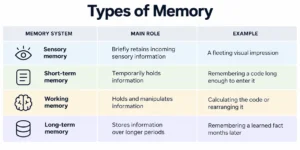
These categories aren’t isolated boxes. Memory systems interact continuously.
Information can be attended to, temporarily maintained, processed, connected with existing knowledge and eventually stored or retrieved.
Why do you forget something you were just thinking about?
This is where the distinction becomes especially useful.
You might think:
“I was just about to say something. What was it?”
Several things can contribute to this kind of lapse.
Your attention may have shifted.
Another thought may have interfered.
The information may not have been rehearsed or encoded strongly.
Or the task may have placed more demands on working memory than you could comfortably maintain.
Everyday forgetting therefore doesn’t automatically mean that your long-term memory is failing.
Sometimes the information simply wasn’t maintained long enough or became inaccessible after attention moved elsewhere.
Can working memory and short-term memory be improved?
There are several practical ways to make tasks that rely on temporary memory easier.
Use chunking
Instead of remembering:
1 9 8 5 2 0 2 6
organize it into meaningful groups:
1985 — 2026
Chunking reduces the number of separate units you need to actively maintain.
Rehearse important information
Repeating information can help keep it accessible temporarily.
This is particularly useful for things like phone numbers, names, directions or short instructions.
Reduce unnecessary distractions
If you’re trying to remember and manipulate information, constant notifications and interruptions add competing demands.
Put your phone away when you’re doing mentally demanding work.
Write things down
External memory aids aren’t a failure of memory.
They reduce the amount of information your working memory has to maintain at once.
A checklist, calendar or notes app can effectively act as an external support system.
Connect new information to what you already know
Meaningful information is often easier to work with than completely unfamiliar material.
For learning, don’t just try to memorize isolated facts. Connect them to concepts, examples and prior knowledge.
What about working-memory training and brain games?
This area requires some caution.
Research suggests that working-memory training can improve performance on tasks similar to the ones being practiced. However, evidence that these improvements reliably transfer to broad abilities such as intelligence, reading, mathematics or other real-world skills is much less convincing.
A 2024 second-order meta-analysis similarly concluded that working-memory capacity in healthy adults can improve with training, but the average effect was small and the practical impact on broader real-life cognition may be limited.
In other words:
Getting better at a memory exercise doesn’t necessarily mean that every aspect of your thinking will improve.
That distinction matters when evaluating claims about “brain training.”
How can you tell whether a task uses short-term or working memory?
Ask one simple question:
Am I only holding the information, or am I doing something with it?
Mostly holding it → short-term memory
Examples:
- Repeating a number
- Remembering a name
- Keeping an address in mind
Holding + manipulating it → working memory
Examples:
- Reversing the number
- Comparing two names
- Rearranging an address
- Following several instructions while adapting to changes
Many real-world tasks use both.
A simple real-life example
Imagine you’re cooking a new recipe.
You read:
“Add two teaspoons of cumin, stir for 30 seconds, then reduce the heat.”
Your short-term memory helps keep the instruction available.
But while cooking, you may need to:
- Remember the amount
- Keep track of the timer
- Monitor the heat
- Remember the next step
- Adjust because the food is cooking faster than expected
Now you’re relying heavily on working memory.
The distinction becomes clear:
Short-term memory helps keep information available.
Working memory helps you use that information while the situation changes.
Frequently asked questions
Is working memory the same as short-term memory?
Not exactly. The terms overlap, and researchers define them differently, but working memory generally emphasizes maintaining information while actively processing or manipulating it.
Which is more important: working memory or short-term memory?
Neither is simply “more important.” They describe related functions that support different demands. Temporary storage is useful when you only need to retain information, while working memory becomes especially important when you need to manipulate or use that information.
How long does short-term memory last?
There isn’t one fixed duration. Information can become unavailable within seconds without rehearsal, but duration varies with the material, attention, interference and task.
Is short-term memory capacity really seven items?
Not as a universal rule. Miller’s famous 7 ± 2 estimate is historically important, but later research has suggested a smaller capacity under some controlled conditions, often around four chunks. Chunking and familiarity can substantially change performance.
Is working memory part of long-term memory?
No. Working memory and long-term memory describe different functions, although they interact constantly. Working memory can temporarily activate or manipulate information retrieved from long-term memory.
Does having a poor memory mean you have poor working memory?
Not necessarily. Memory performance depends on many factors, including attention, sleep, interference, familiarity, retrieval cues and the specific task. A difficulty on one memory task doesn’t provide a complete assessment of someone’s memory abilities.
The bottom line
The easiest way to understand working memory vs. short-term memory is to think about what you’re doing with information.
Short-term memory is primarily about temporary retention.
Working memory involves temporary retention plus active processing.
But the distinction isn’t a hard biological boundary. Modern research recognizes considerable overlap between the two concepts, and different theories define their relationship differently.
If you’re remembering a phone number long enough to type it, you’re relying on temporary storage.
If you’re taking that number, rearranging it, comparing it with another number, or using it to solve a problem, you’re engaging working memory.
And when the task becomes more complex, attention, distraction, cognitive load and existing knowledge all start to matter.
Understanding that difference can make it much easier to understand why some mental tasks feel effortless while others suddenly become difficult.
Sources & further reading
- Baddeley, A. — Working Memory, Science.
- Baddeley, A. — Working Memory: Theories, Models, and Controversies, Annual Review of Psychology.
- About the Distinction Between Working Memory and Short-Term Memory, Frontiers in Psychology.
- Expanded Taxonomies of Human Memory, Frontiers in Cognition.
- Melby-Lervåg et al. — working-memory training meta-analysis.