Have you ever tried learning something unfamiliar and noticed how much effort it takes at first? Even a simple activity, such as using a new software tool, remembering a few words in another language, or learning to play a song, can feel surprisingly difficult when you are starting from scratch.
You have to pay attention, remember instructions, recognize patterns, and figure out what to do when something goes wrong. But as you practise, the task often becomes easier. You begin recognizing things that once confused you, and you can do more without constantly checking instructions.
This happens partly because your brain can adapt to new experiences through a process called neuroplasticity.
Learning something new gives your brain opportunities to adapt, form memories, practise problem-solving, and develop new skills. The benefits depend on what you learn and how you practise, and improving one skill does not automatically improve every aspect of intelligence or prevent cognitive decline.
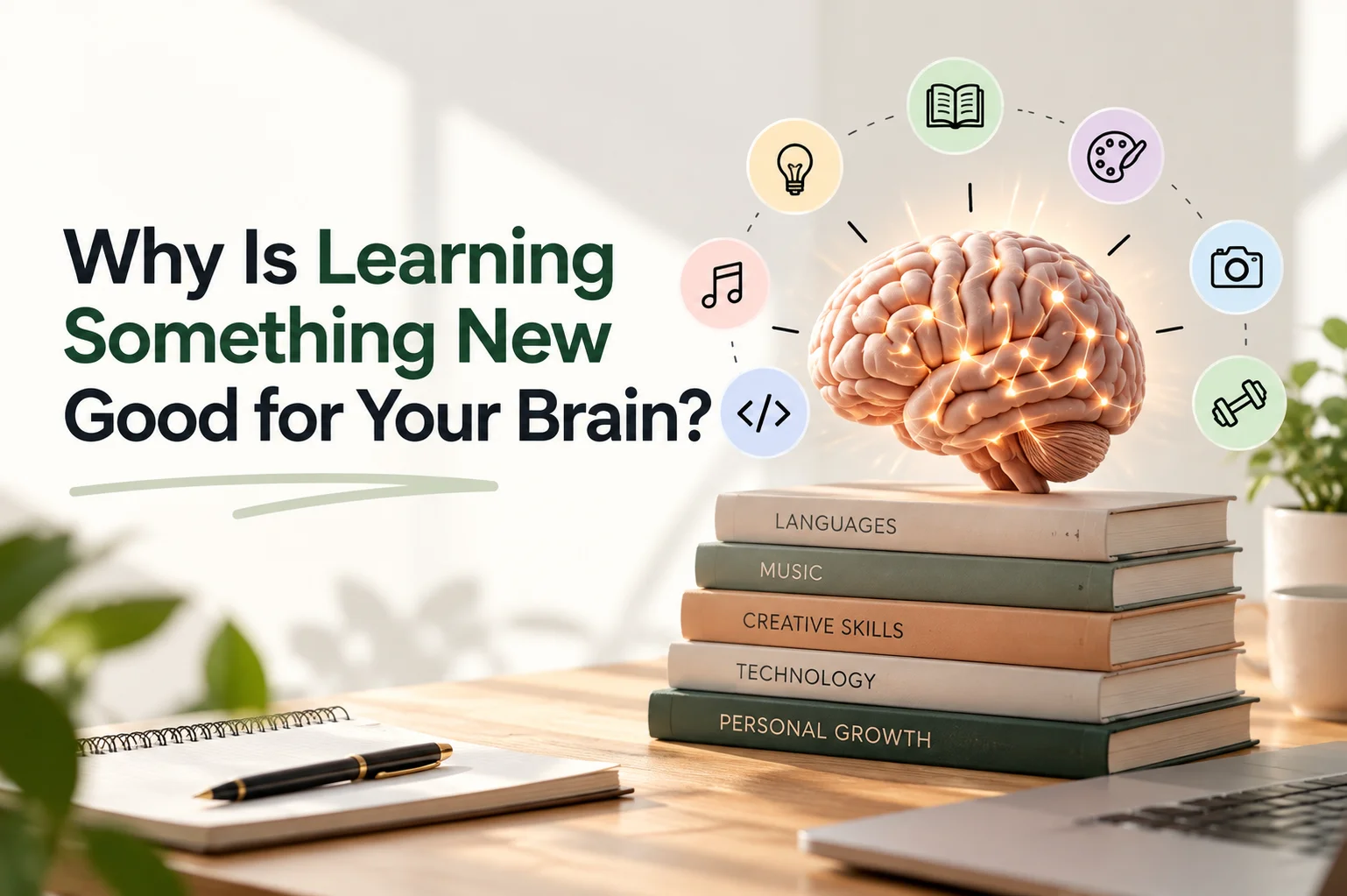
The encouraging part is that learning doesn’t have to involve formal education or complicated subjects. You can learn through cooking, reading, music, photography, language practice, creative hobbies, or activities that challenge you to think differently.
In this guide, we’ll explore why learning is beneficial for your brain, what scientific research actually tells us, which activities you can try, and how to build a learning routine that fits into everyday life.
1. Learning New Things Helps Your Brain Adapt
Your brain is not a completely fixed system. Throughout life, it can change in response to experience, practice, and learning. Scientists refer to this ability as neuroplasticity.
Neuroplasticity involves changes in how neurons and neural networks function and communicate. Depending on the experience, it can also involve changes in the connections between neurons and the organization of certain brain networks.
When you learn an unfamiliar skill, your brain has to process information and coordinate the mental or physical actions involved. Repeated practice can gradually change how efficiently you perform those actions.
Consider learning to drive.
During your first lessons, you may have to consciously think about steering, checking mirrors, controlling speed, observing traffic, and following road signs. There is a lot to manage, and each decision requires attention.
With instruction and practice, these actions can become more familiar. You begin recognizing common situations and coordinating different tasks with less conscious effort.
Learning to use a new software application, play an instrument, or speak another language can involve similar adjustments.
The important point is that your brain is responding to experience. You are not simply collecting information; you are practising ways to process and use it.
However, neuroplasticity does not mean that every new activity produces a dramatic physical change in the brain. The changes depend on factors such as the skill, the amount and quality of practice, and the individual.
What you can do: Choose one skill that requires you to think or act differently from your usual routine. Practise it consistently, pay attention to your mistakes, and gradually increase the challenge as you improve.
2. It Gives You Opportunities to Strengthen Memory
Learning and memory are closely connected. When you learn something, your brain has to encode information, connect it with what you already know, and sometimes retain it so that you can use it later.
But simply seeing information repeatedly is not always the best way to remember it.
Imagine you are learning a few phrases in a new language. You read the phrases several times and feel that you recognize them. Then you close the lesson and try to recall them without looking.
Suddenly, some of the words are harder to remember than you expected.
That difference matters. Recognizing information when it is in front of you is not the same as retrieving it from memory.
Practising retrieval by testing yourself can help you identify what you actually remember and what needs more work. Revisiting information over several sessions can also help support long-term retention.
For example, you might:
- Learn a small amount of information today.
- Try recalling it without looking at your notes.
- Review the difficult parts the following day.
- Test yourself again a few days later.
- Apply what you learned to a new example.
This approach is useful for academic subjects, professional training, languages, and many practical skills.
Rest and sleep also matter. The National Institutes of Health has reported research showing that the brain can replay patterns associated with a newly practised motor skill during short periods of wakeful rest. This suggests that learning continues to develop during periods when you are not actively practising.
Read the NIH explanation of how short breaks help the brain learn new skills.
The practical takeaway: Don’t measure learning only by how much information you consume. Give yourself opportunities to recall, practise, and use what you have learned.
3. Learning Can Help You Practise Concentration
Learning something unfamiliar often requires sustained attention.
You might need to follow a sequence of instructions, notice small differences, remember what happened in your previous attempt, or work through a problem you cannot solve immediately.
These demands encourage you to direct your attention toward a specific task.
Think about learning photography. At first, you may focus on getting the camera settings right. As you gain experience, you can start paying more attention to lighting, composition, movement, and the relationship between different elements in a photograph.
Your attention is still involved, but what you need to focus on changes as your skills develop.
Learning can therefore provide opportunities to practise concentrating on a particular activity. However, it is important to distinguish practising attention during a task from improving attention in every situation.
Research on cognitive training often finds that improvements are strongest in the abilities or tasks people actually practise. Whether those benefits transfer to unrelated activities depends on the type of training and the evidence available.
For instance, becoming better at concentrating on a musical exercise does not automatically mean you will never get distracted while working.
Still, choosing activities that require deliberate attention can be a useful way to spend time, especially when you approach them without constantly switching between tasks.
Try this: Spend 15 minutes practising a skill with unnecessary notifications turned off. Focus on one specific goal, such as completing a short lesson or mastering one technique. When you finish, note what you learned and what still needs attention.
If distractions are making this difficult, read our guide on why your phone makes it harder to concentrate.
4. It Encourages Problem-Solving and Flexible Thinking
One of the most valuable parts of learning is discovering that your first approach doesn’t always work.
When you encounter something unfamiliar, you may need to compare different options, identify patterns, test an idea, or adjust your strategy.
This process encourages you to move beyond simply repeating what you already know.
Suppose you start learning to cook a dish you’ve never prepared before. You follow the instructions, but the result doesn’t turn out as expected.
You could repeat exactly the same steps and hope for a different result. Or you could investigate what happened.
Was the temperature too high? Did you use a different ingredient? Did you cook the dish for too long? Would changing the order of the steps make a difference?
By examining the result and adjusting your approach, you learn more than the recipe itself. You begin understanding how the process works.
The same principle applies to learning programming, solving mathematics problems, playing strategy games, or developing a creative skill.
Why mistakes can be useful
A mistake gives you information about the difference between your current understanding and the result you want.
It becomes useful when you examine that information and use it to make a better attempt.
This doesn’t mean every mistake automatically improves your thinking. Repeating an error without understanding it may simply reinforce an ineffective approach. Feedback, reflection, and suitable guidance help make practice more productive.
A useful question to ask when learning is: “What did I expect to happen, what actually happened, and what can I change next time?”
That question turns an unsuccessful attempt into an opportunity to investigate rather than a reason to give up.
5. Learning Can Help Keep Your Mind Engaged as You Age
The ability to learn does not disappear when you become older.
Some cognitive abilities, such as processing speed or quickly recalling certain information, may change with age. However, older adults can continue learning new skills, forming memories, and improving their knowledge.
The National Institute on Aging explains that older adults can develop new skills and improve abilities such as vocabulary and language. It also emphasizes that research into the lasting cognitive benefits of many recreational activities is still developing.
Read the National Institute on Aging’s guidance on cognitive health and older adults.
Researchers also study a concept called cognitive reserve. Broadly, it describes how a person’s experiences and cognitive resources may help them cope with age-related changes or brain damage.
Education, occupational experiences, and intellectually engaging activities have all been investigated in relation to cognitive reserve. However, these relationships are complex, and learning one new skill cannot be assumed to prevent dementia or protect someone from every form of cognitive decline.
It is more useful to view lifelong learning as one way to remain mentally engaged rather than as a guaranteed medical intervention.
You might learn to use unfamiliar technology, take a class, study a subject that has always interested you, or explore a creative hobby.
The goal isn’t to make your brain immune to aging. It is to continue participating in activities that challenge you, provide enjoyment, and help you develop abilities that matter in your life.
6. Learning Something New Can Build Confidence
Starting something unfamiliar can make you feel inexperienced. You might struggle with a task that seems easy for someone else, forget information you just studied, or need several attempts to understand a concept.
That is a normal part of being a beginner.
As you practise, you have opportunities to see your progress directly. Something that once required constant instructions may become easier to perform. A concept that seemed confusing may begin to make sense.
These small improvements can build confidence in your ability to learn.
Imagine that you decide to learn basic graphic design. At first, you might struggle to arrange elements, choose suitable typefaces, or understand spacing. After practising, you begin recognizing common design principles and making more deliberate decisions.
You may not become an expert immediately, but you can see that your skills are developing.
This experience can make it easier to approach other unfamiliar activities without expecting yourself to master them straight away.
Research on adult learning has also explored its relationship with well-being, self-confidence, and life satisfaction. Some findings are encouraging, although the outcomes vary between programmes and participants.
A useful way to build confidence is to track progress rather than perfection. Write down what you can do now that you couldn’t do when you started. Those changes are often easier to recognize when you look back at them.
7. It Can Make Everyday Life More Interesting
Learning has value beyond productivity or cognitive performance. It can also introduce you to interests, experiences, and people you might not otherwise encounter.
Perhaps you start learning about astronomy and begin noticing the night sky differently. Maybe you learn a few phrases in another language and become curious about the culture behind it. You might take up gardening and discover that you enjoy understanding how plants grow.
These activities can give ordinary moments a new dimension.
Learning can also create opportunities for social connection. A language class, photography group, dance lesson, or community workshop brings people together around a shared interest.
The social experience may be as valuable to you as the skill itself.
You also don’t have to choose something difficult just because you think it will be better for your brain. An activity that holds your interest and encourages you to keep learning can be more sustainable than one you abandon because it feels like a chore.
Start with curiosity. Ask yourself what you have wanted to understand, make, or try but haven’t yet given yourself time to explore.
8. Learning Can Help You Become More Comfortable With Being a Beginner
Many people avoid learning new things because they dislike feeling inexperienced.
It can be frustrating to make mistakes, compare your progress with someone else’s, or realize that a task takes longer than you expected.
But being a beginner is not evidence that you lack ability. It simply means you haven’t developed the relevant knowledge or skill yet.
Learning gives you repeated opportunities to work through uncertainty.
You might initially struggle to pronounce a word correctly, understand a complicated concept, or perform a movement with the right coordination. With practice and feedback, you can identify what needs improvement and adjust your approach.
Over time, this process may help you become more willing to try unfamiliar activities.
The benefit is not that learning automatically makes you fearless or resilient. People respond differently to challenges, and some activities may remain difficult despite practice. Rather, learning can give you practical experience in dealing with mistakes, receiving feedback, and making gradual progress.
Try replacing the thought “I’m not good at this” with a more specific question:
“What part of this task do I not understand yet?”
That question gives you somewhere to begin.
9. Learning Helps You Connect New Information With What You Already Know
Knowledge becomes more useful when you understand how different ideas relate to each other.
Imagine that you are learning about personal finance. Initially, you might treat budgeting, saving, debt, and interest as separate topics.
As you learn more, you begin seeing how they influence one another. Interest affects the cost of borrowing. Regular saving can help build an emergency fund. A budget can help you decide how much you can realistically save.
The individual facts start forming a larger picture.
This happens across many subjects. Understanding basic biology can make advanced biological concepts easier to approach. Learning the foundations of programming can help you understand more complicated code. Knowing a little about history can help you make sense of current events.
Connecting ideas gives you a framework for understanding new information.
How to make these connections while learning
After studying a new concept, ask yourself:
- What does this remind me of?
- How does it connect with something I already understand?
- Can I think of a real-world example?
- Could I explain the relationship to someone else?
- What would happen if one part of the process changed?
These questions encourage you to work with information rather than simply repeat it.
For a related technique, read our guide on why explaining something helps you remember it.
What Are the Best Things to Learn for Your Brain?
There is no single best activity for everyone. Different skills challenge different abilities, and the benefits depend on the activity, your current experience, and how you practise.
Here are some options to consider.
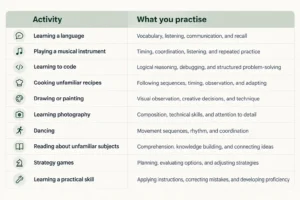
This is not a scientific ranking of brain-training activities. The fact that a hobby engages a mental ability does not automatically prove that it will improve that ability in every context or prevent cognitive decline.
The best activity is usually one that interests you, offers an appropriate challenge, and gives you a reason to return to it.
You can also combine different kinds of activities. For example, learning a dance involves physical movement, remembering sequences, listening to music, and potentially interacting with other people.
Variety can make your routine more enjoyable, but you don’t need to turn every part of your life into a brain-training exercise.
A Simple Seven-Day Plan to Start Learning Something New
You don’t need a complicated programme to begin. The following seven-day plan is a practical framework for getting started with a skill you have been curious about.
It is a suggested routine, not a clinically tested programme for improving brain health. Adjust the time and difficulty to suit the activity.
Day 1: Choose One Skill
Pick something specific you want to learn.
Instead of choosing a broad goal such as “learn photography,” try “understand how lighting affects a photograph.” A smaller target gives you a clearer starting point.
Write down why the skill interests you and what you would like to be able to do.
Day 2: Learn the Basics
Spend around 15–20 minutes learning the fundamentals through a reliable tutorial, book, class, or other suitable resource.
Avoid trying to understand everything at once. Focus on the main concepts and note any questions you have.
Day 3: Recall What You Learned
Without looking at your notes, write down or explain the main ideas you remember.
Then compare your explanation with the original material. Identify anything you misunderstood or forgot.
This gives you a practical way to check your understanding.
Day 4: Practise One Weak Area
Return to the part you found difficult.
If you are learning a language, practise the words you keep forgetting. If you are learning to code, work through a small example. If you are learning photography, experiment with one camera setting.
Focus on improving one part rather than repeating the entire lesson.
Day 5: Apply the Skill
Use what you have learned in a small practical task.
Prepare a simple recipe, create a basic design, write a short programme, or use your new vocabulary in a few sentences.
Application helps you discover whether you can use the information rather than only recognize it.
Day 6: Try a Slightly Harder Challenge
Choose a task that builds on what you have already practised.
It should be challenging enough to require thought but not so difficult that you have no idea where to begin.
If you struggle, break it into smaller steps or return to the relevant lesson.
Day 7: Review Your Progress
Ask yourself:
- What can I do now that I couldn’t do at the beginning?
- Which concepts do I remember clearly?
- What still feels difficult?
- What would be a useful next step?
You may discover that you have made progress in one area while still needing practice in another. Both outcomes are useful information.
The purpose of the week is not to master an entire skill in seven days. It is to establish a realistic learning routine and experience how practice, feedback, and review fit together.
How to Learn More Effectively
Choosing an activity is only the first step. The way you approach learning can also influence how much you retain and how successfully you develop the skill.
Practise consistently
Short, manageable sessions can make it easier to return to an activity. Choose a schedule that fits your responsibilities rather than assuming you need hours of practice every day.
Test yourself instead of only rereading
Close your notes and try to recall the important ideas. For practical skills, attempt the task without following every instruction. This helps reveal what you can do independently.
Use feedback
If possible, compare your work with a reliable example, ask a knowledgeable person for feedback, or use a structured exercise that shows you where you went wrong.
Feedback helps you avoid repeating mistakes without understanding them.
Make the challenge manageable
If the material is too easy, you may have little opportunity to develop the skill. If it is far beyond your current ability, you may become overwhelmed.
Break difficult tasks into smaller parts and increase the challenge as you become more comfortable.
Give yourself time to rest
Learning requires effort, and exhaustion can make it harder to focus. Short breaks can be useful, and sufficient sleep supports memory and overall cognitive functioning.
You don’t have to keep practising until you feel completely drained. Sometimes, returning to a skill later is more productive than continuing when you can no longer concentrate effectively.
Does Learning Something New Prevent Memory Loss or Dementia?
This is an important question, especially for people interested in maintaining their cognitive health as they grow older.
Research suggests that mentally engaging activities can support specific skills and may contribute to aspects of cognitive health. Some structured cognitive-training studies have also reported lasting benefits in the abilities participants practised.
However, the evidence does not establish that learning any particular hobby will prevent dementia or guarantee protection against age-related cognitive decline.
The National Institute on Aging distinguishes between promising research findings and benefits that have not yet been firmly established. It also cautions against assuming that commercial brain-training games provide the same benefits as specific interventions studied in research.
You can explore the evidence in its guidance on cognitive health and older adults.
It is also worth remembering that cognitive health is influenced by many factors, including physical health, sleep, hearing, mental health, social circumstances, and other lifestyle factors.
Learning can be one meaningful part of a broader approach to well-being. It should not replace medical advice, appropriate treatment, or other health-supporting activities.
The most responsible conclusion is that learning provides opportunities for mental engagement and skill development, while its effects on long-term cognitive decline remain an active area of research.
Frequently Asked Questions
1. What happens to your brain when you learn something new?
Your brain processes unfamiliar information and can adapt the way neural networks function and communicate. This ability is known as neuroplasticity. With practice, the processes involved in a skill can become more efficient, and you may become better at remembering or performing that particular task.
2. Does learning new things improve memory?
Learning gives you opportunities to encode information, connect it with existing knowledge, and practise recalling it. Techniques such as retrieval practice and spaced review can help support retention. The benefits depend on what you learn and how you practise.
3. Is it good to learn something new every day?
Learning every day can be a useful routine, but it is not a requirement for a healthy brain. Regular practice at a manageable pace can be more sustainable than forcing yourself to learn something new daily. Rest and review are also important parts of the learning process.
4. Can older adults learn new skills?
Yes. Older adults can continue learning new skills, forming memories, and developing knowledge. Some aspects of learning may take longer with age, but the ability to learn remains. The experience varies depending on the person, the task, and the amount of practice.
5. What is the best hobby for brain health?
There is no universally best hobby. Languages, music, creative activities, practical skills, and intellectually engaging games all offer different experiences. Choose something that interests you and provides an appropriate challenge. Don’t assume that one activity will improve every cognitive ability.
6. Does learning something new increase IQ?
Learning can increase your knowledge and improve specific skills, but that is not the same as proving an increase in general intelligence. Improvements from practising one task do not necessarily transfer to unrelated cognitive abilities.
7. How long should I spend learning a new skill?
Start with a manageable session, perhaps 10–20 minutes, and adjust according to your goals and the difficulty of the activity. Some skills develop over weeks or months, while others take years of practice. Consistency, useful feedback, and realistic goals matter more than following an arbitrary schedule.
8. Is reading enough to keep your brain active?
Reading can engage comprehension, language, attention, and knowledge building. Exploring unfamiliar subjects and thinking critically about what you read can make the experience more active. However, reading is not a guaranteed way to prevent cognitive decline, and it can be combined with other meaningful activities.
Final Thoughts
Learning something new is good for your brain because it gives you opportunities to adapt, practise memory, develop skills, solve problems, and connect ideas.
It can also build confidence, introduce you to new interests, and make everyday life more engaging.
But the real value of learning isn’t that every new hobby will make you smarter or protect you from cognitive decline. It is that learning gives you a chance to understand more, do more, and approach unfamiliar challenges with greater experience.
You don’t need to master a difficult subject or spend hours studying. Choose something that interests you, start with a manageable goal, practice regularly, and give yourself time to improve.
Your next learning experience doesn’t have to change your entire life. It just needs to give you something meaningful to discover.