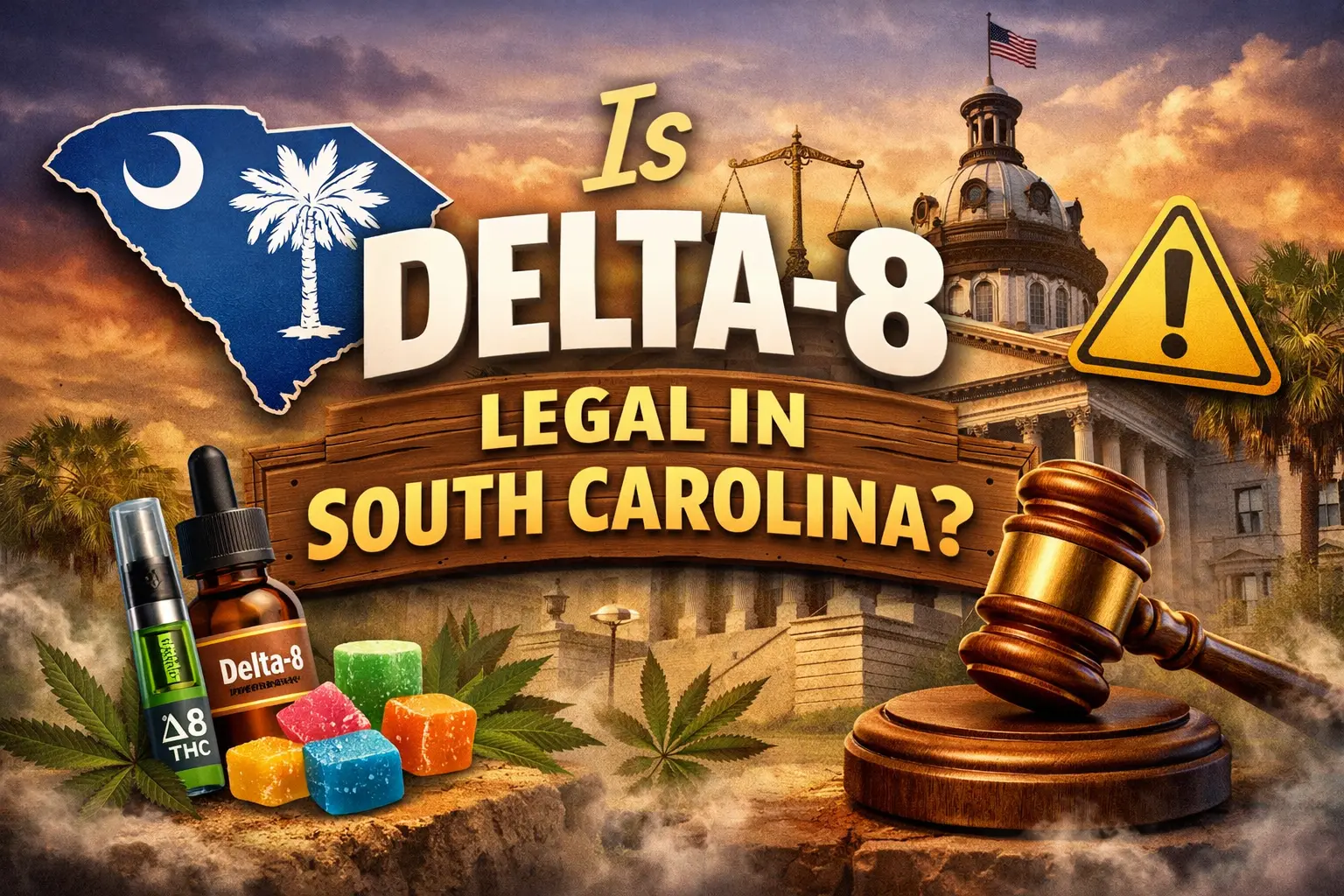
The answer isn’t as straightforward as many people expect. While federal hemp laws opened the door for Delta-8 products, state laws, legal opinions, and proposed legislation have created a complex and sometimes confusing legal environment.
In this in-depth guide, we’ll break down everything you need to know about Delta-8 legality in South Carolina, including federal laws, state regulations, enforcement issues, and potential future changes.
What Is Delta-8 THC?
Delta-8 THC (Delta-8 tetrahydrocannabinol) is a cannabinoid derived from the cannabis plant. It is chemically similar to Delta-9 THC, which is the main psychoactive compound found in marijuana.
However, Delta-8 typically produces milder psychoactive effects compared to Delta-9 THC. Many users report that it offers relaxation, mild euphoria, and pain relief with fewer side effects such as anxiety.
Delta-8 is usually produced from hemp-derived CBD through a conversion process. Because hemp became federally legal in 2018, this created a legal loophole that allowed Delta-8 products to enter the market.
Today, Delta-8 is commonly sold as:
- Gummies and edibles
- Vape cartridges
- Oils and tinctures
- Capsules
- Disposable vapes
Despite its popularity, the legality of Delta-8 varies widely from state to state.
The Federal Law Behind Delta-8
To understand Delta-8’s legal status in South Carolina, we first need to look at federal law.
The 2018 Farm Bill legalized hemp and hemp-derived compounds across the United States. Under this law, hemp is defined as cannabis containing no more than 0.3% Delta-9 THC by dry weight.
Because Delta-8 is typically derived from hemp rather than marijuana, many manufacturers argue that it falls within the Farm Bill’s legal definition of hemp products.
This legal interpretation created a booming market for Delta-8 products across the country. However, the law did not specifically mention Delta-8 THC, which has left room for states to regulate or ban it.
Is Delta-8 Legal in South Carolina?
The legality of Delta-8 in South Carolina is often described as a legal gray area.
Technically, Delta-8 products derived from hemp are generally considered legal if they meet federal requirements—particularly the rule that the product contains less than 0.3% Delta-9 THC.
However, the state has taken a more cautious stance.
Attorney General Opinion
In 2021, the South Carolina Attorney General issued a nonbinding opinion stating that Delta-8 THC is illegal under state law.
Although this opinion does not automatically change the law, it has influenced how law enforcement agencies interpret Delta-8 products.
As a result, the situation has become complicated:
- Some retailers openly sell Delta-8 products.
- Some law enforcement agencies treat Delta-8 as illegal.
- Arrests and product seizures have occurred in certain cases.
This means that while Delta-8 products may still be available in stores, their legal status remains uncertain.
South Carolina Hemp Laws
South Carolina legalized hemp cultivation through the South Carolina Hemp Farming Act, which aligns with federal hemp regulations.
Under this law:
- Hemp is legal if it contains no more than 0.3% Delta-9 THC.
- Hemp products can be produced and sold under state regulations.
- Hemp-derived compounds such as CBD are legal.
Because Delta-8 products are often derived from hemp, many retailers argue that they fall within this legal framework.
However, regulators have raised concerns about how Delta-8 is manufactured and marketed.
Proposed Legislation Targeting Delta-8
South Carolina lawmakers have introduced several bills aimed at regulating or restricting Delta-8 and other hemp-derived cannabinoids.
For example, proposed legislation would classify products containing certain chemically derived cannabinoids—such as Delta-8 THC, Delta-10 THC, and HHC—as regulated consumable hemp products.
Some proposals include restrictions such as:
- Minimum purchase age of 21 years
- Limits on THC content per serving
- Restrictions on marketing and packaging
- Bans on certain synthetic cannabinoids
Another version of the legislation would prohibit consumable hemp products containing chemically derived cannabinoids like Delta-8 altogether.
These bills show that the state is actively considering stricter regulations for intoxicating hemp products.
Can You Buy Delta-8 in South Carolina?
Despite legal uncertainty, Delta-8 products are widely available across South Carolina.
Consumers often find them in:
- CBD stores
- Smoke and vape shops
- Convenience stores
- Online retailers
- Many retailers voluntarily restrict purchases to customers 21 years or older, even though earlier state laws did not specifically require it.
However, because enforcement policies vary, consumers should be aware that availability does not necessarily guarantee legality.
Law Enforcement and Legal Risks
One of the biggest issues surrounding Delta-8 in South Carolina is inconsistent enforcement.
Some law enforcement agencies have taken action against retailers selling Delta-8 products based on the attorney general’s interpretation that the compound may fall under controlled substance laws.
This has led to:
- Store raids
- Product seizures
- Arrests for possession or sale
- Even though Delta-8 products may technically comply with federal hemp rules, the lack of clear state legislation creates legal risks for both businesses and consumers.
How South Carolina Compares to Other States
Delta-8 laws vary dramatically across the United States.
Some states have fully banned Delta-8, while others regulate it similarly to cannabis products.

States Where Delta-8 Is Banned
Several states have outlawed Delta-8 entirely, including:
- Alaska
- Colorado
- Delaware
- Idaho
- Rhode Island
States Where Delta-8 Is Legal or Regulated
Other states allow Delta-8 but impose regulations such as age restrictions, licensing requirements, or THC limits.
South Carolina falls somewhere in the middle—where Delta-8 is not clearly legalized or banned.
Why Delta-8 Is Controversial
The rise of Delta-8 has sparked debate among regulators, lawmakers, and health experts.
1. Lack of Regulation
Many Delta-8 products entered the market without strict oversight. This raised concerns about product quality, labeling accuracy, and safety.
2. Manufacturing Process
Delta-8 is often produced through chemical conversion of CBD rather than extracted directly from hemp. Some lawmakers argue this makes it a synthetic cannabinoid, which could be illegal under certain laws.
3. Youth Access
Delta-8 products—especially gummies and flavored vapes—have been criticized for appealing to minors.
These concerns have led many states to implement new regulations.
Possible Federal Changes
Delta-8’s future may depend on federal legislation.
Lawmakers in Washington have proposed tightening the hemp definition in order to close the loophole that allowed intoxicating hemp products to flourish.
Recent policy discussions have suggested stricter limits on THC content and potential bans on certain hemp-derived cannabinoids.
If federal rules change, Delta-8 laws across the country—including South Carolina—could shift dramatically.
Tips for Buying Delta-8 Safely
If you decide to purchase Delta-8 products in South Carolina, it’s important to take a cautious approach.
Here are some tips:
Check Lab Testing
Look for products with third-party lab reports (Certificates of Analysis). These verify THC levels and confirm that the product is free of contaminants.
Verify THC Levels
Ensure the product contains less than 0.3% Delta-9 THC, which is required for hemp legality.
Buy From Reputable Brands
Avoid unverified sellers or products without clear ingredient labels.
Stay Updated on Laws
Because Delta-8 regulations are evolving, staying informed about state legislation is essential.
The Future of Delta-8 in South Carolina
The legal status of Delta-8 in South Carolina is likely to change in the coming years.
Lawmakers are increasingly focused on regulating intoxicating hemp products, and several bills have already been introduced to address this issue.
Possible future outcomes include:
- Strict regulation similar to cannabis markets
- Age restrictions and licensing requirements
- Full bans on chemically derived cannabinoids
- Federal restrictions that override state policies
Until clear legislation is passed, the legal status of Delta-8 will likely remain uncertain.
Final Thoughts
So, is Delta-8 legal in South Carolina?
The short answer is: it exists in a legal gray area.
- Hemp products containing less than 0.3% Delta-9 THC are federally legal.
- Delta-8 derived from hemp is often sold in stores across the state.
- However, the South Carolina Attorney General has suggested that Delta-8 may be illegal under state law.
- New legislation could soon regulate or restrict these products further.
For consumers, the key takeaway is that Delta-8 may be accessible in South Carolina—but its legal status is not fully settled.
Anyone interested in buying or selling Delta-8 products should keep an eye on evolving laws and regulations to avoid potential legal issues.
About the Author