If you’ve spent any time researching hemp, cannabis, or alternative cannabinoids lately, you’ve probably come across one confusing question: How is THCA legal if it basically turns into THC?
It’s a fair question—and the answer sits right at the intersection of chemistry, legal definitions, and a major piece of U.S. legislation: the 2018 Farm Bill.
In this guide, we’ll break it down in a simple, human way—no legal jargon overload—so you understand why THCA is considered legal (in many cases) and what most people misunderstand about it.
What Is the 2018 Farm Bill (In Simple Terms)?
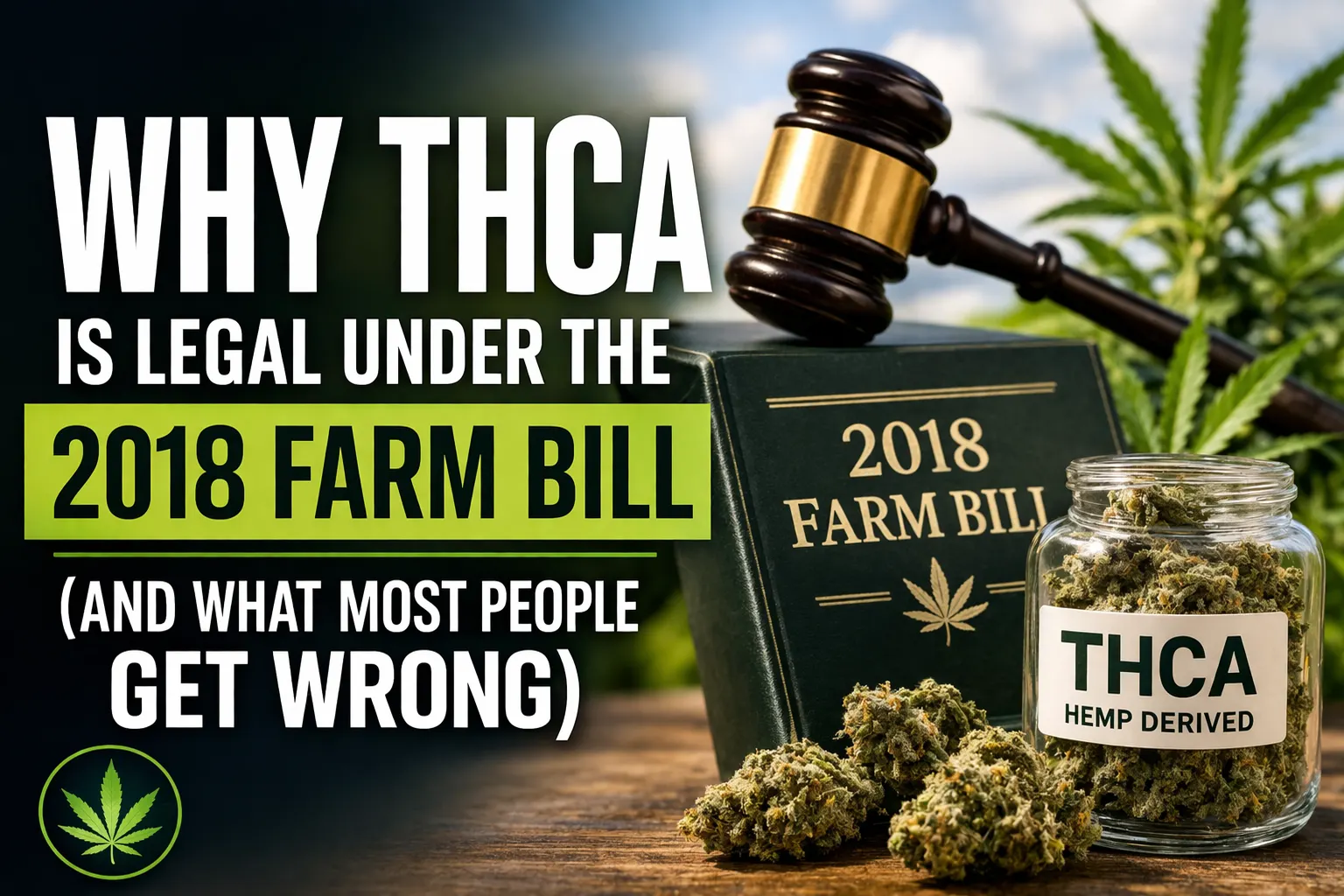
The 2018 Farm Bill officially known as the Agriculture Improvement Act of 2018—changed everything for hemp in the United States.
Before this law, cannabis in almost all forms was treated as a controlled substance. But the Farm Bill created one big exception: hemp.

Here’s the key definition:
- Hemp = cannabis with no more than 0.3% Delta-9 THC (by dry weight)
- Anything above that = marijuana (still federally illegal)
This single definition is what opened the door to CBD, hemp products, and eventually… THCA.
The law also made something very important clear:
Hemp includes all derivatives, extracts, cannabinoids, acids, and isomers as long as they meet that Delta-9 THC limit
And that’s where things get interesting.
What Exactly Is THCA?
THCA (tetrahydrocannabinolic acid) is the raw, natural form of THC found in cannabis plants.Unlike THC, it doesn’t produce psychoactive effects unless heated.
Here’s the key difference:
- THCA (raw) → non-psychoactive
- THC (heated) → psychoactive (“gets you high”)
THCA only becomes THC when exposed to heat through a process called decarboxylation (like smoking, vaping, or cooking).
So in its natural state, THCA doesn’t produce a high.
However, not all THCA products are created equal quality, sourcing, and lab testing play a huge role in safety and effectiveness. If you want a deeper look at quality and sourcing, check out this detailed guide on top-rated THCA strains and trusted brands.
Why THCA Is (Technically) Legal
Now let’s connect the dots.
The 2018 Farm Bill only limits Delta-9 THC, not THCA.
That means:
- A hemp product can contain high levels of THCA
- As long as Delta-9 THC stays below 0.3%, it qualifies as legal hemp
That’s the core reason THCA products exist legally in many places.
In fact, the law focuses specifically on Delta-9 THC concentration—not total THC potential—when defining hemp
The “Loophole” Explained
Because THCA isn’t explicitly restricted in the law:
- Hemp flower can test below 0.3% Delta-9 THC
- But still contain high THCA levels
- Which convert into THC when heated
This is why some people call it a “legal loophole” the law regulates what the plant contains now, not what it can become later.
What Most People Get Wrong About THCA
This is where confusion (and misinformation) spreads quickly.
Let’s clear up the biggest myths.
Myth #1: “THCA is fully legal everywhere”
Not true.
While THCA may fit the federal hemp definition, state laws can override this.
Some states:
- Restrict “total THC” (including THCA)
- Ban smokable hemp
- Or regulate hemp-derived cannabinoids differently
Even federal agencies have raised concerns about how THCA should be interpreted legally.
Bottom line: Federal legality ≠ state legality
Myth #2: “THCA is not THC at all”
Technically true—but misleading.
Yes, THCA is chemically different.
But in real-world use:
- THCA → becomes THC when heated
- Smoking THCA flower = same effect as marijuana
That’s why regulators are paying closer attention to it.Many users today rely on premium THCA flower guide resources to better understand what separates top-tier products from average ones.
Myth #3: “The Farm Bill clearly legalized THCA”
Not exactly.
The Farm Bill never mentions THCA directly.
Instead, it:
- Defines hemp based on Delta-9 THC
- Includes cannabinoids and acids broadly
This created interpretation gaps, not explicit legalization.
Myth #4: “If it’s sold online, it must be legal”
This is a dangerous assumption.
The hemp market moves faster than regulation. Just because a product is available doesn’t mean:
- It complies with local laws
- It meets testing standards
- It won’t cause legal issues
Myth #5: “Testing only looks at Delta-9 THC”
This is where things get complicated.
Some regulators and agencies argue that testing should consider “total THC”, which includes THCA after conversion.
For example, the DEA has indicated that testing methods may account for THCA conversion into THC
This creates legal gray areas depending on how testing is interpreted.
The Real Reason THCA Exists in the Market
The rise of THCA products isn’t random—it’s a direct result of how the law is written.
After 2018:
- Hemp became legal federally
- Businesses started exploring every cannabinoid pathway
- Companies realized THCA could fit within legal limits
So instead of traditional cannabis markets, we now have:
- THCA flower
- THCA vapes
- THCA concentrates
All operating in a space shaped by legal definitions—not just chemistry.

One major misunderstanding is how cannabinoids are formed and classified. While THCA exists naturally in raw cannabis, not all cannabinoids in the market are the same. Some are created through chemical conversion processes, which raises different legal and safety considerations. To understand this better, check out this detailed explanation of natural vs lab-converted cannabinoids.
Why the Government Is Paying Attention
THCA and similar cannabinoids have triggered major discussions in recent years.
Lawmakers and regulators are concerned because:
- Some hemp products can still produce a “high”
- The original intent of the law may be stretched
- Consumers may not understand what they’re buying
There have already been efforts to:
- Redefine hemp based on total THC
- Restrict intoxicating hemp products
- Give states more control over enforcement
This means the current situation may not last forever.
Federal vs State Law: The Big Divide
Here’s the simplest way to understand THCA legality:
Federal Law
- Focuses on Delta-9 THC (≤ 0.3%)
- Allows hemp and its derivatives
State Law
-
Can:
- Ban THCA products
- Restrict smokable hemp
- Use “total THC” rules
That’s why a product can be:
- Legal in one state
- Restricted in another
Is THCA Really “Different” From Marijuana?
From a chemical perspective:
-
Yes (before heating)
From a practical perspective:
-
Not really
Because once THCA is heated:
- It becomes THC
- Produces the same psychoactive effects
That’s why many experts argue that THCA products blur the line between hemp and marijuana.
The Future of THCA Legality
THCA sits in a legal gray zone—and that gray zone is shrinking.
Possible future changes include:
- Updating the Farm Bill definition of hemp
- Including total THC limits
- Stricter testing requirements
- More state-level bans
As regulation evolves, THCA could become:
- More restricted
- Or more clearly defined
Final Thoughts
So, why is THCA legal under the 2018 Farm Bill?
Because the law:
- Defines hemp using Delta-9 THC only
- Includes cannabinoids and acids broadly
- Doesn’t directly address THCA
That combination created a legal gap not necessarily a deliberate legalization.
The truth is simple:
THCA is legal because of how the law is written—not because it’s fundamentally different from THC in effect.
Quick Recap
- THCA = raw, non-psychoactive form of THC
- Becomes THC when heated
- Farm Bill only limits Delta-9 THC (≤ 0.3%)
- THCA isn’t directly mentioned in the law
- State laws can override federal legality
- Regulations are evolving fast.
About the Author