

Ever notice how even a simple task feels difficult after a poor night’s sleep? When you’re tired, focusing, remembering information, and staying mentally alert can all become harder. You may find yourself rereading the same sentence, getting distracted easily, or staring at a task without making much progress.
This isn’t simply a lack of motivation. Fatigue can affect the brain’s ability to maintain attention and handle mental effort. And when that happens, you may experience something commonly described as brain fog.
The good news is that occasional difficulty focusing when you’re tired is usually a normal response to fatigue. Understanding why it happens can help you recognize what your brain needs—and what you can do to feel more mentally clear.
Why Is It Hard to Focus When You’re Tired?
Your brain doesn’t stop working when you’re tired, but it may not work as efficiently.
Fatigue can affect several processes involved in concentration, including:
- Attention: Staying focused on one task can become more difficult.
- Working memory: Holding and using information temporarily may feel harder.
- Alertness: You may feel less mentally awake and responsive.
- Mental processing: Tasks that normally feel easy can require more effort.
- Self-control: Ignoring distractions or resisting the urge to switch tasks can become harder.
This is one reason you might sit down to work while tired and find yourself checking your phone, losing your train of thought, or struggling to finish something you’ve done many times before.
What Happens to Your Brain When You’re Tired?
Sleep and adequate recovery are important for normal cognitive functioning. When you’re sleep-deprived or significantly fatigued, your ability to sustain attention can decline.
You may notice that:
- You lose focus more quickly.
- Your thoughts feel slower or less organized.
- You make more small mistakes.
- You have trouble remembering what you just read.
- Decision-making feels more effortful.
- You become more easily distracted.
In other words, being tired can make mental work feel more demanding. You may still be capable of doing the task, but it can take considerably more effort to stay engaged.
This is also why trying to “push through” severe tiredness isn’t always the most productive approach. Your brain is constantly filtering information and deciding what deserves your attention. Learn how your brain decides what to pay attention to and why some things capture your focus more easily than others.
What Is Brain Fog?
Brain fog is a commonly used term for a temporary feeling of mental sluggishness or difficulty thinking clearly. It isn’t a specific medical diagnosis.
People experiencing brain fog may describe:
- Difficulty concentrating
- Forgetfulness
- Trouble finding the right words
- Feeling mentally slow
- Difficulty staying focused
- Problems organizing thoughts
- Feeling mentally exhausted
The experience can vary from person to person.
Importantly, brain fog isn’t necessarily the same thing as simply being tired. Fatigue is one possible contributor, but brain fog can have several potential causes.
Can Being Tired Cause Brain Fog?
Yes, being tired can contribute to the kind of mental sluggishness people often call brain fog.
When you’re not getting enough sleep—or your sleep quality is poor—your brain may have more difficulty maintaining attention and performing mentally demanding tasks. That can leave you feeling distracted, forgetful, or mentally “cloudy” the next day.
For example, after a particularly short night of sleep, you might notice that you:
Read the same paragraph twice.
Forget what you were about to say.
Struggle to start a task.
Lose focus during a conversation.
These experiences don’t necessarily mean something is wrong. Sometimes, your brain simply needs adequate rest.
However, persistent brain fog shouldn’t automatically be blamed on tiredness.
Why Are You Tired and Unable to Focus?
Lack of sleep is an obvious reason, but it isn’t the only possibility.
Difficulty focusing can also occur alongside:
Poor-quality sleep
You can spend enough time in bed but still wake up feeling unrefreshed if your sleep is frequently disrupted or isn’t restorative.
Mental fatigue
Long periods of studying, working, problem-solving, or intense concentration can leave you mentally drained.
Stress
When your mind is occupied with ongoing worries or responsibilities, it can become harder to direct your attention toward the task in front of you.
Physical exhaustion
Hard physical activity, illness, or simply being run down can affect how mentally alert you feel.
Dehydration or irregular eating
Not drinking enough fluids or going long periods without adequate nutrition may also leave you feeling less energetic and focused.
If tiredness and concentration problems continue despite getting adequate rest, it’s worth considering whether something else may be contributing.
How to Focus When You’re Tired
You can’t always eliminate tiredness immediately, but you can make focusing easier.
1. Prioritize sleep
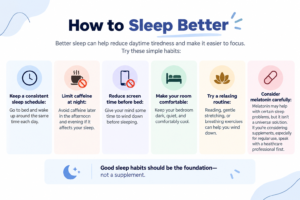
If you’re consistently tired, improving your sleep should come before trying to compensate with productivity hacks. Maintain a reasonably consistent sleep schedule and give yourself enough time to sleep.
2. Take a short break
When your attention starts slipping, stepping away briefly can be more useful than forcing yourself to continue staring at the same task.
Get up, move around, stretch, or simply give your mind a few minutes away from the work.
3. Work on one thing at a time
When you’re tired, multitasking can make concentration even more difficult. Choose one clearly defined task and work on it without unnecessary switching.
Instead of:
“I need to finish everything today.”
Try:
“I’ll spend the next 20 minutes finishing this section.”
Smaller targets can make mentally demanding work feel more manageable.
4. Remove obvious distractions
Put your phone away, close unnecessary browser tabs, and reduce notifications while working.
When your attention is already limited by fatigue, reducing distractions becomes even more valuable.
5. Get some movement
A short walk or a few minutes of light movement can be a useful way to break up prolonged sitting and mental work.
6. Don’t ignore basic needs
Drink enough fluids and eat regular, balanced meals. If you’re exhausted, trying to compensate entirely with caffeine or other stimulants may not address the underlying problem: insufficient recovery.
7. Consider a short nap when appropriate
A brief nap may help with temporary sleepiness for some people. However, frequent or long daytime naps can interfere with nighttime sleep, particularly if you’re already struggling with your sleep schedule.
When Should You Be Concerned About Brain Fog?
Occasionally feeling tired and unfocused—especially after a poor night’s sleep—isn’t unusual.
But if persistent fatigue, brain fog, or difficulty concentrating continues despite adequate sleep and begins interfering with work, studies, relationships, or everyday activities, it’s worth talking with a healthcare professional.
Persistent symptoms can have many possible explanations, and it’s better not to assume that tiredness is always the cause.
The Bottom Line
It’s hard to focus when you’re tired because fatigue can affect attention, alertness, working memory, and the amount of mental effort needed to complete a task.
That mentally sluggish feeling may sometimes be described as brain fog. Getting enough quality sleep, taking appropriate breaks, reducing distractions, staying hydrated, and giving your brain time to recover can all help.
And if difficulty focusing or feeling mentally foggy becomes persistent rather than occasional, don’t simply assume you need to “try harder.” It may be worth finding out what’s causing it.
Frequently Asked Questions
Why can’t I focus when I’m tired?
Tiredness can affect attention, alertness, working memory, and mental processing. As a result, staying focused can require more effort, and you’re more likely to become distracted or lose your train of thought.
Can lack of sleep cause brain fog?
Yes. Insufficient or poor-quality sleep can contribute to difficulty concentrating, forgetfulness, reduced alertness, and the mentally sluggish feeling commonly described as brain fog.
What does brain fog feel like?
Brain fog can feel like mental sluggishness or difficulty thinking clearly. People may experience problems with concentration, memory, finding words, organizing thoughts, or staying mentally engaged.
How can I focus when I’m extremely tired?
If possible, prioritize rest and sleep rather than relying solely on productivity techniques. When you need to work, reduce distractions, focus on one small task at a time, take short breaks, and use light movement to break up long periods of mental work.
Why am I tired even after sleeping?
Feeling tired after sleeping can happen for several reasons, including insufficient sleep, poor sleep quality, an inconsistent sleep schedule, stress, or other factors. If persistent tiredness continues despite adequate sleep, consider discussing it with a healthcare professional.
Centers for Disease Control and Prevention (CDC) — Sleep and HealthUseful for sleep duration, sleep habits, and the importance of adequate sleep. CDC — Sleep and Health
National Institute of Neurological Disorders and Stroke (NINDS) — Brain BasicsA strong government source for general information about the brain and sleep. NINDS — Brain Basics
Sleep Deprivation, Vigilant Attention, and Brain Function: A ReviewUseful for supporting the article’s claims about sleep deprivation, sustained attention, and cognitive performance. PubMed — Sleep Deprivation, Vigilant Attention, and Brain Function
Impact of One Night of Sleep Restriction on Sleepiness and Cognitive Function: A Systematic Review and Meta-analysisParticularly relevant because it examines how even one night of restricted sleep can affect sustained attention. PubMed — Sleep Restriction and Cognitive Function