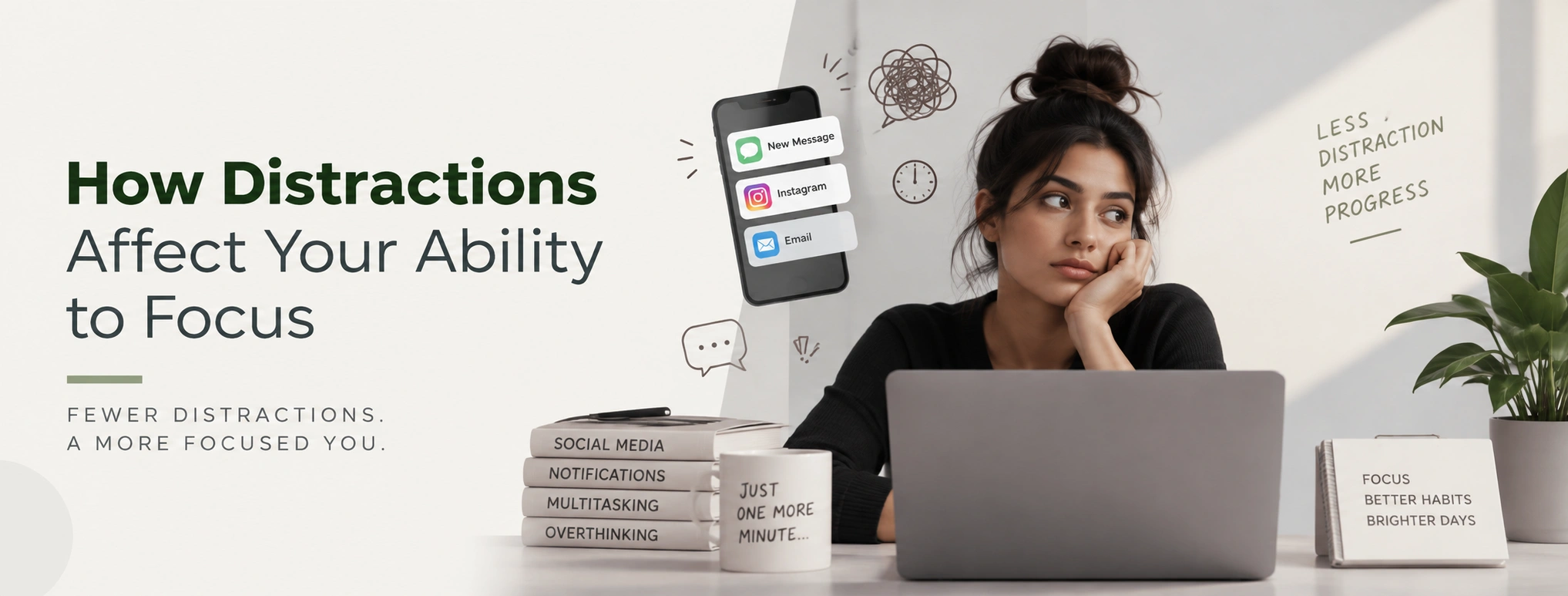
You sit down to read, work, study, or finish an important task. A notification appears. You check it for a few seconds, open another app, reply to a message, and eventually return to what you were doing.
Then you realize you have lost your train of thought.
This is one of the most common ways modern distractions interfere with concentration. The problem is not always that you cannot focus. Often, your attention is simply being pulled between competing sources of information.
Understanding the relationship between attention and distractions can help you build better habits, reduce unnecessary interruptions, and make it easier to stay focused on demanding tasks.
What Happens to Your Brain When You Get Distracted?
Your attention is limited. At any given moment, your brain has to decide which information deserves priority and which information can be ignored.
A distraction introduces another competing signal.
For example, imagine you are writing an important report when your phone lights up. Even if you do not pick it up, part of your attention may shift toward wondering who messaged you and why.
Research has found that mobile notifications can disrupt performance on attention-demanding tasks even when people do not directly interact with their phones.
This is one reason why simply having potential interruptions nearby can make sustained concentration more difficult.
Distractions and Concentration: Why Switching Tasks Is So Costly
People often describe themselves as good at multitasking, but multitasking frequently involves rapidly switching attention between tasks rather than truly performing them simultaneously.
The American Psychological Association notes that switching between tasks can create measurable costs in efficiency and performance.
Consider this:
Reading → checking a notification → replying → returning to reading
Your brain has to reconstruct where you were, what you were thinking about, and what you intended to do next.
Doing this repeatedly can make a simple task feel surprisingly exhausting.
The more demanding the original task is, the more noticeable the disruption can become.
The Effects of Distractions Go Beyond Lost Time
The obvious cost of an interruption is time. But there can be other effects.
Frequent interruptions may contribute to:
- Reduced concentration
- More mistakes
- Slower completion of tasks
- Difficulty remembering what you just read
- Mental fatigue
- Frustration
- Procrastination
- A feeling that you were busy without accomplishing much
Recent research published in Computers in Human Behavior found that social media-style notifications produced a temporary slowdown in cognitive processing, with the magnitude of disruption influenced by notification relevance and smartphone interaction habits.
This helps explain why a quick notification can sometimes have a larger effect than its duration suggests.
Not All Distractions Are Digital
When people think about losing focus, they often blame smartphones and social media. But distractions can come from almost anywhere.
External distractions
These originate in your environment.
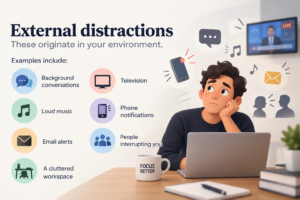
Examples include:
- Background conversations
- Television
- Loud music
- Phone notifications
- Email alerts
- People interrupting you
- A cluttered workspace
Internal distractions
These originate within your own thoughts.
Examples include:
- Worrying about something
- Thinking about an upcoming event
- Replaying a conversation
- Feeling bored
- Daydreaming
- Planning what to do later
Internal distractions can be particularly difficult because changing your environment does not necessarily eliminate them.
Stress can also interfere with attention and inhibitory control. A 2026 study found that participants reporting higher perceived stress showed slower reaction times and fewer correct responses on attention and inhibition tasks.
What Are Manual Distractions?
The term manual distraction is most commonly used in safety research, particularly distracted-driving research.
A manual distraction occurs when a person takes their hands away from the primary task to manipulate something else. For example, while driving, adjusting a device, eating, or reaching for an object can become manual distractions.
The National Highway Traffic Safety Administration (NHTSA) categorizes distraction into visual, manual, and cognitive components.
The concept is useful beyond driving too.
If you are studying and repeatedly stop to pick up your phone, adjust your workspace, search for something unrelated, or interact with another device, the physical action can become another interruption in your workflow.
Why Digital Distractions Are So Difficult to Ignore
Smartphones are particularly effective at capturing attention because they combine communication, entertainment, social interaction, information, and novelty in one device.
A notification does not have to be important to become tempting.
You might hear a sound and immediately wonder:
Who sent that?
What happened?
Did someone reply?
Is this something important?
That uncertainty itself can pull attention away from the task.
This is why reducing digital interruptions is often more effective than simply telling yourself to “try harder” to concentrate.
How to Avoid Digital Distractions
If your phone is regularly interrupting your work, start by reducing the number of opportunities it has to compete for your attention.
Try these strategies:
1. Turn off non-essential notifications
You do not need every app to announce every update immediately.
Keep notifications for genuinely important communication and silence the rest.
2. Keep distracting apps away from your home screen
Increasing the number of steps required to open an app can create a useful pause between the impulse and the action.
3. Put your phone out of reach
A phone sitting next to your keyboard is easier to check than one placed across the room.
Physical distance can create a simple but effective barrier.
4. Use Focus or Do Not Disturb modes
Modern smartphones include tools designed specifically to reduce interruptions.
On iPhone, Focus allows you to silence notifications or permit notifications only from selected people and apps.
5. Check messages at predetermined times
Instead of responding whenever something arrives, create specific windows for messages and email.
This gives your attention a clearer boundary.
An iPhone Setting That Reduces Distractions
If you’re looking for an iPhone setting that reduces distractions, Apple’s Focus feature is one of the simplest places to start.
Go to:
Settings → Focus
From there, you can create or customize a Focus mode such as Work, Personal, Sleep, or Do Not Disturb.
You can choose which people and apps are allowed to interrupt you while the Focus is active.
On supported devices with Apple Intelligence, there is also a Reduce Interruptions Focus. It is designed to silence notifications that are not considered important while allowing potentially important notifications through.
Feature availability can vary depending on your iPhone model, operating system, language, and region.
How to Avoid Distractions and Stay Focused
Removing every distraction from your life is unrealistic. A better approach is to make focused work easier and interruptions harder.
Try this simple system:
Choose one task
Before starting, decide exactly what you are going to work on.
Instead of:
“I need to study.”
Try:
“I will read and take notes on Chapter 3 for 30 minutes.”
Specific goals make it easier to recognize when something is unrelated.
Create a distraction-free environment
Put your phone away, close unnecessary browser tabs, silence notifications, and keep only the materials you need nearby.
Work in focused blocks
You do not necessarily need to work for several hours without stopping.
Try a manageable period of concentrated work followed by a short break.
Write down distracting thoughts
If you suddenly remember something unrelated, write it down instead of acting on it.
For example:
“Reply to email — later.”
This allows you to capture the thought without immediately abandoning your current task.
Make returning to the task easy
When taking a break, leave yourself a clear next step.
Instead of ending with:
“Continue tomorrow.”
Write:
“Next: finish the second paragraph and add the research example.”
This reduces the mental effort required to restart.
What About Social Media?
Social media can be particularly disruptive because it provides a continuous stream of new information.
The problem is not necessarily that every session is harmful. The bigger issue is the repeated transition between focused work and highly stimulating content.
If you repeatedly move from studying to short-form videos and then back to studying, your attention is constantly being redirected.
A useful strategy is to separate entertainment from focused work rather than trying to combine them.
For example:
Focused work → break → social media
is generally easier to control than:
Focused work → social media → focused work → messages → social media → focused work
How to Improve Attention Without Becoming Anti-Technology
Technology itself is not the enemy.
Your phone can be a calendar, reading tool, communication device, navigation system, learning resource, and productivity tool.
The goal is not to eliminate technology. It is to control when it gets access to your attention.
A healthier approach is to create boundaries around technology:
- Disable unnecessary alerts.
- Schedule focused work.
- Use app limits when appropriate.
- Keep distracting apps out of immediate reach.
- Use Focus modes.
- Take regular screen-free breaks.
- Avoid checking your phone every time you feel bored.
The objective is intentional attention, not complete disconnection.
Why You Sometimes Feel Like You “Can’t Focus”
Distraction is not always the root problem.
Poor concentration can also be influenced by factors such as insufficient sleep, stress, an unsuitable work environment, lack of interest, or trying to work on an overly demanding task for too long.
This distinction matters.
If you are constantly exhausted or stressed, simply installing another productivity app may not solve the underlying problem.
Instead, look at the broader conditions affecting your ability to concentrate.
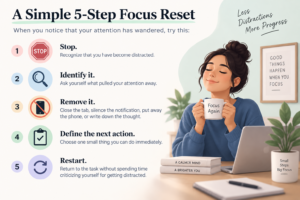
The goal is becoming better at returning your attention. You might wanna read about Why Does Your Attention Wander While Reading?
The Bottom Line
Distractions compete with the limited attention you need for reading, studying, working, and solving problems. Constant task switching can reduce efficiency, while notifications and digital interruptions can disrupt attention even when you do not actively engage with them.
Learning how to avoid distractions is therefore less about forcing yourself to concentrate and more about designing an environment where concentration is easier.
Start small: silence unnecessary notifications, create a focused workspace, keep your phone out of reach, and give yourself one clearly defined task at a time.
You don’t need to eliminate every distraction.
You need to make your attention harder to interrupt.
Frequently Asked Questions
What are the main effects of distractions on concentration?
Distractions can interrupt your train of thought, increase task-switching, slow your progress, and make it harder to maintain sustained attention. Frequent interruptions may also contribute to mental fatigue and errors.
How can I avoid distractions while studying?
Keep your phone away from your workspace, silence non-essential notifications, close unrelated browser tabs, choose a specific study goal, and work in manageable focused sessions.
How can I avoid digital distractions?
Start by reducing notifications, removing distracting apps from your home screen, using Focus or Do Not Disturb modes, and setting specific times for checking social media and messages.
What iPhone setting helps reduce distractions?
The iPhone’s Focus feature can silence or filter notifications based on what you are doing. On supported devices, Reduce Interruptions can prioritize potentially important notifications while silencing less important ones.
What are manual distractions?
Manual distractions are activities that require your hands to move away from the primary task. The term is commonly used in distracted-driving research, where examples include manipulating a device, eating, or reaching for an object.
Is multitasking bad for concentration?
Multitasking often involves rapidly switching between tasks. Research summarized by the American Psychological Association indicates that this switching can reduce efficiency and increase the cognitive cost of completing tasks.
Sources & Further Reading
- American Psychological Association — Multitasking: Switching Costs
- PubMed — The attentional cost of receiving a cell phone notification
- Computers in Human Behavior — Attention hijacked: How social media notifications disrupt cognitive processing (2026)
- Apple Support — Set up a Focus on iPhone
- Apple Support — Summarize notifications and reduce interruptions with Apple Intelligence on iPhone
- National Highway Traffic Safety Administration — Human Factors Program Areas: Distraction