

You start reading an article, book, or report with the intention of paying attention. A few paragraphs later, you realize you’ve been staring at the words without actually processing them.
You go back to the beginning.
Then it happens again.
If you’ve ever been distracted while reading, you’re experiencing something psychologists commonly describe as mind wandering: attention shifting away from the task toward thoughts, memories, plans, worries, or other internally generated ideas.
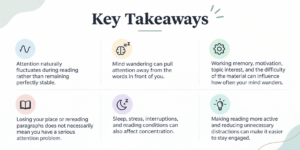
This is a surprisingly common part of reading. Research suggests that mind wandering is associated with poorer reading comprehension, although the relationship is influenced by factors such as working memory, interest in the topic, text difficulty, and individual differences in attentional control.
So why does your attention wander while reading—and what can you do about it?
Why Does Your Mind Wander While Reading?
Reading appears simple because your eyes move across a page and your brain interprets the words.
But comprehension requires considerably more than recognizing individual words.
Your brain has to connect sentences, retain information, interpret meaning, make inferences, and build a coherent understanding of what you’re reading.
At the same time, your mind can generate thoughts that have nothing to do with the text.
You might suddenly think about:
- Something you need to do tomorrow
- A conversation you had earlier
- A message you haven’t answered
- Something you’re worried about
- A memory triggered by a sentence
- What you’re going to eat later
- An unrelated idea that suddenly appeared
Your eyes may continue moving across the page while your attention has shifted somewhere else.
This is one reason people sometimes reach the bottom of a page and realize they cannot remember what they just read.
Research describes mind wandering as a shift of attention away from an ongoing external task toward internally generated thoughts. During reading, this can interfere with the processing needed to construct a meaningful representation of the text.
What Happens When You Get Distracted While Reading?
When your attention moves away from the material, your brain isn’t necessarily stopping all visual processing.
You may still be looking at the words.
The problem is that looking at text and actively processing its meaning are not the same thing.
Comprehension requires you to integrate information as you move through a passage. If your thoughts drift away for several sentences, you may miss the information needed to connect one idea with the next.
This can create a familiar experience:
You read the words → your mind wanders → you keep reading → you return to the text → you realize you missed the meaning.
Research has found a significant negative relationship between mind wandering and reading comprehension. A meta-analysis of 25 studies found a pooled correlation of approximately −0.21, indicating that greater mind wandering was generally associated with lower comprehension.
That doesn’t mean every instance of mind wandering destroys comprehension.
The relationship is more complicated than that.
But it does explain why zoning out while reading can leave you with the feeling that you technically read the page without really understanding it.
Reading Requires More Than Keeping Your Eyes on the Page
One reason reading can demand so much mental effort is that comprehension depends on several processes working together.
As you read, you need to:
- Recognize words and sentences.
- Maintain information from earlier parts of the text.
- Connect new information with what you already know.
- Interpret relationships between ideas.
- Make appropriate inferences.
- Maintain enough attention to continue following the argument.
Working memory is particularly relevant because it helps you temporarily maintain and manipulate information while processing new material.
Research by McVay and Kane found that individual differences in working memory capacity were related to reading comprehension partly through differences in attention control and mind wandering.
In other words, reading isn’t simply a matter of keeping your eyes moving.
Your brain has to continuously maintain the information necessary to understand what comes next.
Why Is It Harder to Concentrate on Some Things Than Others?
Not all reading requires the same amount of attention.
Compare reading a gripping novel with reading a dense technical paper.
The first may naturally hold your interest.
The second may require deliberate effort.
Research examining mind wandering during reading has found relationships with factors including working memory capacity, topic interest, motivation, and prior experience with the subject.
This helps explain why you can read twenty pages of something you’re fascinated by without checking the time, but struggle to finish three pages of something you find confusing or uninteresting.
The problem isn’t necessarily that your brain has suddenly lost its ability to concentrate.
The task itself may be demanding more attentional control.
Text Difficulty Can Make Your Attention Wander
Dense or unfamiliar material can require more mental effort.
If you encounter an unfamiliar concept, complicated sentence structure, or vocabulary you don’t understand, your brain has more work to do to construct meaning.
Research included in a meta-analysis of mind wandering and reading comprehension identified factors such as text difficulty, topic interest, working memory, and text length as relevant variables in the relationship between wandering thoughts and comprehension.
This creates an interesting possibility:
Sometimes you don’t lose focus because the material is boring.
You may lose focus because the material is difficult to process.
If you’re struggling to understand a paragraph, your attention may drift because the cognitive demands of the task have increased.
That is one reason rereading the same sentence repeatedly doesn’t always solve the problem.
Sometimes you need to slow down, look up an unfamiliar concept, or break the material into smaller sections.
Your Unfinished Thoughts Can Compete With Reading
Imagine sitting down to read while thinking about everything you need to do tomorrow.
Your eyes are on the page, but part of your mind keeps returning to your plans.
Research has found that directing attention toward current personal concerns before reading can increase task-unrelated thoughts and is associated with poorer reading comprehension.
This is an important reminder that concentration doesn’t happen in isolation.
Your brain doesn’t simply shut off everything else because you’ve opened a book.
Unfinished plans, concerns, memories, and future intentions can remain mentally active and compete with the task you’re trying to perform.
If you’ve ever thought:
“I can’t concentrate because I have too much on my mind.”
there may be some truth to that experience.
Why You Sometimes Read Without Remembering Anything
One of the strangest reading experiences is reaching the end of a page and realizing that almost none of it registered.
This can happen when attention has drifted for long enough that the information being read is not effectively integrated into the developing understanding of the text.
Research examining mind wandering during reading has found that off-task thought can affect the construction of the mental representation—or “situation model”—that readers use to understand events and relationships described in a text.
This is why reading comprehension is more than recognizing words.
You can technically decode every sentence while still failing to construct a useful understanding of the passage.
Is Being Distracted While Reading Always a Problem?
No.
Everyone experiences fluctuations in attention.
Your mind wandering occasionally while reading does not automatically mean that you have poor attention, a cognitive disorder, or a serious problem.
In fact, mind wandering is a normal feature of human cognition.
The more useful question is how often it happens, how disruptive it is, and whether it interferes with things you need to do.
If you occasionally reread a paragraph because your thoughts drifted, that’s very different from consistently being unable to read, study, work, or follow conversations because your attention repeatedly disappears.
It’s also worth remembering that mind wandering isn’t always inherently negative. Researchers have identified potential costs as well as possible benefits associated with internally generated thought, depending on the circumstances and the task.
The goal isn’t to eliminate every thought that isn’t related to the page.
The goal is to be able to return your attention when the task requires it.
How Sleep Can Affect Your Ability to Concentrate
Your ability to sustain attention is influenced by your overall cognitive state.
When you’re tired, maintaining attention on a long or repetitive passage can become more difficult.
This is particularly relevant when reading requires sustained concentration rather than rapid recognition of familiar information.
If you regularly find yourself struggling to understand material late at night, the problem may not be the material itself. Your brain may simply be operating under less favorable conditions for sustained attention.
That doesn’t mean every reading difficulty is caused by sleep deprivation.
But adequate rest is an important part of maintaining normal cognitive performance and alertness.
What Can You Do When Your Attention Keeps Wandering?
The solution isn’t to force yourself to “concentrate harder” for hours.
Instead, make the reading task easier for your attention system to manage.
1. Set a specific reading goal
Before you start, decide what you want to get from the material.
For example:
“I want to understand the three main arguments in this chapter.”
A specific goal gives your attention something concrete to look for.
2. Remove unnecessary distractions
Put your phone away.
Close irrelevant browser tabs.
Turn off nonessential notifications.
The fewer competing signals around you, the fewer things your attention has to evaluate.
3. Break difficult material into sections
Instead of thinking:
“I need to read this entire 40-page report.”
Break it into smaller sections.
After each section, briefly ask yourself:
“What was the main point?”
This turns passive reading into an active comprehension task.
4. Pause and summarize
After several paragraphs, explain the idea in your own words.
If you cannot explain it, you may have been reading without fully processing the material.
5. Deal with recurring thoughts before reading
If you keep thinking about something you need to do, write it down.
A simple task list can sometimes reduce the need to keep mentally rehearsing the same thought while you’re trying to read.
6. Adjust the difficulty
If the material is substantially beyond your current knowledge, look for an introductory explanation first.
Building background knowledge can make subsequent reading easier because fewer concepts need to be processed from scratch.
What If You Keep Losing Focus After Reading for a While?
Sometimes the issue isn’t just getting distracted at the beginning.
You may start reading with good concentration and then notice that your focus gradually deteriorates.
This can happen during long study sessions, repetitive work, or extended periods of mentally demanding reading.
If that’s the pattern you’re experiencing, our guide on why you lose focus after working for a while explores several possible reasons and practical ways to improve sustained concentration.
Likewise, if your difficulty extends beyond reading and you regularly struggle to maintain concentration during everyday tasks, you may find our guide on why it can be so hard to focus useful.
And if prolonged mental effort leaves you feeling mentally drained and less able to direct your attention, explore our guide to attention fatigue.
These topics overlap, but they aren’t identical. Understanding the difference can help you identify whether you’re dealing with an ordinary lapse in attention, prolonged mental fatigue, environmental distraction, or a broader difficulty with concentration.
A Simple Reading Technique to Bring Your Attention Back
You don’t have to prevent your mind from wandering.
Instead, try this:
Notice → Return → Reconnect.
Notice
Realize that you’ve stopped processing the material.
Don’t spend time criticizing yourself for it.
Return
Bring your eyes and attention back to the last sentence you genuinely understood.
Reconnect
Ask yourself:
“What is this paragraph trying to tell me?”
Then continue.
This approach is useful because attention naturally fluctuates. The skill isn’t necessarily maintaining perfect concentration without interruption.
It’s recognizing when attention has drifted and redirecting it toward the task.
Why Active Reading Can Help
Passive reading makes it easy to continue moving through a page without checking whether you’re actually understanding it.
Active reading introduces small moments of engagement.
You can:
- Highlight only important information.
- Write short notes in your own words.
- Ask questions about the material.
- Predict what the author will explain next.
- Summarize each section.
- Connect new information to something you already know.
These techniques give your attention something to do beyond simply following words across a page.
The objective isn’t to turn every book into a study session.
It’s to increase the amount of meaningful interaction between you and the material when comprehension matters.
When Difficulty Concentrating While Reading May Need More Attention
Occasional distraction is normal.
But persistent difficulty concentrating while reading may be worth discussing with a qualified healthcare or mental-health professional if it is frequent, worsening, or significantly interfering with school, work, relationships, or everyday activities.
There are many possible reasons someone may struggle with sustained attention, and they cannot be determined from a single symptom.
Avoid self-diagnosing based solely on how often your mind wanders while reading.
If concentration problems are persistent across different situations, a professional can help determine what may be contributing to them.
The Bottom Line: Why Does Your Attention Wander While Reading?
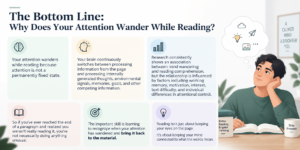
Your attention wanders while reading because attention is not a permanently fixed state.
Your brain continuously switches between processing information from the page and processing internally generated thoughts, environmental signals, memories, goals, and other competing information.
Research consistently shows an association between mind wandering and reading comprehension, but the relationship is influenced by factors including working memory, motivation, interest, text difficulty, and individual differences in attentional control.
So if you’ve ever reached the end of a paragraph and realized you weren’t really reading it, you’re not necessarily doing anything unusual.
The important skill is learning to recognize when your attention has wandered and bring it back to the material.
Reading isn’t just about keeping your eyes on the page.
It’s about keeping your mind connected to what the words mean.
Frequently Asked Questions
Why does my attention wander when I read?
Attention can shift away from reading toward internally generated thoughts, future plans, memories, concerns, or environmental distractions. This is commonly referred to as mind wandering and is a normal feature of cognition.
Why do I read a page and remember nothing?
If your attention shifts away from the material while your eyes continue moving across the page, you may process less of the information needed for comprehension. Mind wandering has been associated with poorer reading comprehension in research.
How can I stop getting distracted while reading?
Start with a specific reading goal, remove unnecessary notifications and interruptions, break difficult material into smaller sections, and periodically summarize what you’ve read. If your thoughts wander, notice it and return to the last point you understood.
Why is it difficult to concentrate while reading?
Several factors can contribute, including mental fatigue, lack of sleep, stress, competing thoughts, low interest, difficult material, environmental distractions, and differences in attention control. Research has specifically linked mind wandering during reading with factors such as working memory, motivation, and topic interest.
Does mind wandering affect reading comprehension?
Research generally finds a negative association between mind wandering and reading comprehension. A meta-analysis of 25 studies found a significant negative relationship, although the strength of that relationship varied depending on how mind wandering was measured and other factors.
Is it normal to lose focus while reading?
Yes. Occasional lapses in attention are normal. The more important consideration is whether the problem is persistent, occurs across different activities, or significantly interferes with your daily life.
How can I improve my reading attention?
Try making reading more active: set a clear purpose, remove distractions, take short breaks during long sessions, summarize important sections, and return your attention to the text when you notice it has wandered.
Sources & Further Reading
1. Bonifacci et al. — The Relationship Between Mind Wandering and Reading Comprehension: A Meta-Analysis
A systematic meta-analysis examining 25 studies and the relationship between mind wandering and reading comprehension.
2. McVay & Kane — Why Does Working Memory Capacity Predict Variation in Reading Comprehension?
Research examining the role of working memory, attention control, and mind wandering in reading comprehension.
3. Unsworth & McMillan — Mind Wandering and Reading Comprehension
Research investigating how working memory, topic interest, motivation, and topic experience relate to mind wandering and reading comprehension.
4. Smallwood, McSpadden & Schooler — When Attention Matters: The Curious Incident of the Wandering Mind
Research examining how temporary inattention during reading can affect the construction of a mental representation of the text.
5. Mooneyham & Schooler — The Costs and Benefits of Mind-Wandering
A review examining both the potential costs and possible benefits of mind wandering across different cognitive tasks.
6. Farrell et al. — Interactions of Decoding, Working Memory, and Mind Wandering on Reading Comprehension
Recent research examining how decoding, working memory, and mind wandering interact in relation to reading comprehension.