

Written by Elena · Reviewed by Vito Maxwell – Senior Mental Health Practitioner · Updated September 1, 2026
Losing focus after working for a while is usually a sign of mental fatigue rather than a lack of discipline. Your ability to maintain attention isn’t unlimited, and research on sustained attention has documented performance declines as time spent on a task increases.
You may start a task feeling productive and focused, only to find yourself checking your phone, staring at the same screen, rereading sentences, or thinking about something completely unrelated an hour later.
So, why do you lose focus after working for a while? Several factors can contribute to it, including mental fatigue, repetitive tasks, distractions, stress, poor sleep, and working for too long without meaningful breaks.
Why Do You Lose Focus After Working for a While?
Your concentration isn’t unlimited. Even when you’re motivated to finish a task, maintaining attention for an extended period requires continuous mental effort. As that effort builds, your ability to stay focused can decrease.
Here are some of the most common reasons it happens.
1. Your Brain Gets Mentally Fatigued
Concentrating on a demanding task requires your brain to continuously process information, make decisions, remember details, and ignore distractions.
The longer you maintain that level of attention, the more difficult it can become to sustain the same level of concentration. Research on sustained attention has found that performance can decline as time spent on a task increases, particularly with simple or repetitive tasks.

This is often referred to as mental fatigue.
It doesn’t necessarily mean you’re incapable of focusing. It may simply mean that your brain needs a period of recovery before it can maintain the same level of attention again.
2. You’re Working on the Same Task for Too Long
Working on one task continuously can eventually make it harder to maintain your attention, particularly when the task is repetitive or requires sustained concentration.
For example, you might be able to write, analyze data, code, study, or work on a report with strong concentration at first. After a prolonged period, however, the same task can start feeling increasingly difficult.
Your attention may begin to drift even though you haven’t finished the work.
Changing activities, taking a short break, or approaching the task from a different angle can sometimes help restore your attention.
3. You’re Constantly Switching Between Tasks
Multitasking can make it difficult to maintain deep concentration.
Checking email while working on a presentation, responding to messages while writing, or constantly switching between browser tabs forces your attention to move from one task to another.

Even if each interruption lasts only a few seconds, repeatedly shifting your attention can make it harder to return to the original task.
Instead of trying to work on everything simultaneously, try giving one important task your full attention for a defined period.
You can then check messages and handle smaller tasks during a separate block of time.
4. Your Environment Is Full of Distractions
Sometimes the problem isn’t the work itself. It’s your surroundings.
Office conversations, phone notifications, background noise, incoming emails, social media, and frequent interruptions can all compete for your attention.
Even when you consciously ignore a distraction, your brain still has to process and filter what’s happening around you.
Creating a quieter, more controlled work environment can make sustained concentration easier.
Simple changes can include putting your phone away, turning off nonessential notifications, using a dedicated workspace, or reducing unnecessary background noise.
5. You’re Not Taking Meaningful Breaks
Trying to work continuously for hours may seem productive, but working without breaks can eventually make concentration harder.
Research on micro-breaks supports the idea that short breaks can help with fatigue and energy levels. A systematic review and meta-analysis covering 22 study samples and 2,335 participants found that micro-breaks produced small but significant improvements in vigor and reductions in fatigue. However, the researchers did not find a significant overall improvement in performance across all tasks.

This means a break shouldn’t necessarily be viewed as a guaranteed productivity boost. Instead, it can be a useful way to manage fatigue and make prolonged work more sustainable.
6. Poor Sleep Can Affect Your Concentration
Sleep plays an important role in attention, memory, learning, and mental performance.
When you haven’t slept well, staying focused can become more difficult. You may find yourself losing track of what you’re doing, making more mistakes, or needing more time to complete tasks.
If your concentration regularly drops during the day, look beyond your working habits and consider whether you’re consistently getting enough quality sleep.
Improving your sleep routine can be an important part of supporting better concentration during the day.
7. Stress and Mental Overload Are Competing for Your Attention
It’s difficult to concentrate on one task when your mind is occupied with several other concerns.
Work deadlines, personal responsibilities, financial worries, unfinished tasks, and constant decision-making can all contribute to mental overload.
You may technically be sitting at your desk and working, but part of your attention is still occupied by everything else you need to remember or deal with.
Writing down pending tasks and deciding what actually needs your attention right now can help reduce some of that mental clutter.
If you’re interested in understanding the broader reasons concentration can feel difficult in the first place, you can also read Why Is It So Hard to Focus?.
8. You Have Too Much Work on Your Plate
Having a long list of unfinished tasks can make it harder to concentrate on any single one.
When everything feels urgent, your brain may continuously jump between priorities:
“I need to finish this report.”
“I also need to respond to that email.”
“I haven’t started the presentation yet.”
“What about tomorrow’s meeting?”
Instead of focusing on the task in front of you, you’re constantly thinking about what comes next.
Prioritizing your workload can help. Choose one or two important tasks to focus on first rather than trying to keep every unfinished task active in your mind.
9. The Work Isn’t Engaging You
Not every concentration problem is caused by exhaustion.
Sometimes you lose focus because the task simply isn’t interesting, challenging, or meaningful to you.
When a task feels repetitive or unimportant, maintaining attention can require considerably more conscious effort.
This can explain why you might struggle to focus on a routine work assignment but spend hours completely absorbed in a hobby, game, book, or project you genuinely enjoy.
Finding ways to make routine work more engaging can help. You could set smaller goals, introduce variety, track progress, or connect the task to a larger objective.
How to Regain Focus After Working for a While
Once you notice your concentration dropping, continuing to force yourself through the task isn’t always the best solution.
Try these strategies to reset your attention.
Take a Short Break
Step away from your workspace for a few minutes. Move around, stretch, get some water, or simply give your mind a break from the task.
Remove Unnecessary Distractions
Turn off nonessential notifications and keep your phone away when you’re doing focused work.
Work in Focused Time Blocks
Instead of expecting yourself to concentrate indefinitely, divide your work into manageable periods.
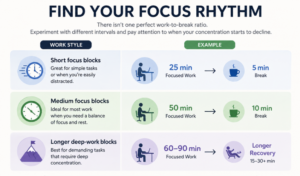
You could experiment with approaches such as 25 minutes of focused work followed by a short break, or longer work blocks such as 50–60 minutes followed by a break.
The best approach depends on the type of work you’re doing and your personal working style.
Change Your Environment
If possible, move somewhere quieter or change your workspace when your attention starts to decline.
A change in surroundings can provide a useful mental reset.
Prioritize One Task
Choose the most important task and focus on that before moving to something else.
Reducing the number of things competing for your attention can make it easier to enter a deeper state of concentration.
Get Some Movement
Standing up, walking around, or doing a few simple stretches can break up long periods of sitting and give you a physical change of activity.
Keep Your Workspace Simple
A cluttered workspace can create additional visual distractions. Keeping only the things you need for the current task within reach can make your environment easier to work in.
How Long Should You Work Before Taking a Break?
There isn’t one scientifically proven work-to-break ratio that works for everyone. Research on work breaks suggests that their effects can depend on factors such as the length and frequency of the break, the type of work being performed, and how demanding the task is.
Some people prefer the Pomodoro Technique, which commonly involves 25 minutes of focused work followed by a short break. Others prefer longer periods, such as 50 minutes of work followed by 10 minutes of rest.
For demanding work, you may find that longer uninterrupted blocks work better. For repetitive or less engaging tasks, shorter blocks may be easier to maintain.
Instead of focusing on a specific number, pay attention to your concentration.
If you notice that you’re repeatedly rereading the same information, making avoidable mistakes, checking unrelated websites, or staring at your screen without making progress, it may be time for a break.
How to Stay Focused at Work for Longer
Improving focus isn’t necessarily about forcing yourself to concentrate for as long as possible.
A better approach is to create conditions that make concentration easier.
Start by identifying your biggest distractions. Then build a working routine around your natural energy levels.
For example, you might schedule your most demanding work during the part of the day when you feel most alert and leave routine tasks for periods when your energy is lower.
You can also:
- Plan your most important tasks before starting the day.
- Keep notifications off during focused work.
- Avoid unnecessary multitasking.
- Take regular breaks.
- Keep your workspace comfortable and organized.
- Get adequate sleep.
- Drink enough water throughout the day.
- Break large projects into smaller tasks.
- Give yourself clear deadlines.
- Leave less demanding tasks for lower-energy periods.
Small changes can make it easier to maintain concentration without constantly fighting against distractions.
Is It Normal to Lose Focus After Working for a While?
Yes. A gradual decline in concentration can happen when you’ve been working continuously, particularly on demanding or repetitive tasks.
The important thing is to recognize the difference between normal temporary fatigue and persistent concentration difficulties.
If you’re regularly struggling to concentrate across different areas of your life, or if changes in your attention are interfering significantly with your daily activities, consider speaking with a qualified healthcare professional. Difficulty concentrating can have many possible causes, and a professional can help determine what may be contributing to it.
Final Thoughts
So, why do you lose focus after working for a while?
The answer isn’t always the same for everyone. Mental fatigue, repetitive work, multitasking, distractions, insufficient breaks, poor sleep, stress, excessive workloads, and lack of engagement can all make it harder to maintain concentration.
Instead of simply forcing yourself to keep working, pay attention to what happens when your focus starts to disappear.
Are you tired? Distracted? Overloaded? Bored? Working in a noisy environment?
Once you identify the reason, you can make a more targeted change.
Better focus isn’t necessarily about working longer. It’s about creating the right conditions for your brain to concentrate, recover, and return to the task when your attention starts to fade.
Frequently Asked Questions
Why do I lose focus after 30 minutes of work?
Your attention can decline as mental fatigue builds, especially when you’re working on a demanding or repetitive task. Distractions, stress, lack of sleep, and an unsuitable work environment can also make concentration drop sooner.
Why can’t I concentrate after working for a few hours?
Several factors may contribute, including accumulated mental fatigue, insufficient breaks, multitasking, stress, poor sleep, and prolonged exposure to the same task.
How can I regain focus quickly?
Take a short break, move away from the task briefly, remove distractions, drink some water, and return with one clearly defined task. Changing your environment can also help reset your attention.
Does taking breaks improve concentration?
Regular breaks can help prevent prolonged mental fatigue and give you an opportunity to recover before returning to focused work. The ideal break frequency varies depending on the person and the type of work.
What is the best amount of time to work before taking a break?
There is no universally ideal duration. Some people use 25-minute work periods, while others prefer 50–60 minute or longer focus blocks. Experiment to find a schedule that allows you to maintain productive concentration without becoming mentally exhausted.