

Feeling tired doesn’t always mean your body needs rest.
Sometimes, your body feels capable of continuing, but your brain feels completely drained. Other times, you may be mentally alert but physically exhausted after exercise, physical work, or a demanding day.
These experiences are often described as mental fatigue and physical fatigue.
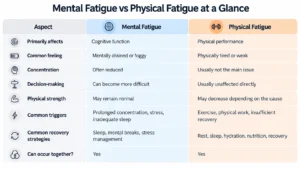
Although they can occur together, they aren’t exactly the same. Mental fatigue primarily affects cognitive functions such as concentration, attention, decision-making, and motivation, while physical fatigue is more closely associated with reduced physical capacity, endurance, or muscle performance.
Mental Fatigue vs Physical Fatigue: The Quick Answer
Mental fatigue is a state of mental or cognitive exhaustion that can make it harder to concentrate, process information, make decisions, or stay mentally engaged.
Physical fatigue refers to a feeling of bodily tiredness or reduced physical capacity that can make movement, exercise, or physical tasks feel more difficult.
The two can overlap. In fact, research suggests that experimentally induced mental fatigue can affect some aspects of subsequent physical performance, particularly endurance, although findings across studies are not completely consistent.
What Is Mental Fatigue?
Mental fatigue is a state of mental exhaustion that can develop after prolonged or demanding cognitive activity.
Your brain may not feel physically painful, but tasks that normally seem simple can suddenly require much more effort.
You might notice that you’re:
- Rereading the same sentence several times
- Struggling to concentrate
- Making simple decisions more slowly
- Losing motivation
- Becoming easily distracted
- Feeling mentally “foggy”
- Finding conversations or work unusually tiring
- Making more mistakes than usual
Mental fatigue has been studied as a psychophysiological state associated with changes in cognitive performance and brain activity. A systematic review of the research found measurable changes associated with experimentally induced mental fatigue, although the exact mechanisms are still being investigated.
What Can Cause Mental Fatigue?
Mental fatigue can occur after prolonged cognitive demands, but several factors can contribute to or intensify it.
Common contributors include:
- Long periods of focused work
- Studying for extended periods
- Constant multitasking
- High levels of stress
- Poor or insufficient sleep
- Long hours of screen-based work
- Repeated decision-making
- Emotionally demanding situations
- Lack of mental breaks
For example, spending eight hours switching between emails, meetings, spreadsheets, messages, and deadlines may leave you mentally exhausted even if you’ve barely moved from your chair.
What Is Physical Fatigue?
Physical fatigue is the feeling that your body doesn’t have its usual capacity for movement or exertion.
It can happen after exercise, physically demanding work, inadequate recovery, or other circumstances that place substantial demands on the body.
Physical fatigue may feel like:
- Heavy or tired muscles
- Reduced endurance
- Feeling physically drained
- Difficulty maintaining your usual exercise intensity
- Needing more effort to complete familiar physical tasks
- Reduced energy for movement
- Slower physical performance
For an athlete, physical fatigue might appear after a demanding training session.
For someone working a physically demanding job, it might develop after hours of lifting, standing, walking, or repetitive movement.
7 Key Differences Between Mental and Physical Fatigue
1. They affect different aspects of performance
The clearest difference is what feels difficult.
With mental fatigue, thinking becomes more demanding.
With physical fatigue, physical activity becomes more demanding.
Someone experiencing mental fatigue may struggle to finish a report despite having enough physical energy to walk home.
Someone experiencing physical fatigue may be mentally ready to continue their day but feel that their body needs rest.
2. Mental fatigue affects cognitive performance
Mental fatigue can make activities requiring sustained attention and cognitive effort feel harder.
You may notice:
- Reduced concentration
- Slower thinking
- More mistakes
- Difficulty making decisions
- Reduced alertness
- Difficulty staying engaged
This is one reason mental fatigue can matter in situations where sustained attention is important, including driving and other safety-sensitive activities.
3. Physical fatigue affects physical performance
Physical fatigue becomes more noticeable when your body is required to continue exerting itself.
You may experience:
- Reduced endurance
- Muscle tiredness
- Reduced exercise capacity
- Heaviness
- Increased perceived effort
Importantly, physical fatigue isn’t simply “having no energy.” The experience can vary considerably depending on what caused it and what part of the body is being used.
4. Their triggers can be different
Mental fatigue is often associated with prolonged cognitive demand, stress, and insufficient sleep.
Physical fatigue is commonly associated with exercise, physical work, prolonged activity, and inadequate recovery.
However, the causes can overlap.
Poor sleep, for example, can leave you both mentally and physically exhausted.
5. They can feel different even when you’re tired
Consider this:
You have spent six hours working on a complicated project. Your body isn’t particularly sore, but you can’t focus on another sentence.
That’s more consistent with mental fatigue.
Now imagine you’ve spent several hours moving furniture. You can think clearly, but your arms and legs feel exhausted.
That’s more consistent with physical fatigue.
6. One doesn’t automatically mean the other
Being mentally tired doesn’t necessarily mean your muscles are physically exhausted.
Likewise, being physically exhausted doesn’t necessarily mean that your cognitive abilities are impaired to the same degree.
However, the boundaries aren’t absolute.
Research has found evidence that mental fatigue can influence aspects of physical performance, particularly endurance and perceived effort, although the size and consistency of these effects vary between studies.
7. They can happen simultaneously
This is extremely common.
Imagine a student who studies for five hours after getting only a few hours of sleep.
By the end of the day, they may experience:
Mental fatigue: difficulty concentrating and remembering information.
Physical fatigue: low energy, heavy eyes, and a strong desire to lie down.
The experience isn’t always one or the other.
What Does Mental Fatigue Feel Like?
Mental fatigue can be difficult to recognize because there isn’t necessarily an obvious physical sign.
You might notice that:
- You can’t focus on a task you normally handle easily.
- You keep checking your phone while working.
- You reread information without absorbing it.
- Simple decisions feel unusually difficult.
- You feel mentally drained after conversations or meetings.
- Your motivation drops as the day progresses.
- You become more irritable or impatient.
- You feel like your brain needs a break even though your body isn’t tired.
One important clue is how you feel when you try to think.
If the primary problem is that your mind feels depleted rather than your body feeling physically exhausted, mental fatigue may be playing a role.
What Does Physical Fatigue Feel Like?
Physical fatigue tends to become more obvious when you move or exert yourself.
You might experience:
- Heavy limbs
- Tired muscles
- Reduced stamina
- Lower exercise performance
- Feeling physically drained
- Needing longer recovery periods
- Difficulty maintaining your normal pace
For example, climbing stairs may feel unusually difficult after strenuous physical activity even though you feel mentally alert.
Can You Have Mental and Physical Fatigue at the Same Time?
Yes.
Mental and physical fatigue can overlap.
A demanding workday combined with inadequate sleep is a simple example.
You may spend hours concentrating, making decisions, answering messages, and solving problems while also dealing with sleep loss. By the end of the day, your mind and body can both feel depleted.
The relationship can also go in the other direction.
After intense physical activity, you may feel so tired that concentrating on complex tasks becomes harder.
This is why asking simply “Am I mentally tired or physically tired?” isn’t always enough.
Sometimes the answer is both.
Can Mental Fatigue Affect Physical Performance?
This is one of the more interesting connections between the two.
Research has investigated whether mentally demanding tasks performed before exercise can affect subsequent physical performance.
A systematic review found that mental fatigue was associated with reductions in endurance performance in several studies, while other aspects of physical performance did not consistently show the same effect.
A later meta-analysis examining strength endurance also found that mental fatigue significantly reduced the number of repetitions participants could perform in both upper- and lower-body exercises.
However, the scientific picture isn’t completely settled. Other reviews have reported contradictory findings and questioned whether some observed effects represent a robust physiological effect or differences in study methods.
So the safest conclusion is:
Mental fatigue can influence physical performance in some circumstances, but it doesn’t mean that feeling mentally tired automatically makes you physically weaker.
Mental Fatigue vs Brain Fog: Are They the Same?
Not exactly.
The terms are sometimes used interchangeably in everyday conversation, but they describe different ideas.
Mental fatigue generally refers to a state of mental exhaustion that can develop after sustained cognitive demand.
Brain fog is a more informal description of symptoms such as difficulty concentrating, thinking clearly, remembering information, or finding words.
They can occur together, but experiencing difficulty concentrating doesn’t automatically tell you why it is happening.
Mental Fatigue vs Burnout: What’s the Difference?
Mental fatigue and burnout aren’t the same thing either.
Mental fatigue can occur after a demanding period of concentration and may improve after adequate recovery.
Burnout is a broader phenomenon associated with prolonged occupational stress and can involve exhaustion, negative or detached feelings toward work, and reduced professional effectiveness.
This distinction matters because simply taking a short break may not address the underlying factors contributing to prolonged burnout.
How to Recover From Mental Fatigue
Recovery depends on what is contributing to the fatigue.
Some practical approaches include:
Get adequate sleep
Sleep is one of the most important foundations for cognitive recovery.
If you’re consistently sleeping too little, short-term productivity tricks may not solve the underlying problem.
Take genuine mental breaks
A five-minute break from one task isn’t necessarily a real mental break if you immediately switch to another demanding task.
Changing activities, stepping away from the screen, or spending a few minutes in a quieter environment may give your attention a chance to reset.
Reduce multitasking
Constantly switching between tasks can make mentally demanding work feel even more exhausting.
Whenever possible, work on one cognitively demanding task at a time.
Move your body
Light physical activity can provide a change from prolonged sedentary cognitive work.
The goal isn’t necessarily an intense workout. Even a short walk can create a useful transition between mentally demanding periods.
Address the source
If mental fatigue keeps returning, ask what’s driving it.
Is it:
- Too little sleep?
- Excessive workload?
- Constant notifications?
- Stress?
- Long periods without breaks?
- Too many competing priorities?
Fixing the underlying problem is more useful than repeatedly trying to push through the fatigue.

Which Is Worse: Mental or Physical Fatigue?
There isn’t a universal answer.
It depends on the situation.
For someone performing a mentally demanding job, mental fatigue may be the bigger problem because concentration and decision-making are central to their work.
For an athlete or someone performing physically demanding labor, physical fatigue may have a much greater immediate impact.
And for someone who is sleep-deprived, stressed, and physically active, both can occur together.
Rather than asking which type is “worse,” a better question is:
Which type of fatigue are you experiencing, and what is causing it?
When Should You Take Fatigue Seriously?
Occasional tiredness after a long day, demanding workout, or poor night’s sleep isn’t necessarily unusual.
But persistent, severe, unexplained, or worsening fatigue deserves more attention.
Consider speaking with a qualified healthcare professional if fatigue:
- Continues despite adequate rest
- Interferes significantly with everyday activities
- Keeps getting worse
- Appears without an obvious explanation
- Occurs alongside other concerning symptoms
Fatigue can have many possible causes, so persistent fatigue shouldn’t automatically be attributed to stress, lack of motivation, or a busy schedule.
The Bottom Line
Mental fatigue and physical fatigue can both leave you feeling exhausted, but they don’t affect you in exactly the same way.
Mental fatigue primarily makes thinking, concentrating, deciding, and staying mentally engaged more difficult. Physical fatigue primarily makes movement and physical exertion more difficult.
The two can occur independently, but they can also overlap.
And the relationship between them is more complicated than a simple mind-versus-body distinction. Research suggests that mental fatigue can affect certain aspects of physical performance, while the strength and consistency of that effect depends on the situation and the type of performance being measured.
Understanding the difference can help you identify what kind of recovery you actually need: a mental reset, physical recovery, better sleep, or attention to a deeper underlying cause.
Frequently Asked Questions
Is mental fatigue the same as physical fatigue?
No. Mental fatigue primarily involves cognitive and mental functioning, while physical fatigue is associated more closely with physical tiredness and reduced physical performance. They can occur at the same time.
What are the main symptoms of mental fatigue?
Common experiences include difficulty concentrating, reduced alertness, trouble making decisions, mental exhaustion, reduced motivation, and difficulty staying focused on demanding tasks.
What are the symptoms of physical fatigue?
Physical fatigue can involve tired or heavy muscles, reduced endurance, feeling physically drained, and difficulty maintaining your usual level of physical activity.
Can lack of sleep cause both mental and physical fatigue?
Yes. Inadequate sleep can leave you feeling mentally and physically exhausted, although the specific effects can vary between individuals.
Can mental fatigue affect exercise performance?
It can. Several studies have reported reductions in aspects of physical performance following mentally fatiguing tasks, particularly endurance. However, research findings aren’t completely consistent across all types of physical performance.
How long does mental fatigue last?
There isn’t one fixed duration. It depends on factors such as the cause, intensity of the mental demand, sleep, stress, and recovery. If fatigue is persistent or significantly interferes with daily life, consider discussing it with a healthcare professional.
How can you tell if you’re mentally or physically tired?
Think about what’s limiting you most. If your main difficulty is concentration, decision-making, or sustained mental effort, mental fatigue may be more prominent. If movement and physical exertion feel unusually difficult, physical fatigue may be more prominent. You can also experience both.
Is mental fatigue a sign of burnout?
Not necessarily. Mental fatigue can occur temporarily after demanding cognitive work. Burnout is a broader condition associated with prolonged occupational stress and can involve exhaustion, detachment from work, and reduced effectiveness.
Does taking a break help mental fatigue?
A meaningful break can help, particularly when fatigue is related to prolonged cognitive work. However, if inadequate sleep, chronic stress, excessive workload, or another underlying factor is driving the fatigue, a short break may not be enough.
When should I see a doctor about fatigue?
Consider seeking professional medical advice if your fatigue is persistent, severe, unexplained, worsening, or interfering substantially with everyday activities.