
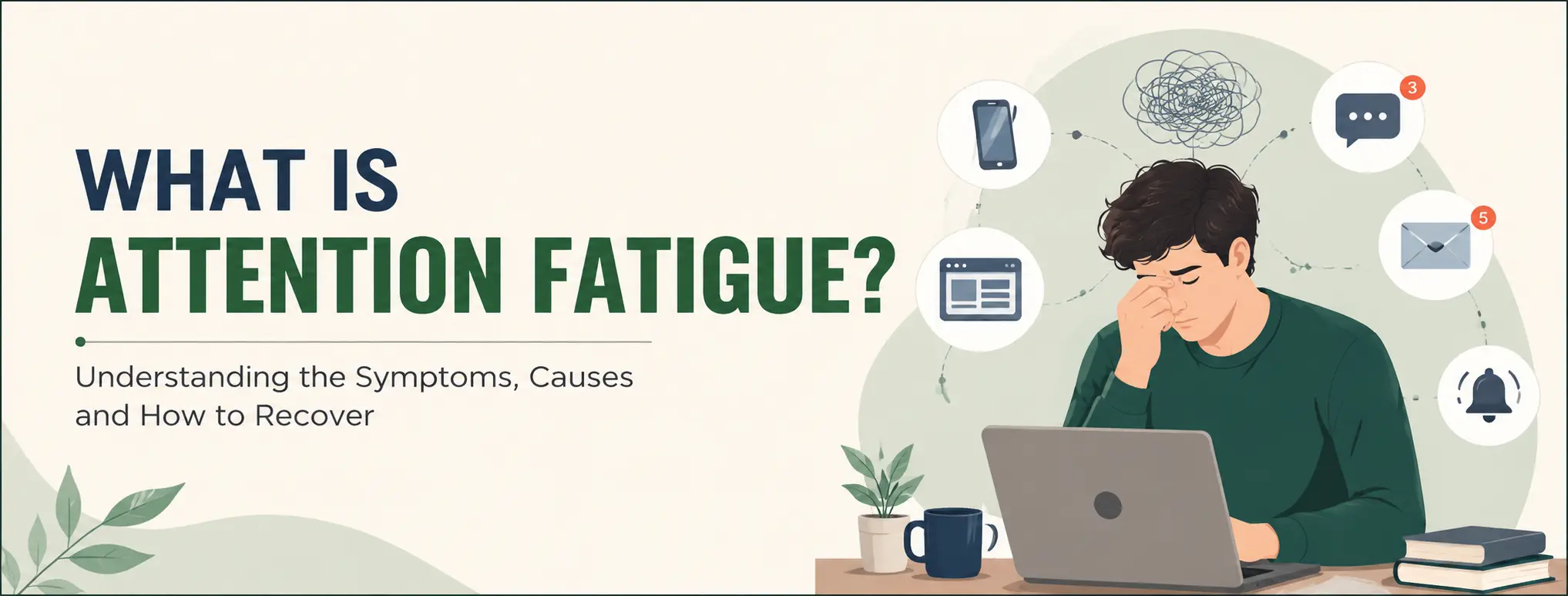
Have you ever noticed that after hours of work, studying, scrolling, meetings, or switching between tasks, your brain seems to stop cooperating?
You can still look at the screen, but concentrating feels unusually difficult. Small distractions become harder to ignore. You reread the same sentence. Simple decisions feel irritating. You may even become impatient or mentally restless without feeling physically tired.
This experience is often described as attention fatigue or directed attention fatigue.
Attention fatigue refers to a temporary decline in our ability to sustain deliberate, effortful attention after prolonged cognitive demands. It can make focusing, filtering distractions, planning, and regulating responses feel more difficult.
Importantly, attention fatigue is not the same thing as ADHD or another mental health disorder. Similar symptoms can occur for very different reasons, and persistent attention problems deserve a proper evaluation rather than self-diagnosis.
In this article, we’ll explain the meaning of attention fatigue, its symptoms and causes, how it differs from mental fatigue and ADHD, and what you can do to restore your ability to focus.
What Is Attention Fatigue?
Attention fatigue is a state of temporary mental exhaustion that can occur when you repeatedly use effortful, directed attention for extended periods.
Directed attention is the kind of attention you use when you deliberately concentrate on something while resisting competing thoughts, sounds, notifications, or other distractions.
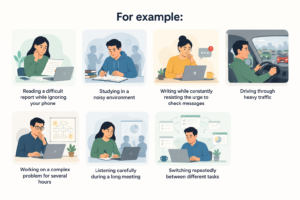
The brain isn’t simply “focusing harder” during these activities. It is also working to inhibit competing information and keep attention aligned with the current goal.
Attention Restoration Theory proposes that this effortful form of attention is limited and can become fatigued with prolonged use.
That is why attention fatigue can feel different from ordinary sleepiness. You might be physically awake but mentally less capable of filtering distractions and maintaining concentration.
Attention fatigue meaning in simple terms
If you want the simplest attention fatigue meaning, think of it as:
Your ability to deliberately control and sustain your attention temporarily becomes less effective after prolonged mental effort.
It doesn’t necessarily mean that your brain is damaged or that you have permanently lost your ability to focus.
In many situations, reducing cognitive demands and allowing adequate recovery can help attention return to normal.
What Does Attention Fatigue Feel Like?
Attention fatigue doesn’t look exactly the same for everyone.
For some people, the first sign is distractibility. For others, it may be irritability, forgetfulness, mental restlessness, or difficulty making decisions.
You may notice that:
- You keep losing your place while reading.
- Background sounds suddenly seem much more distracting.
- You switch between tasks without finishing them.
- You make small mistakes that you would normally catch.
- Simple decisions require more effort.
- You feel mentally “full” or overloaded.
- You become impatient more easily.
- You have trouble organizing your next steps.
- You feel restless despite wanting to concentrate.
- You find boring or routine tasks particularly difficult.
- You are more likely to reach for your phone when work becomes demanding.
These experiences overlap with broader forms of cognitive and mental fatigue, so they should not automatically be interpreted as proof of attention fatigue.
You may notice that concentration becomes increasingly difficult the longer you work on a demanding task. If you’ve experienced this pattern yourself, you may also want to explore why you lose focus after working for a while and what happens to concentration during prolonged work.
Attention Fatigue Symptoms
The attention fatigue symptoms people notice can involve more than concentration alone.
A useful way to understand them is to group them into several areas.
1. Difficulty concentrating
You may find it harder to maintain attention on a task, particularly when the task is repetitive, demanding, or not especially interesting.
You might read the same paragraph several times without absorbing it or find yourself drifting toward unrelated thoughts.
2. Increased distractibility
Normally irrelevant stimuli can become disproportionately difficult to ignore.
A phone notification, conversation nearby, open browser tab, or background noise may repeatedly pull your attention away from what you’re doing.
3. Forgetfulness
Mental fatigue can make it harder to hold information in mind and follow through on small details.
This might look like:
- Forgetting what you were about to do
- Losing your place in a task
- Walking into a room and forgetting why
- Missing small details in instructions
Occasional forgetfulness is common and does not automatically indicate a medical problem.
4. Mental restlessness
Instead of feeling sleepy, you may feel as though your mind wants to move constantly from one thing to another.
You might check your phone, open another tab, change tasks, or look for something more stimulating whenever sustained concentration becomes uncomfortable.
5. Irritability and reduced patience
Attention control also plays a role in regulating behavior and responding appropriately to competing stimuli.
When mentally fatigued, people may become more impatient, short-tempered, or easily frustrated. Research on directed attention fatigue has associated cognitive fatigue with impaired inhibitory control and irritability.
6. Difficulty planning and making decisions
Another potential sign is that executive tasks become harder.
You may know what needs to be done but struggle to decide:
- What should I do first?
- Which option makes the most sense?
- How should I organize this?
- What can wait until later?
7. More impulsive responses
When attentional control is reduced, it may become harder to pause before responding.
That doesn’t necessarily mean dramatic impulsivity. It can be as simple as answering a message immediately when you intended to finish a task first.
8. Reduced work quality
Attention fatigue can affect performance as well as subjective feelings.
More errors, slower processing, difficulty maintaining concentration, and reduced efficiency can occur when sustained attention becomes demanding.
What Causes Attention Fatigue?
There isn’t one single cause.
Generally, attention fatigue becomes more likely when you spend long periods repeatedly directing attention while suppressing competing information.
Common contributors include:
Prolonged concentration
Studying, writing, coding, analyzing data, reading technical material, or solving complex problems can require sustained cognitive control.
The longer you maintain this effort without adequate recovery, the more mentally demanding the task can feel.
Constant task switching
Jumping between emails, messages, browser tabs, meetings, documents, and notifications creates repeated demands on attention.
This is particularly relevant in digital environments where interruptions are frequent. Research and clinical commentary have increasingly discussed the cognitive costs of repeated attention switching and digital interruptions.
Information overload
Modern work often involves processing more information than we can meaningfully engage with at once.
News, social media, email, notifications, advertisements, workplace messages, and multiple streams of content can continuously compete for attention.
The problem isn’t simply the number of pieces of information. It is the repeated requirement to decide what deserves attention and what should be ignored.
Background distractions
Noise, conversations, television, phone alerts, and visual interruptions can all increase the effort required to maintain concentration.
Stress
Stress can consume cognitive resources and make sustained attention more difficult.
A deadline, examination, demanding project, or emotionally difficult situation can therefore contribute to mental exhaustion even when the task itself isn’t physically demanding.
Poor or insufficient sleep
Sleep and attention are closely connected. When you haven’t recovered adequately, maintaining concentration and regulating attention can become more difficult.
Sleep problems can contribute to fatigue generally, although not every episode of poor concentration should be attributed to attention fatigue.
Too much high-intensity stimulation
Rapidly changing digital content can repeatedly capture attention.
Short videos, notifications, messages, and constantly changing feeds are designed to provide frequent changes in stimulation. That doesn’t mean social media automatically causes attention fatigue, but an environment filled with interruptions can make sustained, uninterrupted attention more difficult.
Attention fatigue is only one possible reason for difficulty concentrating. If you’re experiencing unexplained concentration problems, our guide on why it is so hard to focus sometimes explores other factors that can make focusing difficult.
Mental Attention Fatigue vs. Mental Fatigue
The terms mental attention fatigue, mental fatigue, cognitive fatigue, and attention fatigue are sometimes used interchangeably, but they aren’t perfectly synonymous.
Mental fatigue is a broader concept describing a state of reduced mental energy or cognitive efficiency following prolonged cognitive effort.
Directed attention fatigue is more specific. It focuses on the temporary reduction in our ability to deliberately direct attention and inhibit distractions.
In practice, the experiences can overlap.
For example, after several hours of studying, you might feel mentally exhausted overall while also noticing that it has become unusually difficult to ignore distractions.
Research into attention restoration specifically connects directed attention fatigue with prolonged use of effortful attention and describes mental fatigue as a related outcome of sustained cognitive demands.
Attention Fatigue vs. ADHD: Are They the Same?
No.
This is one of the most important distinctions to understand.
Attention fatigue is generally discussed as a temporary state associated with sustained cognitive demands. ADHD, by contrast, is a neurodevelopmental disorder involving persistent patterns of inattention and/or hyperactivity-impulsivity that can interfere with daily functioning.
The symptoms can overlap.
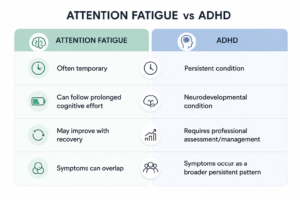
Both may involve:
- Difficulty sustaining attention
- Distractibility
- Forgetfulness
- Impulsivity
- Difficulty completing tasks
- Problems with organization
This overlap is one reason people sometimes wonder whether suddenly having trouble focusing means they have ADHD.
But there is an important difference in the pattern.
Attention fatigue
Attention fatigue may appear after prolonged mental effort and can improve when the person gets sufficient recovery or changes the demands placed on attention.
ADHD
ADHD is a persistent condition that typically begins earlier in development and affects functioning across relevant areas of life. It isn’t simply a consequence of having a busy week or spending too much time on your phone.
Research has specifically noted that attention fatigue can temporarily produce behaviors resembling ADHD-related inattention and impulsivity, while distinguishing the two as different phenomena.
If concentration problems are persistent, severe, or interfering substantially with work, education, relationships, or everyday functioning, it is better to speak with a qualified healthcare professional rather than trying to determine the cause from symptoms alone.
Is Attention Fatigue the Same as Burnout?
Not necessarily.
Burnout generally refers to a broader state of chronic occupational or situational stress characterized by dimensions such as emotional exhaustion, cynicism or detachment, and reduced professional efficacy.
Attention fatigue is narrower and concerns the ability to sustain and control attention after cognitive demands.
The two can coexist.
For example, someone experiencing prolonged workplace stress may develop burnout-related exhaustion while also experiencing difficulty concentrating. But difficulty focusing alone isn’t enough to establish burnout.
How Does Attention Fatigue Affect the Brain?
The brain doesn’t have a simple “attention battery” that empties after a certain number of hours.
Attention is a collection of interacting cognitive processes involving networks responsible for selecting information, maintaining goals, inhibiting distractions, monitoring performance, and regulating behavior.
The concept of directed attention fatigue comes largely from Attention Restoration Theory, developed by environmental psychologists Stephen and Rachel Kaplan.
According to this framework, directed attention requires effort because we have to maintain focus while suppressing competing stimuli. Prolonged use can make this process less efficient, contributing to mental fatigue and difficulty concentrating.
This is also why saying that your “brain is tired” can be useful conversationally but is an oversimplification scientifically.
The exact biological mechanisms behind subjective mental fatigue and changes in cognitive performance are complex and remain an active area of research.
Can Screen Time Cause Attention Fatigue?
Screen use deserves attention, but the answer isn’t simply “screens cause attention fatigue.”
A screen can be used for very different activities.
Reading a long research paper, playing a fast-paced game, attending a video meeting, scrolling through short videos, writing a report, and watching a slow documentary all place different demands on attention.
The bigger issue is often how digital environments structure attention.
Frequent notifications, rapid task switching, interruptions, and continuous streams of new information can create repeated demands to shift and reorient attention.
Recent research continues to investigate how prolonged digital-device exposure and divided-attention behavior relate to cognitive performance, although individual studies vary and causation is not always established.
So rather than thinking:
“Screens are damaging my attention.”
A more useful question is:
“How much of my day requires me to repeatedly switch, suppress distractions, and redirect my attention?”
That distinction matters.
How to Recover From Attention Fatigue
The goal isn’t to avoid thinking.
The goal is to give your attention system opportunities to stop constantly defending itself against competing demands.
Here are practical strategies that can help.
1. Take genuine breaks
A break isn’t always a break if it consists of switching from work to a stream of notifications and short-form videos.
Try periods where you aren’t required to actively process large amounts of information.
A short walk, quiet conversation, stretching, sitting outside, or simply stepping away from the task can create a meaningful change in cognitive demand.
2. Reduce unnecessary interruptions
Turn off non-essential notifications.
Close irrelevant browser tabs.
Keep your phone away when performing demanding work.
If possible, create blocks of time in which you aren’t expected to respond immediately.
Reducing interruptions means your attention doesn’t have to repeatedly return to the task.
3. Single-task when the work is demanding
Instead of trying to simultaneously:
- Write an article
- Answer messages
- Check email
- Monitor social media
- Watch a video
give one task your attention for a defined period.
This doesn’t make you incapable of multitasking. It simply reduces unnecessary switching during tasks that require deeper concentration.
4. Prioritize sleep
Adequate sleep is foundational for cognitive functioning.
If you’re consistently sleeping poorly, trying to solve concentration problems exclusively with productivity techniques may miss the bigger issue.
Persistent sleep problems should be discussed with an appropriate healthcare professional.
5. Spend time in restorative environments
One of the most interesting approaches comes from Attention Restoration Theory (ART).
ART proposes that environments capable of attracting attention effortlessly—particularly natural environments—may provide an opportunity for directed attention to recover.
The theory identifies four important qualities:
- Being away: mentally or physically stepping away from routine demands
- Fascination: effortless attention toward interesting stimuli
- Extent: feeling immersed in an environment with enough richness and coherence
- Compatibility: an environment that fits what you want or need to do
Natural settings often provide several of these qualities simultaneously.
Experimental research has found that exposure to restorative environments can improve performance on subsequent attention-demanding tasks, although the overall evidence base is mixed and researchers continue to investigate exactly when and why these effects occur.
You don’t necessarily need a wilderness trip.
A walk through a park, sitting near trees, gardening, or spending some quiet time outdoors may provide a useful change from an attention-demanding environment.
6. Make your environment easier to focus in
Don’t rely entirely on willpower.
If your workspace constantly produces interruptions, concentration will require more effort.
Try:
- Keeping your phone out of reach
- Using headphones if appropriate
- Working in a quieter location
- Removing unnecessary visual clutter
- Closing unused applications
- Setting specific times for checking messages
The objective is simple: make the focused choice easier and the distracting choice harder.
7. Give your mind low-demand activities
Not every break needs to be productive.
Quiet activities that don’t demand constant decision-making can provide a useful contrast to high-information environments.
Reading for pleasure, walking, gardening, listening to calm music, or simply sitting somewhere peaceful may be more restorative than immediately replacing one demanding digital activity with another.
Does Nature Really Help Attention Fatigue?
There is a scientific theory behind this idea rather than simply the popular belief that “nature is relaxing.”
Attention Restoration Theory proposes that natural environments can encourage a form of effortless attention sometimes called soft fascination.
Instead of forcing yourself to concentrate on one specific task while suppressing everything else, your attention can gently engage with things such as trees, clouds, water, birds, or changing scenery.
This may provide a different attentional experience from working on a difficult report or trying to ignore dozens of notifications.
Several studies have reported improvements in attention following exposure to restorative environments, including research using photographs or views of nature. However, systematic reviews have also emphasized limitations in the evidence, including differences in study design, sample sizes, and outcomes.
So the strongest conclusion isn’t that “nature cures attention fatigue.”
It is that restorative environments may support recovery from mental fatigue and help restore attentional capacity, and this remains an active area of research.
How Long Does Attention Fatigue Last?
There is no universal duration.
It depends on factors such as:
- How demanding the preceding activity was
- How long you maintained concentration
- Sleep quality
- Stress levels
- Environmental distractions
- Whether you continue exposing yourself to demanding tasks
- Your individual circumstances
Some people may feel noticeably better after a meaningful break, while others may need longer recovery.
If difficulty concentrating persists for weeks or months, repeatedly interferes with daily life, or occurs alongside other concerning symptoms, don’t assume that attention fatigue is the explanation.
Persistent cognitive symptoms can have many possible causes.
When Should You Talk to a Doctor or Mental Health Professional?
Occasional difficulty concentrating is normal.
But persistent or worsening attention problems deserve more attention, particularly when they:
- Interfere with work or education
- Affect relationships
- Make everyday tasks difficult
- Occur even after adequate rest
- Are accompanied by significant mood changes
- Are associated with severe sleep problems
- Begin suddenly or dramatically
- Occur alongside other neurological or physical symptoms
Attention fatigue is a useful concept for understanding temporary mental exhaustion, but it shouldn’t become a catch-all explanation for every concentration problem.
A qualified professional can help determine whether factors such as sleep problems, stress, medication effects, anxiety, depression, ADHD, or another medical condition may be contributing.
Frequently Asked Questions About Attention Fatigue
What is attention fatigue?
Attention fatigue is a temporary reduction in the ability to deliberately sustain attention and suppress distractions after prolonged cognitive demands. It is commonly discussed in connection with directed attention and Attention Restoration Theory.
What are the symptoms of attention fatigue?
Commonly described symptoms include distractibility, difficulty concentrating, forgetfulness, mental restlessness, irritability, reduced patience, difficulty planning, impulsive responses, and increased errors.
Is attention fatigue a disorder?
No. Directed attention fatigue is generally described as a temporary cognitive state rather than a standalone clinical disorder.
Is attention fatigue the same as ADHD?
No. The symptoms can overlap, but ADHD is a neurodevelopmental disorder characterized by persistent patterns of inattention and/or hyperactivity-impulsivity. Attention fatigue is generally discussed as a temporary response to sustained cognitive demands.
Can too much screen time cause attention fatigue?
Heavy screen use does not automatically cause attention fatigue. However, digital environments involving frequent interruptions, rapid task switching, and continuous streams of information can increase attentional demands.
Can sleep help with attention fatigue?
Adequate sleep supports cognitive functioning and recovery from fatigue. However, persistent concentration problems shouldn’t automatically be attributed to insufficient sleep.
Does going outside help attention fatigue?
Exposure to natural and restorative environments may help restore directed attention. This idea is central to Attention Restoration Theory, although research is still examining how strong and consistent these effects are.
What is the fastest way to recover from attention fatigue?
There isn’t one guaranteed “fastest” solution. A useful starting point is to reduce competing demands, take a genuine break, get adequate sleep, limit interruptions, and spend some time in a restorative environment.
The Bottom Line
Attention fatigue is essentially what can happen when effortful attention has been used for too long without enough recovery.
You may still be awake and capable of working, but maintaining concentration can become harder. Distractions feel stronger, routine decisions become more frustrating, and tasks that normally require moderate effort can suddenly feel exhausting.
The solution isn’t necessarily to work harder.
Instead, look at the demands you’re placing on your attention.
Reduce unnecessary interruptions. Single-task when possible. Take meaningful breaks. Protect your sleep. And give yourself opportunities to spend time in environments that don’t require constant cognitive control.
Most importantly, don’t confuse a temporary period of mental exhaustion with a diagnosis. If concentration difficulties are persistent or significantly affecting your life, getting professional guidance is more useful than trying to label the experience yourself.
Your attention is a limited cognitive resource. Learning how to protect and restore it may be just as important as learning how to use it.