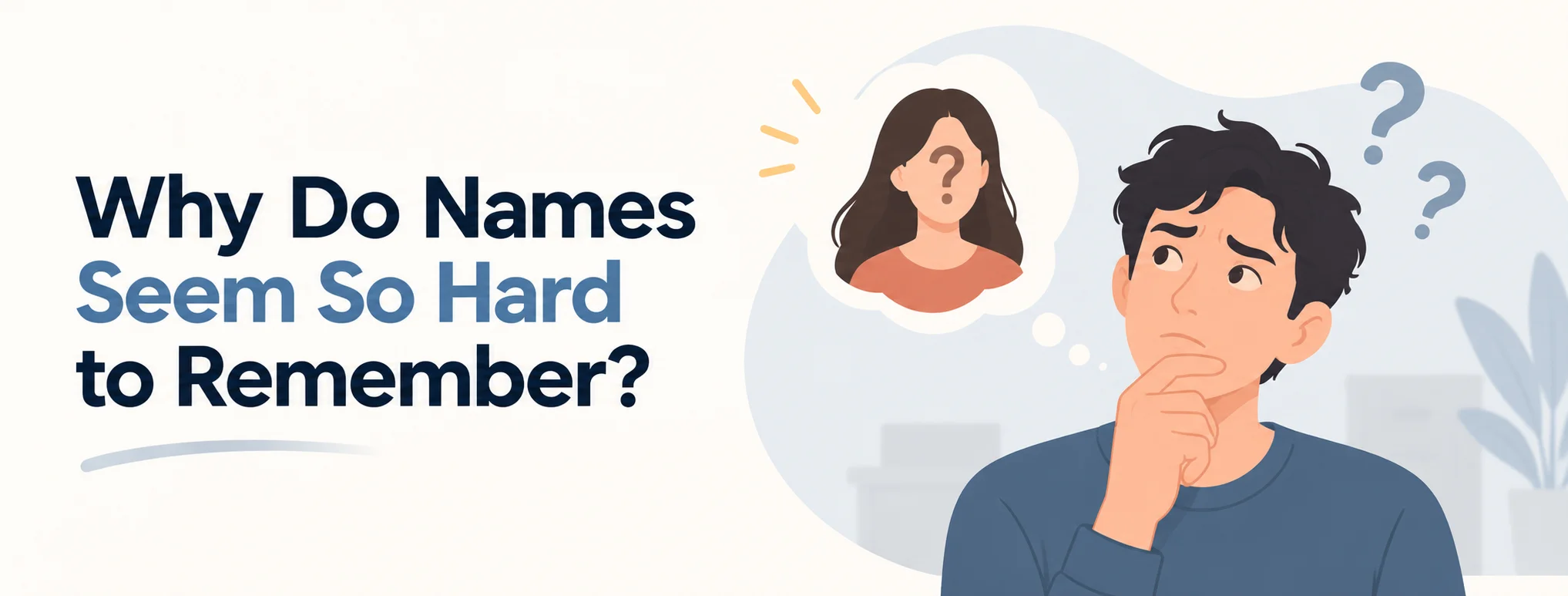
You meet someone new, hear their name, repeat it once, and then—just a few minutes later—you cannot remember it.
What makes it even stranger is that you may still remember their face, where you met them, what they do for work, or what you talked about. The name is the one piece of information that seems to disappear.
So, why do names seem so hard to remember?
The problem is not necessarily that your memory is poor. Research on proper-name memory suggests that names are unusually difficult because they are often arbitrary labels, have relatively few built-in associations, and must be linked to a specific person during encoding and later retrieved through a separate naming process.
In other words, your brain may remember the person perfectly well while temporarily struggling to retrieve the word that identifies them.
Quick Answer: Why Are Names So Hard to Remember?
Names can be difficult to remember because they usually have little inherent meaning or connection to the person they describe.
For example, knowing that someone is a doctor immediately gives you a network of associations: medicine, patients, hospitals, diagnoses, and so on. Knowing that the same person is named Daniel does not automatically tell your brain anything about who Daniel is.
Remembering a person’s name also requires you to form an association between a face and an arbitrary verbal label. Research has consistently found that this face-name association is particularly demanding for memory.
There is another important factor: sometimes the name was stored successfully but simply cannot be retrieved at that moment. This is the familiar tip-of-the-tongue experience.
So forgetting a name can happen at more than one stage:
Attention → Encoding → Association → Storage → Retrieval
A problem at any point can make a familiar name feel strangely inaccessible.
Names Are Different From Most Other Information
One reason names are difficult is that they are proper names. A proper name identifies a particular individual rather than describing a category.
Consider these two pieces of information:
- “She is a teacher.”
- “Her name is Priya.”
The word teacher has meaning. It immediately connects to a large network of concepts and experiences.
Priya, however, does not tell you what the person looks like, what she does, where she lives, or what she likes.
The name is essentially a label assigned to that individual.
Research comparing proper names with common nouns has repeatedly found that proper names are more vulnerable to retrieval difficulties.
This does not mean names are stored in a completely separate “name memory.” Rather, retrieving a person’s name involves accessing information about the individual and then successfully reaching the appropriate lexical representation of their name.
That extra association can make the process surprisingly fragile.
The Baker-Baker Paradox Explains Part of the Problem
One of the most famous demonstrations of the difficulty of remembering names is commonly known as the Baker-baker paradox.
Imagine you see a photograph of a man.
One person is told:
“This man is a baker.”
Another person is told:
“This man’s last name is Baker.”
The important information sounds almost identical, but the two versions can be remembered differently.
The occupation baker has meaning. You can associate it with bread, ovens, flour, shops, and other concepts.
The surname Baker does not automatically create those same associations. It simply identifies one particular person.
This illustrates a broader problem with proper names: they often provide fewer semantic hooks for memory.
However, the Baker-baker effect should not be treated as an absolute rule. Later research has questioned how universal the effect is, and studies have found that the relationship between names, meaning, and memory is more complicated than the simple demonstration suggests.
The more useful takeaway is that meaningful associations can give information more retrieval routes, while an arbitrary name may have fewer obvious connections.
Your Brain Has to Connect a Face With a Word
Remembering someone’s name is not simply remembering a word.
You have to connect:
Face + person + personal information + name
That is an example of associative memory.
When you meet someone named Arjun, for example, your brain has to establish a relationship between the person’s face and the sound pattern “Arjun.”
The difficulty is that the face and the name are inherently unrelated. The person’s facial features do not naturally tell you what their name is.
Brain-imaging research on novel face-name associations has found involvement of a distributed network that includes the hippocampus and regions involved in visual and executive processing. Researchers describe face-name learning as a particularly difficult associative memory task because the two pieces of information are unrelated.
This helps explain why you might remember someone’s face almost immediately but struggle to attach their name to it.
Why Can You Remember the Face but Not the Name?
This is one of the most interesting parts of the experience.
You may see someone and think:
“I know this person.”
You may even remember:
- where you met them
- what company they work for
- their profession
- what they talked about
- roughly when you last saw them
But their name refuses to appear.
This does not necessarily mean the person’s information has disappeared from memory.
Instead, the difficulty may occur during name retrieval.
Research on familiar people’s names shows that people can sometimes recognize the person and access substantial information about them while still being unable to produce their name.
That is why the experience can feel so strange.
Your brain seems to know who the person is, but cannot immediately produce what they are called.
The Tip-of-the-Tongue Effect
You have probably experienced this with names:
You know the person.
You know that you know their name.
You may even know the first letter.
But you cannot say it.
Then, five minutes later, the name suddenly appears in your mind.
This is called a tip-of-the-tongue (TOT) state.
A tip-of-the-tongue experience occurs when someone is temporarily unable to retrieve a word despite feeling confident that they know it. Proper names are particularly vulnerable to this type of retrieval failure.
The important distinction is:
Knowing something and being able to retrieve it immediately are not always the same thing.
Your memory may contain the information even when access to it is temporarily weak.
Why Does the Name Suddenly Come Back Later?
Sometimes you stop trying to remember someone’s name.
Then, while you’re driving, showering, working, or doing something completely unrelated, it suddenly appears:
“Oh! It was Rohan!”
This can happen because retrieval is not simply an on/off process.
A name may become temporarily inaccessible because the connections needed to retrieve its sound pattern are not sufficiently activated. Later, a useful cue or change in mental context may provide enough activation for the name to become accessible.
Research into tip-of-the-tongue states has found that phonological information—the sound structure of a name—can be particularly important in resolving these failures.
That also explains why remembering the first sound or letter can sometimes help.
Attention Matters More Than You Think
Sometimes the problem starts before the name is even stored properly.
Imagine meeting someone at a networking event.
They say:
“Hi, I’m Neha.”
While they’re saying it, you may be thinking:
- What should I say next?
- Do they recognize me?
- Should I shake their hand?
- What do they do?
- Did I hear the name correctly?
Your attention is divided.
If you do not pay enough attention to the name when you first hear it, there may be a weak memory trace to retrieve later.
This is why remembering names is not purely a storage problem. Attention and encoding matter too.
A name that receives only a fraction of your attention during a busy conversation is much harder to retrieve later than one you deliberately notice and connect with the person.
Social Situations Can Make Name Memory Harder
Introductions are cognitively demanding.
You are often trying to listen, speak, maintain eye contact, interpret the other person’s reactions, and decide what to say next—all at roughly the same time.
That means the name can become just one small piece of information competing for attention.
There is also a social pressure attached to names.
You may immediately think:
“I need to remember this person’s name.”
Ironically, worrying about forgetting the name can consume some of the attention you need to encode it.
The result is a familiar cycle:
Hear the name → focus on the conversation → fail to encode it strongly → forget it → worry about forgetting → struggle even more.
Why Names Can Feel Especially Important to Remember
Forgetting someone’s occupation may be mildly inconvenient.
Forgetting their name can feel socially embarrassing.
Research has found that people are particularly aware of memory failures involving names because of their potential social consequences.
This can make name-forgetting feel much more noticeable than forgetting an ordinary fact.
You might forget what someone said five minutes ago and never realize it.
But if you cannot remember their name when you see them again, the failure becomes immediately obvious.
So part of the problem may be metacognitive: we notice and judge our name-memory failures more strongly.
Why Some Names Are Easier to Remember Than Others
Not all names are equally difficult.
Several factors can influence how easily a face-name association is learned.
Familiarity
A name you have encountered many times may already have strong connections in memory.
Distinctiveness
A highly distinctive name may stand out more than one that resembles several other names you recently encountered.
Repetition
Hearing and using someone’s name repeatedly gives your brain additional opportunities to establish the association.
Personal relevance
A person who becomes important to you is likely to receive more attention and repeated exposure.
Context
Remembering where you met someone or what you discussed can provide additional retrieval cues.
Similarity between faces
If several people have similar-looking faces, distinguishing the correct face-name association can become more difficult. Research has found that similarity among faces can reduce the accuracy of face-name associative memory.
Why You Might Remember Someone’s Job but Forget Their Name
This is another example of the difference between semantic information and an arbitrary label.
Suppose you meet someone named Sameer who works as an architect.
Later, you may remember:
“He was an architect.”
But not:
“His name was Sameer.”
The occupation gives your memory something meaningful to work with. It belongs to a category and connects to knowledge you already have.
The name primarily identifies one individual.
Research has repeatedly found that people’s names can be more difficult to retrieve than other information about them, including occupations and other biographical details.
Why Repeating a Name Can Help
If you hear a name once and never use it again, the association may remain weak.
But repetition gives you another opportunity to strengthen it.
For example:
“Nice to meet you, Ananya.”
A few minutes later:
“So, Ananya, how long have you worked here?”
You have now encountered the name more than once and used it in relation to the same person.
This is consistent with broader memory research showing that retrieval and repeated exposure can strengthen long-term retention.
For names specifically, research reviews have found that spaced retrieval practice can be an effective way to improve name learning in both younger and older adults.
The key is not simply hearing the name repeatedly. Actively retrieving it gives the memory a stronger workout.
Why Asking Someone to Repeat Their Name Is Actually Helpful
If you did not hear someone’s name clearly, asking again is often better than pretending you remember it.
You can simply say:
“Sorry, could you remind me of your name?”
This gives you another exposure while also preventing you from building the wrong association.
If you heard the name but are unsure about its spelling or pronunciation, asking about it can create additional encoding opportunities.
You might say:
“Is that spelled with an A or an E?”
Now the name is receiving more attention and being processed more deliberately.
How to Remember Names More Easily
The good news is that name memory can be improved with deliberate strategies.
1. Pay attention when the person says their name
This sounds obvious, but it is probably the most important step.
When someone introduces themselves, temporarily stop thinking about what you are going to say next.
Listen specifically for the name.
Attention comes before memory.
2. Repeat the name naturally
Use the person’s name once or twice during the conversation.
For example:
“Nice to meet you, Rahul.”
Later:
“So, Rahul, how did you get into marketing?”
You are giving your brain additional exposure and strengthening the connection between the person and the name.
3. Connect the name to something meaningful
Because names can be arbitrary, create your own association.
If you meet someone named Nikhil who works in photography, you might consciously connect:
Nikhil → photographer → camera → this person
The goal is to create additional retrieval routes rather than leaving the name isolated.
Research reviews on name-learning strategies support the use of associative techniques, although some mnemonic methods can be effortful in real-world conversations.
4. Notice one distinctive feature
Instead of trying to memorize the entire face, choose one noticeable feature.
For example:
“Riya — curly hair.”
Now you have created a simple retrieval path:
Curly hair → Riya
You can also connect the name with something you discussed.
Riya → works in design → met at the conference
The more useful cues you have, the more ways you have to retrieve the name later.
5. Retrieve the name later
This is one of the most useful steps.
After meeting someone, try to recall their name without looking it up.
A few hours later, try again.
The next day, try again.
This is essentially spaced retrieval.
Rather than repeatedly looking at the name, you give your brain opportunities to retrieve it.
Reviews of proper-name learning strategies have found spaced retrieval to be one of the more consistently useful approaches for improving name learning.
6. Use context as a retrieval cue
If you cannot remember someone’s name, think about the circumstances surrounding the person.
Ask yourself:
- Where did I meet them?
- Who introduced us?
- What were we talking about?
- What were they wearing?
- Who else was there?
- Where did I see them last?
Context can help reactivate the network surrounding a memory.
Interestingly, people often report searching for semantic and contextual information when trying to recover a forgotten name, even though experimental research suggests that phonological cues can sometimes be more directly useful for resolving the name itself.
What If You Know the First Letter?
Sometimes you experience something very specific:
“I know their name. It starts with S.”
This is actually a useful clue.
You may have partial access to the name’s representation without being able to produce the complete word.
Research on tip-of-the-tongue states has shown that phonological information—such as sounds or initials—can help resolve some proper-name retrieval failures.
So instead of randomly guessing names, try to recover:
- the first letter
- number of syllables
- first sound
- rhythm of the name
- possible ending
Sometimes the missing word becomes accessible once enough of its sound structure is activated.
Why Names Can Become Harder to Retrieve With Age
Difficulty retrieving names can increase with normal aging.
Older adults generally experience more difficulty with associative memory, including linking faces with names, and proper names are particularly vulnerable to age-related retrieval problems.
This does not mean that forgetting a name occasionally is evidence of cognitive decline.
In fact, name-retrieval problems are common enough to be considered a normal frustration of memory.
What matters more is the overall pattern of cognitive change.
A person might occasionally forget a name while remembering the rest of the conversation perfectly. That is very different from experiencing a broad, progressive decline in memory, language, orientation, or everyday functioning.
Is Forgetting Names a Sign of Poor Memory?
Not necessarily.
You can have a generally strong memory and still be bad at remembering names.
Name recall depends on several processes:
Attention → encoding → face-name association → lexical retrieval
A weakness at any stage can produce the same everyday experience:
“I know this person, but I cannot remember their name.”
Research specifically examining people’s beliefs about their memory has found that people are particularly aware of difficulties involving names, partly because forgetting someone else’s name has obvious social consequences.
So being bad with names does not automatically mean that your overall memory is bad.
Why Do Names Sometimes Feel Completely Gone?
There is an important difference between forgetting and failing to retrieve.
If the information was never encoded strongly, there may be very little to retrieve.
But if you recognize the person, know facts about them, and feel that their name is “right there,” you may be experiencing a retrieval failure instead.
That is why the name can suddenly return later.
The memory was not necessarily erased. Access to the name was temporarily unsuccessful.
This distinction is one reason the tip-of-the-tongue phenomenon is so interesting to memory researchers.
Why Stress and Distraction Can Make Name Recall Worse
Your ability to remember a name depends partly on what your attention is doing when the name is introduced.
If you are:
- distracted by your phone
- thinking about an upcoming task
- nervous about meeting someone
- trying to remember several names at once
- already mentally overloaded
the name may receive less attention during encoding.
And if encoding is weak, later retrieval becomes harder.
This is especially relevant in situations where many people are introduced quickly. You may hear ten names in a few minutes but have very little opportunity to build meaningful associations with any of them.
Why Meeting Lots of New People Is So Difficult for Memory
Imagine attending a conference and meeting 20 people.
You now have:
20 faces + 20 names + 20 conversations + 20 contexts
Your brain has to distinguish among many new associations.
If several people have similar names or similar-looking faces, the task becomes even more demanding.
Research on face-name memory shows that similarity between faces can interfere with associative recall, illustrating why distinguishing several new face-name pairs can be challenging.
This is one reason names often become easier to remember after repeated interactions.
The person stops being a completely new association and becomes a familiar individual with a richer network of memories attached to them.
Why Names Become Easier to Remember Once You Know Someone
Think about a close friend.
You probably do not consciously memorize their name anymore.
Their name is connected to:
- their face
- their voice
- their personality
- shared experiences
- conversations
- places you’ve visited
- memories you’ve created together
The name now has many retrieval routes.
That is very different from meeting someone for the first time and hearing an unfamiliar name once.
The more experiences you have with a person, the more opportunities your brain has to connect the name to meaningful information.
A Simple 5-Step Method for Remembering Names
If you frequently forget names, try this the next time you meet someone:
1. Hear it
Pay attention when they say their name.
2. Repeat it
Use their name naturally in the conversation.
3. Connect it
Link the name to their face, profession, location, or something they told you.
4. Retrieve it
Try to recall the name later without looking it up.
5. Space it
Repeat the retrieval later that day and again the next day.
The basic principle is:
Attention → Association → Retrieval → Repetition
You are giving the name more than one weak connection.
You are building a small network around it.
What Should You Do When You Cannot Remember Someone’s Name?
Don’t spend several minutes desperately searching for it.
That can sometimes make the retrieval attempt feel even more frustrating.
Instead:
- Relax.
- Think about where you know the person from.
- Recall their occupation or other personal information.
- Try to retrieve the first sound or letter.
- Give yourself a moment.
- If it still does not come back, simply ask.
There is nothing wrong with saying:
“I’m sorry, remind me of your name?”
It is usually better than confidently using the wrong name.
Why Trying Too Hard Can Feel Counterproductive
A name retrieval failure can create a strange feedback loop.
You think:
“I have to remember it.”
Then you mentally cycle through every name you know.
Nothing works.
You become frustrated.
The harder you try, the more attention goes toward the failure itself.
Sometimes stepping away from the problem allows the name to return naturally later.
This does not mean that “forgetting helps memory.” Rather, retrieval is influenced by activation, cues, and competing information, so a temporary failure does not necessarily mean the memory is gone.
When Should You Be Concerned About Forgetting Names?
Occasionally forgetting someone’s name is extremely common.
However, if difficulty remembering names is new, rapidly worsening, or accompanied by other significant changes—such as repeatedly forgetting important information, getting lost in familiar places, struggling with familiar words, or having noticeable difficulty managing everyday tasks—it is worth discussing the pattern with a qualified healthcare professional.
Recent research on proper-name anomia shows that severe or progressive difficulty retrieving names can occur in neurological conditions, including Alzheimer’s disease, but ordinary occasional name-forgetting should not be interpreted as evidence of such a condition.
The key issue is not:
“Do I ever forget names?”
It is:
“Has there been a meaningful change in my overall cognitive functioning?”
Frequently Asked Questions
Why can I remember someone’s face but not their name?
Faces and names involve different kinds of information. Recognizing a face can occur without successfully retrieving the arbitrary verbal label associated with that person. This is why you can know exactly who someone is while being unable to produce their name.
Why are people’s names harder to remember than their jobs?
Occupations and other biographical details often have more semantic meaning and connections than arbitrary proper names. A person’s name primarily identifies that individual, while their job belongs to a meaningful category.
Is forgetting names normal?
Yes. Occasional difficulty remembering names is common, including among healthy adults. Proper names are particularly vulnerable to retrieval failures and tip-of-the-tongue experiences.
Why do names come back later?
A name can sometimes be temporarily inaccessible even when the underlying information is still available. A new cue, change in context, or activation of the name’s sound structure may help retrieval succeed later.
Does repeating someone’s name help you remember it?
It can. Repetition provides additional opportunities to encode and retrieve the face-name association. Spaced retrieval practice has also been identified as a useful strategy for learning proper names.
Does forgetting names mean my memory is getting worse?
Not by itself. Name retrieval is a specific and unusually vulnerable memory task. Concern is more appropriate when name-forgetting is part of a broader, persistent change in memory, language, reasoning, or everyday functioning.
What is the best way to remember someone’s name?
Pay attention when you first hear it, repeat it naturally, connect it with something meaningful about the person, and try to retrieve it later. Spacing those retrieval attempts can make the association stronger over time.
So, Why Do Names Seem So Hard to Remember?
Names seem unusually difficult to remember because they often give your memory very little information to work with.
A person’s face, occupation, personality, location, and experiences can all provide meaningful associations. Their name may simply be an arbitrary label that has to be connected to that person.
And even when the association has been stored successfully, retrieving the actual word can fail temporarily.
That’s why you can remember:
“I know this person. We met at that conference. She works in marketing. We talked about SEO. Her name starts with S…”
…and still not be able to say the name.
Your memory may not have forgotten the person at all.
It may simply be struggling to retrieve the final label attached to them.
The good news is that name memory is not completely fixed. Paying attention, creating associations, repeating names, and practicing spaced retrieval can give your brain more routes to the information.
So the next time someone’s name disappears five seconds after an introduction, don’t immediately assume you have a bad memory.
You may simply have given your brain a particularly difficult memory task.