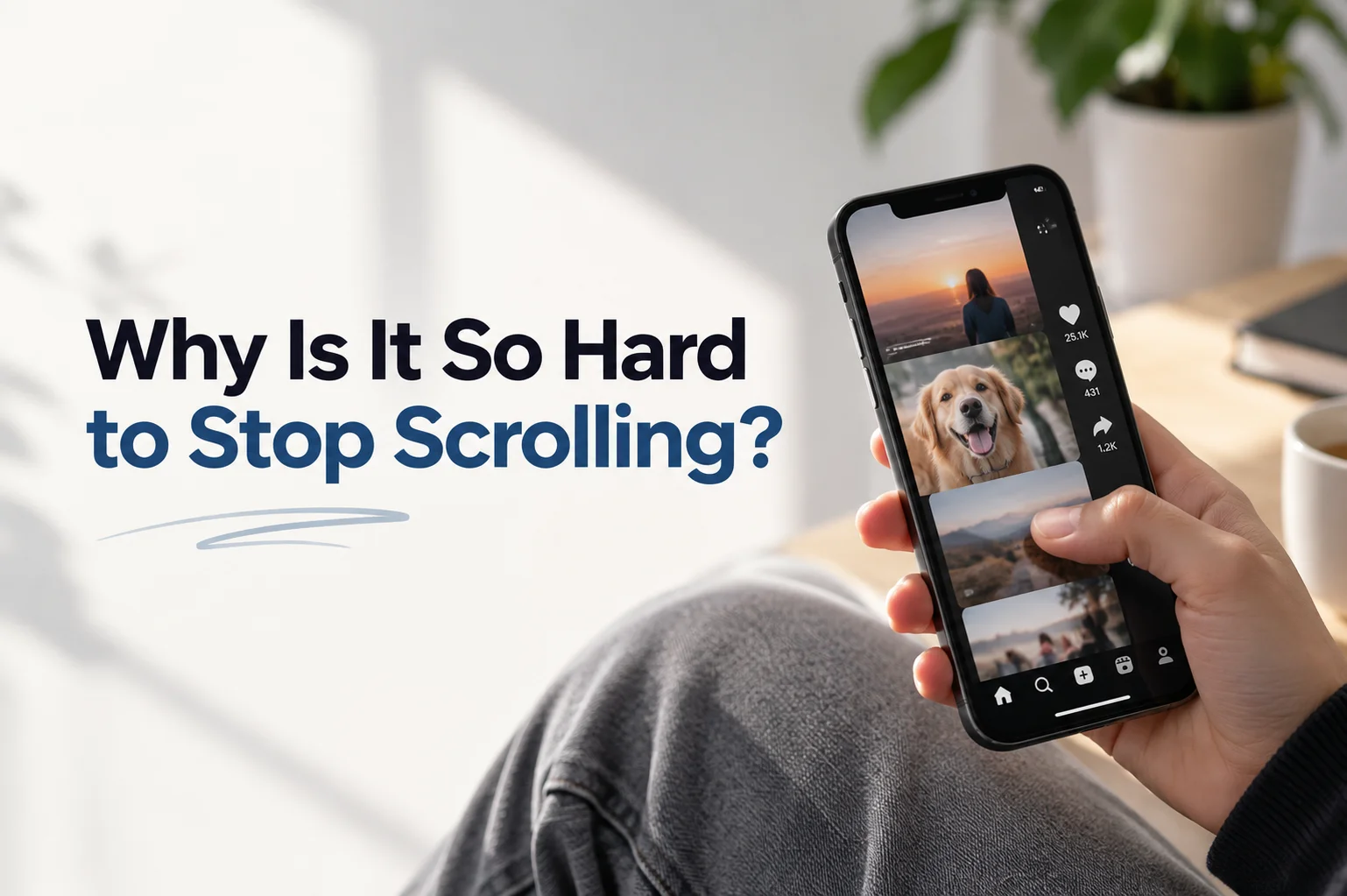
You open Instagram to check one message. A few minutes later, you’re watching Reels, reading comments, checking another profile, and scrolling through videos you never planned to watch. When you finally look at the time, half an hour has disappeared.
The strange part is that you might not even be enjoying yourself anymore. Your eyes feel tired, your mind feels scattered, and you know you have other things to do. Yet, somehow, you keep scrolling.
So, why is it so hard to stop scrolling, even when you genuinely want to put your phone away?
The answer is more complicated than simply lacking self-control. Endless scrolling combines psychological rewards, automatic habits, personalized content, and app designs that make continuing easier than stopping. It can also become a way to deal with boredom, stress, loneliness, or uncomfortable thoughts.
Understanding these factors can help you recognize why the habit happens and, more importantly, how to change it without giving up your phone or social media entirely.
Why Is It So Hard to Stop Scrolling?
It is hard to stop scrolling because your brain can keep anticipating something interesting, while your app provides no clear reason to stop. Each swipe offers another chance to discover something funny, useful, surprising, or emotionally engaging. Over time, the action can also become an automatic response to boredom, stress, or a spare moment.
Several factors work together:
- Unpredictable rewards: You never know whether the next post or video will be especially interesting.
- Infinite scrolling: The feed keeps supplying new content instead of reaching a natural endpoint.
- Personalized recommendations: Platforms learn from your interactions and recommend content likely to interest you.
- Habit formation: You may start opening an app without consciously deciding to do so.
- Emotional relief: Scrolling can temporarily distract you from stress, boredom, or uncomfortable feelings.
- Low effort: Swiping requires very little planning or mental effort compared with many offline activities.
A 2026 study published in Information & Management examined repetitive scrolling on short-form video apps. The researchers found that anticipation of upcoming videos played an important role in compulsive scrolling, while the relationship between content types and recommendation systems was more complex.
Read the research on repetitive scrolling.
Let’s look at why these mechanisms make stopping difficult.
1. Your Brain Keeps Wondering What Comes Next
One of the biggest reasons you keep scrolling is that you don’t know what the next swipe will bring.
The next video might be hilarious. The next post might teach you something useful. You might see a message from someone you care about or discover something you didn’t know you were interested in.
Most of the content might be ordinary, but occasionally you find something that feels particularly rewarding. That possibility makes another swipe seem worthwhile.
Psychologists study similar patterns through the concept of intermittent reinforcement, in which rewards arrive unpredictably rather than after every action.
When you scroll, you cannot predict exactly when you’ll encounter something especially interesting. This uncertainty can encourage you to continue checking for the next rewarding piece of content.
It is important not to overstate the comparison with gambling. Social media use is not automatically an addiction, and the precise mechanisms vary between people and platforms. However, unpredictable rewards provide one useful explanation for why repeated checking can become difficult to interrupt.
Why one more video feels so tempting
Imagine watching ten videos in a row. Eight might be unremarkable, one might be mildly entertaining, and another might be exactly what you wanted to see.
The enjoyable video can make the time spent scrolling feel worthwhile. You may continue because the next one could be just as good.
This creates a familiar thought:
“Let me watch just one more.”
The problem is that there is always another video available.
What helps: Decide when you will stop before opening the app. A clear limit gives you a stopping rule instead of leaving the decision to how interesting the next video feels.
2. Infinite Scrolling Removes the Natural Stopping Point
Think about reading a physical book or watching a television episode. A chapter ends. The credits roll. You reach the end of a newspaper article.
These moments create natural opportunities to decide whether you want to continue.
Social media feeds often work differently. As you reach the bottom, more content appears. You don’t have to choose a new activity or deliberately search for something else.
The next piece of content is already waiting.
This design makes continuing almost effortless. You can remain in the same activity for minutes or hours without encountering an obvious endpoint.
Researcher Sharon Horwood of Deakin University has discussed how infinite scrolling removes natural stopping cues and makes it harder for people to recognize when they have had enough.
Read the explanation of infinite scrolling and how to regain control.
Why this matters
When there is no clear endpoint, you must create one yourself.
That means repeatedly deciding whether to stop while new content continues to compete for your attention. If you are tired, bored, or distracted, making that decision can become even harder.
What helps: Create an artificial endpoint. Choose a specific number of videos, set a timer, or decide that you will stop after checking a particular update. Then close the app when you reach that point rather than negotiating with yourself over every new post.
3. Scrolling Can Become an Automatic Habit
Have you ever unlocked your phone, opened Instagram, and started scrolling before you even remembered why you picked it up?
This is an example of how a behavior can become habitual.
Habits often develop when the same action repeatedly follows a familiar cue. You feel bored, pick up your phone, open an app, and experience a little entertainment or relief. After enough repetitions, the cue can begin triggering the behavior automatically.
A simplified habit loop looks like this:
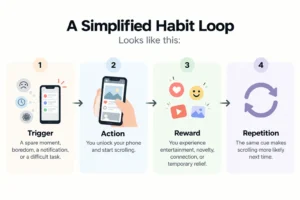
The more often this sequence repeats, the less conscious effort the behavior may require.
Eventually, you might reach for your phone during every quiet moment, including while waiting for food, standing in a queue, sitting at your desk, or getting ready for bed.
The habit is no longer necessarily about wanting to see something specific. The act of checking the phone has become a familiar response to having nothing else to do.
What helps: Interrupt the habit at its starting point. If you usually scroll whenever you sit on your bed, leave your phone across the room. If you open social media whenever you feel bored at work, decide on another short activity you can do during breaks.
You do not have to eliminate the urge immediately. Start by making the automatic action less automatic.
4. Personalized Feeds Make It Difficult to Leave
Social media platforms don’t show every user the same sequence of content. Recommendation systems use signals such as your viewing behavior, likes, searches, and interactions to help select what you see.
If you frequently watch cooking videos, you may see more recipes. If you interact with fitness content, similar videos may appear in your feed.
This personalization can make scrolling genuinely useful. You can discover new interests, learn skills, and find communities that matter to you.
However, it can also make stopping harder because the feed continually presents material that appears relevant to your interests.
You don’t have to search for the next interesting thing. The platform keeps offering possibilities.
Short-form video research published in 2026 examined how content types and recommendation systems interact with anticipation to influence repetitive scrolling. The findings suggest that these factors work together in ways that are more complicated than a simple claim that algorithms always make people scroll longer.
Explore the 2026 study on recommendation systems and compulsive scrolling.
Why personalized content holds your attention
When a feed contains several topics you enjoy, leaving it means giving up the possibility of discovering something else you might like.
This can make stopping feel less appealing than continuing, even when you’ve already spent more time on the app than intended.
What helps: Be intentional about the accounts you follow and the content you consume. Unfollow sources that leave you feeling worse, use chronological feeds when available, and remove recommendations that repeatedly pull you into unwanted scrolling.
You don’t need to make your feed completely boring. The aim is to make it serve your interests rather than consume time you intended to use elsewhere.
5. You May Be Scrolling to Escape Boredom or Stress
Not every scrolling session begins because you want entertainment.
Sometimes you open your phone because you are worried about a task, uncomfortable with silence, mentally exhausted, lonely, or simply unsure what to do next.
Scrolling offers an easy change of focus. Instead of thinking about an unfinished assignment, a difficult conversation, or an unpleasant feeling, you can immerse yourself in something else for a while.
This can provide temporary relief.
The difficulty arises when scrolling becomes your default response to every uncomfortable feeling.
For example, imagine that you have a task you don’t want to start. You open social media for a short break. The task is still waiting when you return, but now you may also feel frustrated about the time you’ve lost. That frustration can make you want another distraction.
Over time, scrolling can become part of a cycle of avoidance rather than a genuinely refreshing break.
The difference between a break and avoidance
A break helps you return to an activity feeling ready to continue. Avoidance postpones an uncomfortable task or feeling without resolving it.
Neither is determined by screen time alone. A ten-minute video break might be perfectly reasonable after demanding work. A much shorter session can become avoidance if it repeatedly prevents you from doing something important.
What helps: Before opening an app, ask yourself, “What am I looking for right now?”
If the answer is entertainment, choose it intentionally. If you are avoiding a difficult task, try working on that task for five minutes before taking a break. If you are stressed, a short walk, stretching, journaling, or talking to someone may address the underlying need more effectively.
6. Scrolling Requires Very Little Effort
Many everyday activities require you to plan, make decisions, concentrate, or tolerate a period of uncertainty.
Reading a challenging book, learning a new skill, completing paperwork, and exercising all require some effort before you experience a reward.
Scrolling has a much lower barrier to entry.
You can start instantly, stop whenever you like, and receive a continuous stream of changing content. You don’t have to prepare anything, decide what to do next, or commit to a single activity for very long.
When you are tired or mentally overloaded, that convenience can make scrolling particularly appealing.
This does not mean your brain is permanently damaged by short videos or that you have lost the ability to concentrate. It means that, in a particular moment, an easy and immediately available activity may be more attractive than a demanding one.
Why productive tasks can feel harder afterward
If you repeatedly switch between short videos and other activities, returning to a task that requires sustained attention may feel frustrating. You have to redirect your attention and rebuild your place in the task.
The experience can be especially noticeable when you are already tired or distracted.
What helps: Make the activity you want to do easier to start. Keep your book open on your desk, prepare your work before taking a break, or set a small target such as completing one paragraph.
You don’t need to rely entirely on willpower. Reducing the effort required to begin a useful activity can make it more attractive.
7. Notifications Keep Pulling You Back
Even when you have put your phone down, a notification can bring your attention back to it.
A message arrives. Someone likes your post. A new video is recommended. You notice the screen lighting up.
Each interruption gives you a reason to check the device again. Once you open it, you may end up scrolling through content unrelated to the original notification.
This can turn occasional phone use into repeated checking throughout the day.
Notifications can be particularly distracting because they create uncertainty. You may wonder whether the alert is important, whether someone needs a response, or whether you are missing something.
Not every notification creates a strong urge, and some alerts are genuinely useful. The problem is when nonessential alerts repeatedly interrupt activities you want to focus on.
What helps: Disable nonessential notifications, remove social apps from your home screen, and choose specific times to check messages. Keep calls and alerts from important contacts available if you need them.
The fewer unnecessary interruptions you receive, the fewer opportunities you have to slip into an unplanned scrolling session.
8. Scrolling Can Become Part of Your Bedtime Routine
For many people, scrolling is the final activity of the day.
You get into bed intending to watch a few videos, and suddenly it is much later than you expected. Even when you feel tired, the next post can seem more appealing than putting the phone away.
There are several possible reasons for this pattern.
First, scrolling can become a familiar cue associated with getting ready for sleep. Second, your phone makes entertainment available when there are fewer competing activities. Third, an endless feed offers no natural signal that it is time to stop.
Late-night phone use can also displace sleep. If scrolling delays bedtime, you may get less rest than you intended.
The effects of screens on sleep depend on factors such as timing, content, individual habits, and how the device is used. It is too simplistic to say that every minute of screen time directly damages sleep. However, regularly sacrificing sleep to scrolling is worth addressing.
For general guidance on healthy sleep habits, see the CDC’s information on sleep and sleep habits.
What helps: Choose a time to put your phone away before you get into bed. Charge it away from your pillow, use a separate alarm clock if practical, and create a short wind-down routine that doesn’t depend on a screen.
If you find yourself scrolling because you don’t want the day to end, consider whether stress, unfinished tasks, or a lack of relaxing personal time during the day is contributing to the habit.
9. You May Not Notice How Much Time Has Passed
Scrolling often involves many small actions rather than one long decision.
You watch a video, swipe to another, read a comment, open a profile, and continue. Because each action takes only a few seconds, the overall session may not feel particularly long.
Your attention is occupied by the next item rather than by tracking how much time you have spent.
This can create a gap between your intention and your actual behavior. You planned to spend five minutes on an app but never made a clear decision to continue for another twenty.
The problem is not necessarily that you have no sense of time. It is that the activity provides few natural opportunities to stop and evaluate how much time has passed.
What helps: Use an external reminder rather than relying on your internal sense of time. Set a timer, enable app limits, or use your phone’s screen-time dashboard to review your actual usage.
A reminder works best when you have already decided what to do when it appears. For example, when the timer goes off, close the app and move your phone out of reach.
How to Stop Scrolling So Much
Understanding why scrolling happens is useful, but knowing what to change is even more important.
You do not necessarily need to delete every social media app, switch off your phone permanently, or avoid online entertainment. A more realistic goal is to make scrolling a deliberate choice instead of an automatic response.
Here are practical strategies you can start using today.
1. Set a Specific Limit Before You Open an App
“Spend less time on social media” is difficult to measure.
Instead, choose a specific limit for the session. You might decide to check messages for ten minutes or watch a few videos during a planned break.
The exact number is less important than having a clear stopping point.
Use your phone’s built-in screen-time controls if you struggle to keep track of time. Remember that app limits are tools, not perfect solutions; you may need to adjust them to make them realistic and useful.
2. Turn Off Notifications You Don’t Need
Start with notifications from apps that frequently pull you into unplanned sessions.
You can keep alerts from important people, work tools, or essential services while disabling promotional alerts and nonessential updates.
This reduces the number of external triggers competing for your attention.
3. Make Unplanned Scrolling Less Convenient
Small changes to your environment can interrupt an automatic habit.
Try moving social media apps into a folder, logging out after use, removing shortcuts from your home screen, or leaving your phone in another room while you work.
If you repeatedly pick up your phone while studying or working, place it somewhere that requires you to stand up to retrieve it.
A little extra effort can give you enough time to notice what you are doing and decide whether you actually want to continue.
4. Identify Your Main Scrolling Trigger
Pay attention to when you tend to scroll.
Is it when you wake up? When a task becomes difficult? When you feel lonely? When you are waiting for something? Or when you get into bed?
The answer matters because different triggers need different solutions.
If you scroll out of boredom, prepare a few easy alternatives. If you scroll to avoid a task, break the task into smaller steps. If you scroll when stressed, try an activity that helps you address the stress directly.
You can also keep a simple record for a few days, noting when you opened an app, how you felt beforehand, and how you felt afterward. This can reveal patterns you might not otherwise notice.
5. Replace the Habit Instead of Simply Removing It
If you remove scrolling from your routine without deciding what to do instead, you may find yourself returning to it whenever you have an empty moment.
Choose an alternative that meets the same need.
| If you usually scroll because… | Try replacing it with… |
|---|---|
| You’re bored | Reading a few pages, listening to music, or doing a small activity |
| You’re stressed | Taking a short walk, stretching, or writing down what’s bothering you |
| You’re avoiding work | Starting with five minutes of the task |
| You feel lonely | Sending a thoughtful message or arranging a conversation |
| You’re mentally tired | Taking a screen-free break or resting |
| You’re waiting | Observing your surroundings, listening to a podcast, or carrying a book |
The replacement doesn’t have to be productive. Rest and entertainment are valid needs, too. The goal is to give yourself more than one way to meet them.
6. Create Phone-Free Moments During the Day
Instead of trying to change every habit at once, choose one or two parts of your day when you will not scroll.
For example, you could keep your phone away during meals, the first fifteen minutes after waking, or the final half hour before bed.
Once these routines become more comfortable, you can introduce other phone-free periods.
Small, consistent changes are often easier to maintain than strict rules that feel impossible to follow.
7. Use a Pause Before You Swipe Again
When you notice that you have been scrolling longer than intended, stop for a moment.
Ask yourself:
- Am I still enjoying this?
- Did I open the app for a reason?
- Is there something else I would rather be doing?
- How will I feel if I continue for another twenty minutes?
You don’t need to answer every question every time. Even a brief pause can interrupt the automatic sequence and give you a chance to make a conscious choice.
8. Review Your Screen Time Without Judging Yourself
Your screen-time report can show which apps consume the most time and when you tend to use them.
Look for patterns rather than treating a high number as proof that you have failed.
Ask whether your usage is interfering with sleep, work, studies, relationships, or activities that matter to you. If it is, identify one specific change you can make.
The purpose of tracking is to help you understand your behavior, not to make you feel guilty about every minute spent online.
What If You Keep Going Back to Scrolling?
Changing a habit rarely happens perfectly on the first attempt.
You may set a limit and ignore it. You might delete an app only to reinstall it later. You may have a productive day and then spend the following evening scrolling longer than you intended.
That doesn’t mean change is impossible.
Habits are influenced by routines, emotional states, environmental cues, and how rewarding an activity feels. Changing only one of these factors may not be enough every time.
Instead of asking, “Why do I have no self-control?” try asking, “What made it difficult to stop this time?”
Perhaps you were exhausted. Perhaps the app was open on your home screen. Perhaps you were avoiding a stressful task or had no clear plan for your free time.
That information can help you choose a more useful strategy next time.
You can also make your goal more specific. Rather than trying never to scroll mindlessly again, aim to avoid scrolling during one work session or to stop using your phone at a particular time in the evening.
If scrolling repeatedly feels uncontrollable and is seriously affecting your sleep, responsibilities, relationships, or emotional well-being, consider talking to a qualified mental health professional. You do not need to label yourself as addicted to seek support for a habit that is causing problems.
Is Scrolling Addiction?
People often use the word addiction to describe scrolling that feels difficult to control. However, spending a lot of time on social media does not automatically mean someone has a clinical addiction.
It is more useful to look at the pattern and its consequences.
Consider these questions:
- Do you regularly spend much longer scrolling than you intended?
- Have repeated attempts to reduce your usage been unsuccessful?
- Does scrolling interfere with sleep, work, studies, or relationships?
- Do you continue despite noticing significant negative consequences?
- Does it feel like your main way of coping with stress or uncomfortable emotions?
A few occasional yeses do not establish a diagnosis. But if the pattern is persistent and causes meaningful difficulties, it is worth taking seriously.
Research distinguishes compulsive use, excessive use, and addiction-related patterns rather than treating them as interchangeable. The distinction matters because difficulty stopping one activity does not, by itself, establish a clinical condition.
The goal is not to diagnose yourself based on screen time. It is to understand whether your current habits support the life you want to live.
Frequently Asked Questions
1. Why do I keep scrolling even when I’m bored?
You may keep scrolling because the next item could be more interesting than the current one. Personalized recommendations, unpredictable rewards, and the lack of a natural endpoint can encourage you to continue. Scrolling may also have become an automatic response to boredom, so you open the app without consciously deciding to do so.
2. Why can’t I stop scrolling once I start?
Once you begin, several factors can work together: the feed keeps supplying new content, the next video might be rewarding, and your attention remains focused on the immediate activity rather than the time passing. If scrolling is also a familiar habit, stopping requires you to interrupt an established routine.
3. Does scrolling release dopamine?
Dopamine is involved in learning, motivation, and reward-related processes, but it is misleading to describe every swipe as producing a predictable dopamine hit. Social media engagement involves multiple psychological and biological mechanisms, and the precise relationship between dopamine and problematic scrolling remains an area of research.
4. How do I stop mindless scrolling?
Start by identifying your main trigger, setting a specific time or activity limit, and making unwanted scrolling less convenient. Turn off nonessential notifications, move apps away from your home screen, and choose an alternative activity for moments when you usually reach for your phone. Focus on one manageable change at a time.
5. Why do I scroll more when I’m stressed or tired?
Scrolling offers easy access to distraction and entertainment, which can feel appealing when you have limited energy or want a break from uncomfortable thoughts. However, if it becomes your main coping strategy, it may postpone the problem without helping you recover. Try choosing a break that matches what you need, such as rest, movement, or talking to someone.
6. Is deleting social media the only way to stop scrolling?
No. Deleting an app can help if you need a stronger boundary, but it is not the only option. You can reduce notifications, use app limits, change your environment, and build alternative routines. The best approach depends on how strongly the habit affects your life and which changes you can maintain.
7. How long does it take to break a scrolling habit?
There is no universal timeline. The time needed depends on how established the habit is, what triggers it, your environment, and how consistently you practise a different response. Rather than focusing on a fixed number of days, track whether you are becoming more intentional about when you start and stop scrolling.
Final Thoughts
It is hard to stop scrolling because the behavior is rarely driven by one factor alone. Endless feeds remove natural stopping points, unpredictable content encourages anticipation, personalized recommendations keep offering new possibilities, and repeated use can turn checking your phone into an automatic habit.
Sometimes, scrolling is simply entertainment. Other times, it becomes a way to escape boredom, stress, or a task you would rather avoid.
The solution is not necessarily to remove social media from your life. It is to recognize when the habit is no longer serving you and make it easier to choose something else.
Start small. Turn off a few notifications, keep your phone away during one important activity, or set a clear stopping point before opening an app.
You don’t have to stop enjoying your phone. You just need to regain the ability to decide when you’ve had enough.