
Have you ever watched a tutorial, understood everything while watching it, and then struggled to repeat the same steps when you tried them yourself?
It happens more often than you might think. You can be exposed to information without fully understanding it, understand something without remembering it later, or remember a concept without knowing how to apply it.
That’s because learning involves more than simply taking information into your brain.
Your brain must interpret what you encounter, direct attention toward relevant details, work with information temporarily, connect it with existing knowledge, and form memories that may be available for future use. These processes interact, and not every piece of information you encounter becomes a lasting memory.
Your brain processes new information through several interconnected processes, including perception, attention, working memory, encoding, memory consolidation, and retrieval. Understanding these processes can help you learn more effectively, recognize why you forget things, and choose better ways to study or develop new skills.
In this guide, we’ll explore what happens when you learn something unfamiliar, why distractions interfere with learning, how information becomes a memory, and practical ways to make new knowledge easier to understand and recall.
How Does the Brain Process New Information?
When you encounter something new, your brain interprets the incoming information and uses attention, memory, and existing knowledge to make sense of it.
A simplified explanation includes five connected stages:
- Perception: Your brain processes sensory information, such as words you read or sounds you hear.
- Attention: Your attention prioritizes information relevant to what you’re doing.
- Working memory: You temporarily maintain and work with information while understanding or using it.
- Encoding and consolidation: Some information is encoded into memory, and certain memories undergo processes that help stabilize them over time.
- Retrieval: You access previously learned information when you need to remember or apply it.
These stages are not a strict sequence that every thought follows. They overlap and influence one another. Your existing knowledge can affect how you interpret information, while retrieving an earlier memory can help you understand something new.
For example, imagine you’re learning to use a spreadsheet application for the first time. You watch a tutorial explaining how to create formulas, follow the instructions, practise a few calculations, and return the next day to repeat the task without help.
During that process, you are not simply memorizing a set of instructions. You are learning what the commands mean, recognizing patterns, practising actions, and developing knowledge that may help you complete similar tasks in the future.
Let’s examine how this works.
1. Your Brain Receives and Interprets New Information
The process begins when you encounter information through your senses or bring an existing idea to mind.
You might read a sentence, listen to an explanation, observe a demonstration, or touch an unfamiliar object. Your sensory systems process different aspects of the experience, allowing your brain to construct a perception of what’s happening.
However, receiving information and understanding it are not the same thing.
Consider the first time you encounter a technical term such as encryption. You might recognize the word when you read it, but that doesn’t necessarily mean you understand what it does.
If someone explains that encryption transforms information into a form that cannot readily be understood without the appropriate key, the term starts to acquire meaning. You can now connect the word with an explanation and perhaps a familiar example, such as protecting information sent over the internet.
Your existing knowledge helps shape this process.
Someone who already understands computers may grasp the explanation quickly. Someone encountering the subject for the first time might need simpler examples before the idea becomes clear.
This is one reason background knowledge matters. New information becomes easier to interpret when you have a foundation to connect it to.
How to use this when learning
Before starting a difficult topic, ask yourself three questions:
- What do I already know about this subject?
- Which words or concepts are unfamiliar?
- Can I find a simple example that explains the main idea?
You don’t need to understand everything before you begin. The purpose is to establish enough context to make the new material easier to follow.
2. Attention Determines Which Information Gets Priority
Your surroundings constantly provide information. You may notice sounds, movement, notifications, conversations, and changes in your environment while trying to concentrate on a single task.
Attention helps prioritize some of this information for further processing.
When you focus on a lesson, your brain directs resources toward information relevant to that task. Other events may still capture your attention, especially when they are unexpected or personally important.
This matters because attention and memory are closely connected. A 2024 review published in Annual Review of Psychology examines how attention relates to working memory, long-term memory, and the formation of memories. The relationship is complex, but attention can influence what information is encoded and how it is later remembered. Read the review on attention and memory.
Why distractions interrupt learning
Return to the spreadsheet example.
You’re watching a tutorial about formulas when a message appears on your phone. You check the message, reply, and return to the tutorial.
The instructor has continued explaining the process while you were away. Now you need to work out which step you missed, remember what you were doing, and reconnect the explanation with the earlier instructions.
A single interruption doesn’t necessarily ruin learning, but repeated interruptions can make it harder to maintain a continuous understanding of a task.
This is particularly challenging when the material contains several unfamiliar concepts that depend on one another.
A practical solution: When learning something difficult, silence unnecessary notifications and keep unrelated tabs closed. Give yourself a manageable period of uninterrupted attention before taking a break.
If phone distractions are a recurring problem, read our guide on why your phone makes it harder to concentrate.
3. Working Memory Helps You Think Through Information
Once you focus on information, you often need to hold it in mind while doing something with it. This ability is commonly associated with working memory.
Working memory allows you to maintain and manipulate information temporarily. It helps you follow instructions, compare ideas, understand sentences, solve calculations, and work through unfamiliar problems.
For example, imagine someone asks you to calculate 24 multiplied by 6 without a calculator.
You might break the calculation into smaller parts:
- 20 multiplied by 6 equals 120.
- 4 multiplied by 6 equals 24.
- 120 plus 24 equals 144.
You temporarily maintain the numbers and intermediate results while completing the calculation.
The same principle applies when you learn a new concept. You may need to remember the first part of an explanation while interpreting the second part, then combine both to understand the complete idea.
Why too much information can feel overwhelming
Working memory has limited capacity. When you try to manage many unfamiliar concepts at once, it becomes harder to keep track of their relationships.
Imagine a beginner learning spreadsheet formulas. In one lesson, they encounter cell references, mathematical operators, conditional formulas, and error messages.
Each concept introduces something new to understand. If the learner has not mastered the basics, the later instructions may feel confusing because they depend on information that hasn’t become familiar yet.
This is why breaking a complex task into smaller steps can help.
Instead of learning everything in one sitting, start with a simple formula. Practise it, understand what each part does, and then move on to more complicated examples.
Other useful techniques include writing down intermediate steps, using diagrams, and keeping a short reference sheet nearby.
The key takeaway: You don’t need to hold every detail in your head simultaneously. External notes and smaller learning steps can reduce the mental effort required to work through unfamiliar material.
4. Your Brain Connects New Information With What You Already Know
Learning is easier when new information has something meaningful to connect to.
Your existing knowledge provides a framework for interpreting new experiences. It helps you recognize patterns, make comparisons, and understand relationships between ideas.
Consider learning about compound interest.
If you already understand how savings accounts work, you have a useful starting point. You know that money can earn interest over time. Learning that compound interest also includes interest accumulated previously extends that existing understanding.
Instead of memorizing a completely isolated definition, you can connect the concept with something familiar.
These connections can also help you apply knowledge to different situations. Once you understand how compound interest works, you can begin examining how it affects savings, investments, or the cost of borrowing.
However, familiar comparisons can sometimes be misleading. An analogy might help you understand the basic idea without explaining every detail accurately.
For instance, comparing electrical current to water flowing through a pipe can help introduce a beginner to electrical circuits. But water and electricity behave differently in important ways, so the analogy has limits.
How to make connections more effectively
When learning something unfamiliar, ask:
- What does this remind me of?
- How does it relate to something I already understand?
- Can I explain it using a real-world example?
- What makes this concept different from a similar one?
- Where might my comparison stop being accurate?
These questions encourage you to build a connected understanding instead of memorizing disconnected facts.
They also help you identify gaps in your knowledge. If you cannot explain how two concepts relate, you may need to revisit one of them before moving forward.
5. Encoding Helps Information Become a Memory
Encoding is the process through which information is represented in memory.
When you encounter an experience or learn something new, your brain processes aspects of that information in ways that may contribute to a memory. The strength and durability of that memory depend on several factors, including attention, meaning, prior knowledge, and the nature of the task.
Not everything you encounter is encoded strongly enough to be remembered later.
Think about meeting someone for the first time. You hear their name, acknowledge it, and continue the conversation. A few minutes later, you may struggle to recall the name.
Now imagine you pay closer attention, repeat the name during the conversation, and connect it with a detail about the person.
Those additional opportunities to process the information may make it easier to remember, although they do not guarantee that you will recall it later.
Why understanding can be more useful than memorizing words alone
Suppose you’re learning about photosynthesis.
You could repeat a textbook definition until the wording becomes familiar. But understanding that plants use light energy to help convert carbon dioxide and water into sugars gives you a more useful conceptual foundation.
You can then explain the process in your own words, interpret a diagram, or answer questions about it.
Meaningful engagement creates opportunities to connect information with existing knowledge. This can make the material easier to explain and apply.
Repetition still has a role, especially when learning vocabulary, formulas, or practical procedures. The goal is to combine repetition with understanding rather than treating them as interchangeable.
Try this: After studying a concept, close your notes and explain the central idea in your own words. Then check your explanation against a reliable source and correct anything you misunderstood.
For a related technique, read why explaining something helps you remember it.
6. Memory Consolidation Helps Stabilize Some Memories
Learning doesn’t necessarily stop when you finish a lesson.
Some memories undergo a process called consolidation, through which they become more stable over time. These processes involve changes in brain activity and connections across multiple systems.
The hippocampus plays an important role in forming new memories of facts and experiences. Other brain regions contribute to different aspects of learning, long-term memory, and the development of skills.
Memory is not simply a matter of moving a complete file from one location in the brain to another. Different kinds of memories involve interacting processes and neural systems.
A review of cognitive neuroscience research discusses how encoding, consolidation, retrieval, and reconsolidation contribute to memory. Read the review on the neuroscience of memory.
What does this mean in everyday life?
Imagine you practise a new spreadsheet formula today.
You understand the explanation and successfully complete a few examples. The next day, you return to the task and discover that you remember the basic structure but have forgotten part of the syntax.
You review the difficult part, practise again, and gradually become more comfortable using the formula.
Several processes are involved here. You are retrieving what you learned, receiving another opportunity to encode the information, and practising the skill in a new session.
Sleep also supports memory and cognitive functioning. Research suggests that sleep contributes to the consolidation of some forms of memory, although the precise effects depend on the type of learning and other circumstances.
This is one reason sacrificing sleep to spend more hours studying is not always a good trade-off.
A practical approach: Learn in manageable sessions, revisit important material on later days, and maintain a sleep routine that gives you sufficient rest.
7. Retrieval Helps You Remember What You Have Learned
Having encountered information before doesn’t guarantee that you can recall it when you need it.
Retrieval is the process of accessing information from memory.
For example, you might recognize the correct definition of a term when you see it in a textbook but struggle to explain it without looking. Recognizing an answer and recalling it independently are related abilities, but they are not identical.
This distinction matters when studying.
Rereading a chapter may make the material feel familiar. Closing the book and answering questions from memory gives you a different kind of practice: you have to retrieve the information without seeing the original explanation.
A simple retrieval exercise
After learning something new:
- Close the article, book, or lesson.
- Write down the main points you remember.
- Explain how the ideas relate to one another.
- Compare your explanation with the original material.
- Review the details you missed or misunderstood.
This helps you identify what you can recall independently and what still needs attention.
Retrieval practice is not a guarantee that you will remember every detail permanently. You may recall something incorrectly or miss important information. Checking your answers and correcting mistakes is therefore essential.
You can make this practice more useful by returning to the material after a delay instead of testing yourself only immediately after reading.
8. Why Do You Forget Information You Just Learned?
Forgetting is a normal part of memory. It doesn’t automatically mean that your brain failed to store the information, and it isn’t by itself evidence of a memory disorder.
Several different situations can make recently learned information difficult to recall.
You weren’t paying enough attention
If you were distracted while reading instructions, you might remember seeing them without retaining their meaning.
This is one reason repeatedly checking your phone during a lesson can make it harder to remember what you studied.
You understood the words but not the concept
Memorizing a definition without understanding the underlying idea may make it difficult to explain or apply it later.
Connecting a concept with examples and prior knowledge can help you build a more useful understanding.
You haven’t revisited the material
Information that you rarely use may become harder to recall over time. Returning to it and practising retrieval can provide additional opportunities to retain it.
Similar information is interfering
If you learn two concepts that resemble each other, you may confuse their details.
For example, two spreadsheet functions may have similar names but behave differently. Comparing their purposes, inputs, and outputs can help you distinguish between them.
You are tired or mentally overloaded
Insufficient sleep, stress, interruptions, and demanding tasks can affect attention and memory performance.
When you’re exhausted, you may need more effort to understand a paragraph or follow a sequence of instructions. In that situation, taking a break or returning to the task after resting may be more productive than continuing to push through it.
The useful question is not simply “Why can’t I remember this?” but “What part of the learning process needs more support?”
That question gives you a more practical starting point.
9. A Practical Experiment: Follow One Concept Through the Learning Process
Here’s a short exercise you can use to examine how you learn. It isn’t a scientific experiment or a test of intelligence; it’s a practical way to notice which parts of learning feel easy or difficult for you.
Choose a small concept you don’t already understand, such as a spreadsheet formula, a basic programming command, or a new term from a subject you’re studying.
Step 1: Learn the basics
Spend a few minutes reading a reliable explanation or watching a short tutorial. Choose one concept rather than attempting to learn an entire subject.
Notice whether the explanation makes sense or whether you need additional background information.
Step 2: Explain it without looking
Close the source and explain the concept in your own words.
Can you describe what it does? Can you give an example? If you remember the terminology but cannot explain the meaning, you may need to revisit the explanation.
Step 3: Apply it to a small task
Use the concept in a simple example. If you’re learning a spreadsheet formula, try using it in a sample spreadsheet. If you’re learning a programming command, write a small piece of code that uses it.
This reveals whether you can move beyond understanding the explanation to applying the idea.
Step 4: Check your work
Compare your result with a reliable example or answer. Identify errors and work out why they occurred.
Correcting a misunderstanding is more useful than repeatedly practising the same incorrect approach.
Step 5: Return the next day
Before rereading the explanation, try to recall what you learned and repeat the small task.
Notice what comes back easily and what requires another look.
Your observations might look like this:
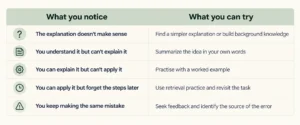
This exercise is useful because it separates different difficulties that can otherwise feel like one general problem with learning.
You may not need to study for longer. You may need a clearer explanation, more practice, or another opportunity to retrieve the information.
10. How to Help Your Brain Process New Information More Effectively
You can’t control every aspect of memory formation, but you can choose learning methods that make information easier to understand, practise, and recall.
Learn in manageable sections
When a topic is unfamiliar, begin with its foundations. Understand one important concept before introducing several more.
Once the basics become familiar, you can build toward more complicated material.
Connect new ideas with existing knowledge
Use examples, comparisons, and explanations that relate to things you already understand.
Check that the connection is accurate, particularly when learning technical or scientific subjects.
Explain what you have learned
After studying a concept, try explaining it without copying the original wording.
If your explanation becomes vague, identify the part you don’t understand and return to that section.
Practise recalling information
Use short questions, flashcards, or written summaries to check what you remember without looking at your notes.
Then compare your answers with a reliable source and correct any errors.
Space out your learning
Return to important information across multiple sessions rather than relying entirely on one long study period.
You might review a concept the following day, test yourself again a few days later, and revisit it the following week. The ideal timing depends on the subject and how long you need to retain it.
Reduce unnecessary distractions
Give demanding tasks your attention and keep interruptions to a minimum when possible.
If you regularly struggle to concentrate, our article on why you lose focus after working for a while explores some related difficulties.
Give yourself time to rest
Learning can be mentally demanding. Short breaks can help you manage effort, while sufficient sleep supports cognitive functioning and memory.
You don’t have to keep studying until you’re exhausted. Choose a routine that you can sustain over time.
Frequently Asked Questions
How does the brain process information step by step?
A simplified model includes perception, attention, working memory, encoding, consolidation, and retrieval. These processes interact rather than occurring as completely separate stages. Your existing knowledge and the situation you’re in also influence how you interpret new information.
Which part of the brain processes new information?
No single brain region handles all information processing. Different brain systems contribute to perception, attention, working memory, learning, and memory. The hippocampus plays an important role in forming new memories of facts and experiences, while other regions support additional aspects of learning and recall.
How does information become a long-term memory?
Information can be encoded into memory when it is processed, and some memories undergo consolidation that helps stabilize them over time. Attention, prior knowledge, meaningful engagement, practice, and sleep can influence aspects of learning and retention. Not everything you encounter becomes a lasting memory.
Why does the brain forget new information?
Information may be difficult to recall because it was not encoded strongly, has not been revisited, competes with similar information, or is difficult to retrieve in the current situation. Distraction, stress, and insufficient sleep can also affect learning and memory performance.
Does repeating information help you remember it?
Repetition can support learning, particularly when it involves meaningful practice. However, repeatedly rereading material is not always as useful as trying to recall it independently. Combining retrieval practice with spaced review can help you check your understanding and support retention.
How can I make my brain absorb information faster?
There is no universal method that makes the brain absorb every kind of information faster. You can make learning more manageable by building background knowledge, reducing distractions, breaking complex topics into smaller parts, practising retrieval, and revisiting information over time.
Does sleep help the brain process information?
Yes. Sleep supports memory and other cognitive functions, and research indicates that it contributes to the consolidation of some forms of memory. The effects vary according to the type of learning and other circumstances, but regularly sacrificing sleep for study is generally not a good learning strategy.
What is the difference between working memory and long-term memory?
Working memory temporarily maintains and manipulates information for an ongoing task, such as following instructions or solving a calculation. Long-term memory supports the retention of knowledge, experiences, and skills over longer periods. The two interact during learning and everyday thinking.
Final Thoughts
Your brain does much more than receive information and store it. It interprets experiences, directs attention, connects unfamiliar ideas with existing knowledge, and uses interacting memory processes to help you learn and remember.
That’s why understanding something in the moment isn’t always enough to remember it later. Lasting learning often requires meaningful engagement, opportunities to practise, and chances to retrieve information after some time has passed.
If you want to make learning more effective, start with one concept. Understand what it means, connect it to something familiar, explain it in your own words, and test yourself later.
When something doesn’t stick, identify which part of the process needs more support rather than assuming you simply need to work harder.
You don’t have to memorize everything you encounter. The goal is to understand the information that matters, build useful connections, and make it easier to apply what you’ve learned when you need it.
Research sources
The following sources support the scientific explanations used in this article:
- The Relation Between Attention and Memory — Annual Review of Psychology. A research review exploring how attention and memory interact across different cognitive processes.
- Cognitive Neuroscience Perspective on Memory. A review discussing encoding, consolidation, retrieval, and other aspects of memory.
- Memory — Cleveland Clinic. An accessible overview of memory processes and the brain systems involved.
- How People Learn II — National Academies of Sciences, Engineering, and Medicine. A research-based overview of learning, prior knowledge, and the influence of context.