Introduction
The CBD Confusion Nobody Warned Americans About
You walk into a store.
One shelf says CBD is “fully legal.”
Another product says “hemp-derived THC.”
Then you read online that your state might ban certain cannabinoids next month.
So what’s actually legal in 2026?
That’s the question millions of Americans are asking right now.
CBD has exploded into one of the fastest-growing wellness industries in the country. Gummies, tinctures, vapes, capsules, and hemp drinks are everywhere. But while CBD products look mainstream, the laws behind them are becoming more complicated than ever.
Here’s the reality most websites won’t tell you:
A CBD product that’s legal in one state could become restricted the moment you cross a state line.
And with new federal hemp rules arriving in late 2026, many products currently sold online may completely disappear from the market.
This guide breaks down:
- Whether CBD is legal federally
- Which states are CBD-friendly
- States tightening restrictions
- Delta-8 and THC loophole changes
- Travel laws for CBD users
- What happens after November 2026
- How to avoid buying illegal hemp products
If you’ve ever searched:
“Can I legally buy CBD in my state?”
this is the guide you need.

What Is CBD?
CBD (cannabidiol) is a naturally occurring compound found in hemp and cannabis plants. Unlike THC, CBD is non-intoxicating, meaning it usually does not create the “high” associated with marijuana.
That’s one reason CBD became massively popular in the United States after the 2018 Farm Bill legalized hemp-derived cannabinoids under federal law.
Today, CBD is sold in forms like:
- CBD gummies
- Oils and tinctures
- Capsules
- Vapes
- Topicals
- Hemp beverages
- Sleep products
- Recovery formulas
But legality depends on several factors:
- THC content
- Source of the CBD
- State laws
- Whether cannabinoids are intoxicating
- Product formulation
And in 2026, those rules are changing fast.
Many consumers still confuse hemp cannabinoids, which is why understanding THCA vs CBD: Which One Should You Choose? becomes important before buying any product online.
Is CBD Federally Legal in 2026?
Yes But There’s a Catch
Most hemp-derived CBD products remain federally legal in 2026 if they comply with THC limits.
Under federal law:
- Hemp products are generally legal
- Hemp must contain less than 0.3% Delta-9 THC
- States can still create stricter rules
- Intoxicating hemp products face increasing scrutiny
But here’s where things get serious:
The federal government is tightening hemp regulations harder than many consumers realize.
New hemp-related restrictions expected in late 2026 may:
- limit total THC content
- crack down on Delta-8 products
- restrict THCA flower
- regulate converted cannabinoids
- change shipping standards nationwide
That means some hemp products sold legally today could become illegal tomorrow.
Why CBD Laws Are Different in Every State
One of the biggest misconceptions online is that federal legalization automatically made CBD legal everywhere.
It didn’t.
Every state still controls:
- retail hemp sales
- possession laws
- edible regulations
- smokable hemp legality
- testing requirements
- packaging rules
- THC restrictions
That’s why:
- One state allows full-spectrum CBD
- Another only tolerates THC-free isolate
- Another bans Delta-8 entirely
This legal patchwork is exactly why Americans stay confused.
The 3 Types of CBD Most People Don’t Understand
Before checking your state laws, you need to understand what type of CBD you’re buying.
1. CBD Isolate
This is pure CBD with no THC.
Why people choose it:
- legally safer
- drug-test friendly
- lower risk in strict states
Best for:
- cautious buyers
- travel
- THC-sensitive users
2. Broad-Spectrum CBD
Contains:
- CBD
- minor cannabinoids
- terpenes
- usually no THC
This sits between isolate and full-spectrum formulas.
3. Full-Spectrum CBD
Contains:
- CBD
- trace THC
- cannabinoids
- terpenes
Many users prefer full-spectrum products because they believe the cannabinoids work better together.
This is often called the “entourage effect.”
But here’s the issue:
Full-spectrum CBD faces the highest legal risk in stricter states because it contains THC traces.
States Where CBD Is Mostly Legal in 2026
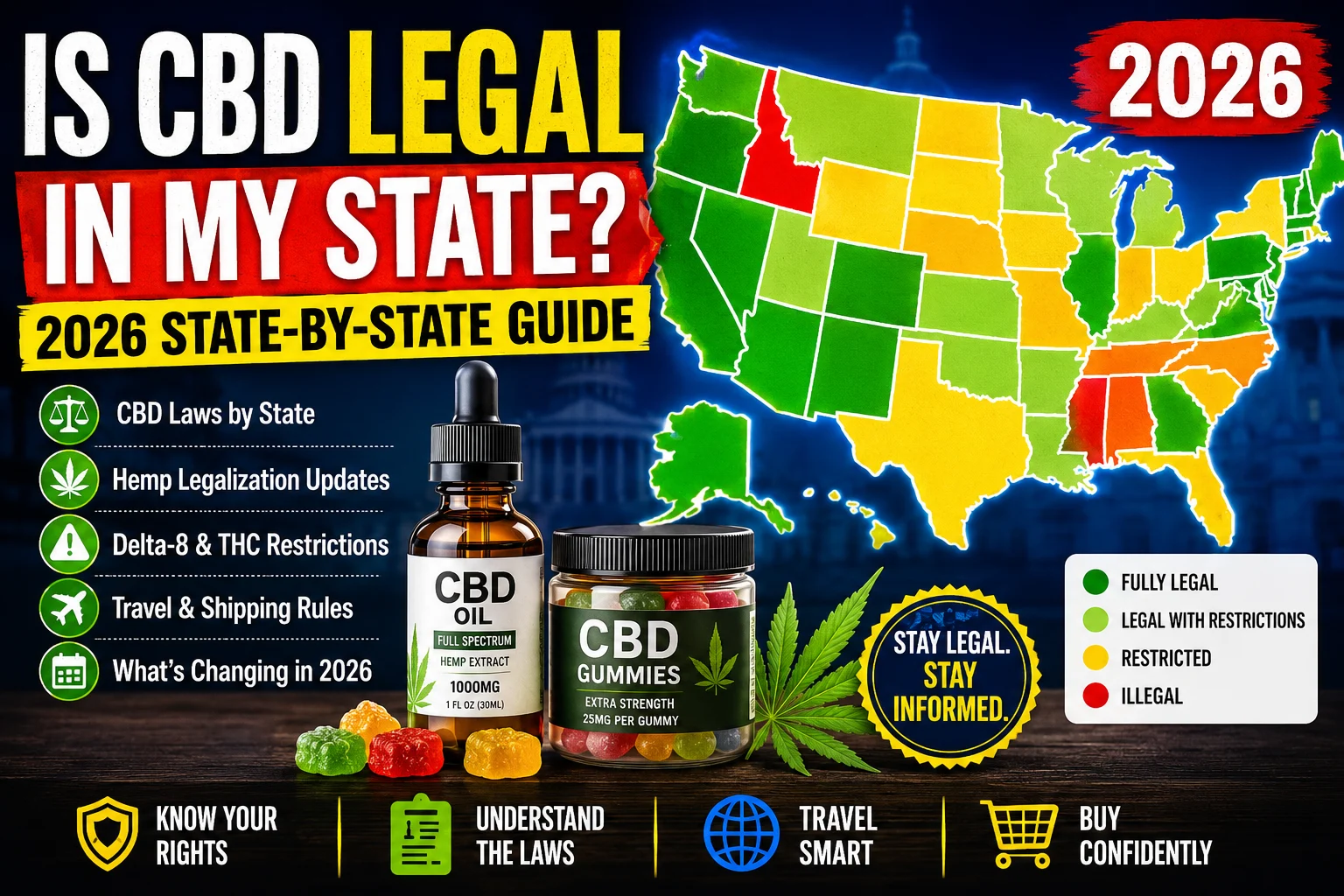
These states generally allow hemp-derived CBD products under current federal guidelines.
CBD-Friendly States
- Florida
- Texas
- Tennessee
- North Carolina
- South Carolina
- Indiana
- Kansas
- Wisconsin
- Pennsylvania
- Nevada
- Illinois
- Virginia
- New Jersey
- New Mexico
In these states, consumers can usually buy:
- CBD gummies
- tinctures
- topicals
- capsules
- hemp drinks
- full-spectrum hemp products
However, intoxicating hemp cannabinoids may still face restrictions.
States Becoming Stricter on Hemp Products
California
California still allows CBD products widely, but the state increasingly restricts intoxicating hemp products sold outside licensed cannabis dispensaries.
That means:
- Delta-8 products face pressure
- THC-infused hemp beverages face scrutiny
- labeling laws are stricter
Colorado
Colorado heavily regulates chemically modified cannabinoids.
Products involving:
- Delta-8 conversion
- synthetic cannabinoid processes
- altered hemp extracts
may face legal problems.
New York
New York has:
- strict testing standards
- labeling rules
- cannabinoid regulations
- retail compliance systems
CBD remains legal, but the state closely monitors hemp sales.
Idaho
Idaho remains one of the strictest states regarding THC.
Many consumers don’t realize:
Full-spectrum CBD may create legal complications in Idaho because of THC traces.
THC-free products are generally safer there.
States Cracking Down on Delta-8 THC
This is where confusion explodes in 2026.
Many consumers think:
“CBD and Delta-8 are basically the same.”
They’re not.
Delta-8 is psychoactive and faces far more legal restrictions.
Several states now heavily restrict or ban:
- Delta-8 THC
- Delta-10 THC
- THC-O
- HHC
- THCA flower
States becoming increasingly strict include:
- Alaska
- Arkansas
- Arizona
- Delaware
- Hawaii
- Rhode Island
This matters because many online “CBD” products secretly contain intoxicating cannabinoids.
State-by-State CBD Legality Guide (2026)
Alabama
CBD is legal if hemp-derived and compliant with THC limits. Intoxicating cannabinoids face tighter rules.
Alaska
CBD is legal, but psychoactive hemp products are more restricted.
Arizona
CBD remains legal, though Delta-8 products face stronger enforcement.
Arkansas
CBD is allowed, but synthetic cannabinoids face heavy restrictions.
California
CBD products remain legal statewide with tighter hemp regulations emerging.
Colorado
CBD is legal, though altered cannabinoids face scrutiny.
Connecticut
CBD is legal under hemp compliance laws.
Florida
Florida remains one of the largest CBD markets in America.
You can still commonly find:
- CBD gummies
- tinctures
- beverages
- sleep formulas
- topical products
throughout the state.
Georgia
CBD remains legal under hemp regulations.
Idaho
THC-free products remain the safest option legally.
Illinois
CBD products remain broadly legal.
Indiana
CBD remains accessible under hemp guidelines.
Kansas
CBD legality depends heavily on THC compliance.
Kentucky
Kentucky continues supporting hemp production and CBD commerce.
Louisiana
CBD is legal but increasingly regulated.
Michigan
CBD is legal, though Delta-8 now falls under stricter cannabis systems.
Minnesota
CBD products remain legal with stronger edible restrictions.
Mississippi
CBD laws continue expanding through hemp programs.
Missouri
CBD remains legal and widely available.
Nevada
CBD is legal and commonly sold statewide.
New Jersey
CBD remains legal while intoxicating hemp restrictions tighten.
New York
CBD is legal with strong compliance regulations.
North Carolina
CBD remains legal under federal hemp standards.
Ohio
CBD remains legal under regulated hemp systems.
Oregon
CBD is legal, though THC-heavy hemp products face scrutiny.
Pennsylvania
CBD remains legal statewide.
South Carolina
CBD remains accessible through hemp retailers.
Tennessee
CBD remains legal, though licensing systems expanded in 2026.
Texas
Texas continues allowing CBD but increased restrictions on smokable hemp products.
Utah
CBD products remain legal with compliance standards.
Virginia
CBD is legal, though THC caps continue tightening.
Washington
CBD remains legal while hemp-derived THC products face restrictions.
Wisconsin
CBD remains legal under federal hemp laws.
Can You Fly With CBD in 2026?
Usually Yes But Be Careful
The TSA generally allows hemp-derived CBD products if they comply with federal THC limits.
But many travelers still make mistakes.
Problems happen when:
- labels are unclear
- THC levels exceed limits
- products resemble marijuana
- users travel internationally
- Delta-8 products are involved
Here’s a smart rule:
If you wouldn’t confidently show the lab report to airport security, don’t travel with it.
Before flying with gummies or tinctures, read How to Travel with CBD: TSA Rules and Tips (2026) to avoid common airport mistakes and TSA confusion.
Can You Order CBD Online Legally?
In most states, yes.

However:
- shipping laws vary
- some cannabinoids trigger restrictions
- certain states block intoxicating hemp products
Before ordering online:
- verify state laws
- check lab testing
- confirm THC content
- review ingredient lists carefully
Many consumers unknowingly buy products containing:
- Delta-8
- THCA
- HHC
- synthetic cannabinoids
thinking they’re standard CBD.
Why Gas Station CBD Is Riskier Than People Think
Cheap CBD products sold in random stores may:
- contain inaccurate THC levels
- fail lab testing
- include contaminants
- violate state laws
This is especially common with:
- vape products
- Delta-8 gummies
- mystery hemp cartridges
That’s why experts recommend buying from transparent brands with:
- third-party COAs
- verified ingredients
- clear cannabinoid breakdowns
Before trusting heavily discounted CBD products, it’s worth reading Are Gas Station Cannabis Products Safe? What You Should Know (2026 Deep Dive Guide) to understand common red flags consumers miss.
The November 2026 Hemp Law Changes Everyone Is Watching
One date has the hemp industry extremely nervous:
November 12, 2026
That’s when stricter federal hemp rules are expected to fully activate.
These changes could:
- shrink the Delta-8 market
- tighten THC calculations
- regulate intoxicating cannabinoids
- impact online shipping
- increase enforcement
Some analysts believe the hemp industry could change more in the next 12 months than it has since the original Farm Bill.
And many companies are already preparing for major product reformulations.
Could CBD Become Illegal Nationwide?
This question appears constantly online.
The answer is:
Probably not.
CBD itself is unlikely to disappear nationwide.
However:
- intoxicating hemp products
- loophole THC products
- converted cannabinoids
face increasing legal pressure.
The future of hemp likely moves toward:
- stricter testing
- lower THC limits
- more regulation
- licensed retail systems
That means clean, compliant CBD products will probably survive long term while gray-area cannabinoids may struggle.
How to Check If Your CBD Is Legal
Before buying any product, ask yourself these questions:
Is It Hemp-Derived?
Federal legality usually depends on hemp sourcing.
Does It Contain THC?
Check:
- Delta-9 THC
- total THC
- cannabinoid percentages
Is It Full-Spectrum?
Full-spectrum products may create legal complications in stricter states.
Does It Include Delta-8 or THCA?
This changes legality dramatically in some areas.
Does the Brand Provide Lab Tests?
Never buy CBD without third-party testing.
The Biggest CBD Mistake Consumers Make
Most people assume:
“If a store sells it, it must be legal.”
That’s not always true.
Some retailers continue selling products in legal gray areas even as state laws tighten.
That’s why informed consumers matter more than ever in 2026.
CBD Legal FAQs
Is CBD legal in all 50 states?
Not exactly. Most states allow hemp-derived CBD, but restrictions vary significantly.
Can CBD contain THC legally?
Yes, if it stays within legal limits. However, some states are stricter than federal law.
Is Delta-8 the same as CBD?
No. Delta-8 is psychoactive and faces far more legal restrictions.
Is full-spectrum CBD legal?
Usually yes, but some states are stricter about THC traces.
Can you travel with CBD?
Generally yes within the U.S., but laws vary by state and country.
Will hemp laws change again?
Almost certainly. The hemp industry is evolving rapidly.
Final Thoughts: Is CBD Legal in Your State in 2026?
For most Americans, hemp-derived CBD remains legal in 2026.
But the details matter more now than ever before.
Here’s the truth:
- not every CBD product is treated equally
- THC rules are tightening
- Delta-8 restrictions are expanding
- states are rewriting hemp laws constantly
The safest approach is buying:
- lab-tested products
- hemp-derived CBD
- compliant THC formulas
- transparent brands
Because in 2026, the biggest risk isn’t just buying bad CBD.
It’s accidentally buying a product your state no longer considers legal.
About the Author