You read something once and understand it. A few days later, you can barely remember it.
Then you see it again.
Suddenly, it feels familiar.
After seeing it several more times—and especially after trying to recall it yourself—the information becomes much easier to remember.
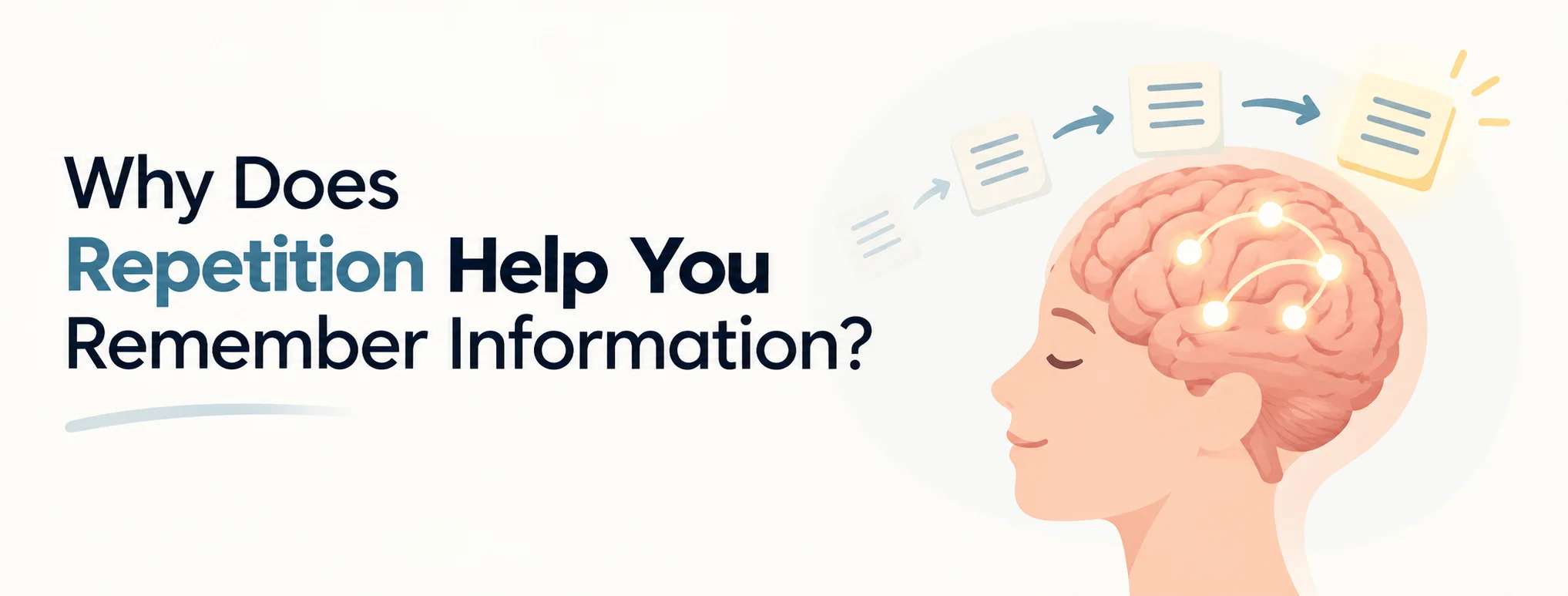
This is one reason repetition helps memory. But repetition isn’t simply a matter of putting the same information in front of your brain over and over again.
How you repeat something, when you repeat it, and whether you actively retrieve it can make a major difference.
Research on learning and memory has consistently found that repeated encounters with information can improve retention, while spacing those repetitions over time and practicing retrieval can make learning more durable.
So why does repetition work?
Quick answer: Why does repetition help you remember?
Repetition can strengthen memory because each encounter gives your brain another opportunity to encode, retrieve, connect, and stabilize information.
But not all repetition is equally useful.
Repeatedly reading the same paragraph five times in a row may make it feel familiar without producing strong long-term recall. In contrast, reviewing information after some time has passed—and trying to remember it before looking at the answer—creates a more demanding form of practice.
This is why spaced repetition and retrieval practice are generally more effective for long-term learning than simply cramming or rereading.
What happens when you learn something for the first time?
When you encounter new information, your brain has to process it before you can remember it later.
Imagine you’re learning the word:
“Mitochondria.”
Seeing the word once doesn’t automatically create a durable memory.
Your brain has to:
- Pay attention to the information
- Process what it means
- Encode it
- Connect it with other knowledge
- Stabilize the memory over time
- Successfully retrieve it later
If you never encounter the information again, some of those processes may be insufficient to make the memory easy to access.
Repetition gives you additional opportunities to process and retrieve the same information.
Repetition gives your brain another chance to encode information
The first time you encounter something, your brain may not process every relevant detail.
You might read a definition but only understand the general idea.
When you encounter it again, you may notice something you missed the first time.
A third encounter might connect it to something you already know.
This means repetition isn’t necessarily creating an identical memory every time.
Each encounter can provide another opportunity for encoding.
That’s particularly useful when information is unfamiliar or complicated.
For example, the first time you learn about working memory, the concept may seem abstract.
After reading about it again, seeing an example, and explaining it yourself, the concept can become easier to understand and retrieve.
Repetition can make information easier to retrieve
One of the most important reasons repetition helps is retrieval.
Remembering isn’t simply about storing information somewhere in the brain.
You also need to be able to access it when you need it.
Suppose you learn a new person’s name.
You hear:
“This is Sarah.”
Later that day, you try to remember her name.
If you successfully retrieve Sarah from memory, you’re practicing retrieval.
If you encounter her again tomorrow and remember her name without being told, you’ve retrieved the same information again.
Repeated successful retrieval can make future retrieval easier.
This is one reason retrieval practice is such an important part of effective learning. Research reviews distinguish retrieval practice from simply restudying information and find substantial benefits for long-term retention.
Repetition isn’t the same as rereading
This distinction is easy to miss.
Imagine you’re studying for an exam.
Method 1: Rereading
You read the same page five times.
By the fifth reading, it feels extremely familiar.
Method 2: Retrieval
You read the page once.
Later, you close the book and ask:
“What were the three main points?”
You try to answer from memory before checking your notes.
Both involve repetition, but they’re not cognitively identical.
The second method requires you to retrieve information, rather than simply recognize it on the page.
That additional retrieval demand is one reason active recall can produce stronger long-term learning than passive rereading.
Why does spaced repetition work better than cramming?
This is one of the most important findings in memory research.
Suppose you have one hour to learn something.
You could spend the entire hour studying it today.
Or you could divide the time across several sessions:
- 20 minutes today
- 20 minutes tomorrow
- 20 minutes several days later
The second approach uses spaced practice.
Research has repeatedly found that repetitions distributed over time can produce better long-term retention than repetitions packed closely together. This is known as the spacing effect.
The interesting part is that spaced learning can sometimes feel harder.
And that’s not necessarily a bad thing.
Why forgetting between repetitions can actually help
Imagine studying a word today and remembering it perfectly ten minutes later.
Then you study it again immediately.
The second encounter may feel effortless because the information is still active.
Now imagine waiting until tomorrow.
You might struggle to remember the word.
That struggle creates an opportunity to retrieve the information again.
Researchers have proposed several mechanisms for why spacing helps, including differences in retrieval difficulty, contextual information and memory consolidation. There isn’t a single universally accepted explanation for every form of the spacing effect.
The important practical finding is more straightforward:
Repeated learning opportunities spaced over time generally produce stronger retention than the same repetitions massed together.
What is the spacing effect?
The spacing effect is the finding that learning tends to improve when repeated study or practice opportunities are distributed over time instead of being concentrated in one session.
For example:
Cramming
Monday:
Study → Study → Study → Study
Spaced practice
Monday:
Study
Wednesday:
Review
Saturday:
Recall
Next week:
Review again
The total amount of practice can be similar, but the timing is different.
Research reviews have found the spacing effect across many types of learning, including verbal information and skills.
Why does cramming feel like it works?
This is where memory can be misleading.
After several repetitions in a single sitting, information can feel extremely familiar.
You might think:
“I know this.”
But familiarity isn’t the same as being able to retrieve the information later.
If you test yourself immediately after studying, you may perform well because the information is still fresh.
Test yourself several days later, and the difference becomes more obvious.
This is one reason effective learning strategies can feel less comfortable than inefficient ones.
Research on spacing and retrieval practice notes that learners often underuse these strategies partly because their benefits can be counterintuitive.
Repetition helps build stronger memory traces—but it’s not simply “making a pathway stronger”
You may have heard the popular explanation that every repetition simply makes a neural pathway stronger.
There is some truth behind the idea that repeated experience can produce lasting changes associated with learning, but the actual biology of memory is more complicated.
Memory depends on coordinated changes across neural systems involved in encoding, consolidation and retrieval.
So it’s better to say:
Repetition provides repeated opportunities for the brain to encode, reactivate and stabilize information.
Rather than:
“Every time you repeat something, the same neural pathway gets stronger.”
The first explanation is more scientifically defensible because different learning tasks involve different neural and cognitive processes.
Repetition and memory consolidation
Learning doesn’t necessarily end when you stop studying.
After information has been encoded, memory can undergo processes that help stabilize it over time.
This is known as memory consolidation.
Spacing repetitions gives the brain time between learning episodes rather than keeping every exposure tightly packed together. Research on spaced repetition has proposed that consolidation and reconsolidation processes may contribute to the long-term benefits of spacing.
This helps explain why studying the same material across several days can be more useful for long-term retention than repeating it continuously for one afternoon.
Repetition can also create stronger connections with what you already know
Information rarely exists in isolation.
Suppose you’re learning about the hippocampus.
The first time you encounter the word, it may simply be a term.
Later, you learn that it’s involved in memory.
Then you learn about its relationship with learning and spatial memory.
Eventually, the word becomes connected to an entire network of concepts.
Repeated exposure can therefore give you additional opportunities to integrate new information with existing knowledge.
And the more meaningful connections you have, the more potential routes you may have for retrieving the information later.
Does repetition always improve memory?
No.
More repetition isn’t automatically better.
Repeating something endlessly in exactly the same way can produce diminishing returns.
For example, if you’ve already memorized a simple fact, reading it another 50 times may add little compared with spending that time retrieving something you haven’t mastered.
The effectiveness of repetition depends on factors such as:
- Timing
- Difficulty
- Attention
- Prior knowledge
- Type of material
- Whether you retrieve the information
- How well the practice matches the eventual task
Research on distributed practice shows that the relationship between repetition, spacing and retention isn’t simply “more repetitions = more memory.” Different spacing intervals and task conditions can produce different outcomes.
Why active repetition works better than passive repetition
Consider two ways of reviewing a fact.
Passive repetition
You read:
“The capital of Australia is Canberra.”
Then read it again.
And again.
Active repetition
You ask yourself:
“What is the capital of Australia?”
You try to answer:
Canberra.
Then you check.
The second method requires your memory to produce the information.
That’s retrieval practice.
A major review in Nature Reviews Psychology identifies retrieval practice and spacing as two well-supported learning strategies and discusses how they work together to improve retention.
Repetition becomes more powerful when you change the context
Repeating information in exactly the same setting isn’t the only way to learn it.
You can also vary how you encounter the information.
For example, if you’re learning a new concept, you might:
- Read about it
- Explain it aloud
- Answer a question about it
- Apply it to an example
- Write a short explanation
- Solve a problem using it
The underlying information is repeated, but the context and retrieval demands change.
This can provide multiple ways of accessing the same knowledge.
Research on distributed practice and repetition has examined the role of contextual variability and study-phase retrieval in explaining why distributed repetitions can improve later memory.
Why repetition helps you remember vocabulary
Learning a new word is a good example of how repetition works.
Suppose you learn:
“Ephemeral = lasting for a very short time.”
Seeing the word once may give you recognition.
Seeing it again may strengthen familiarity.
Using it in a sentence creates another association.
Trying to define it without looking requires retrieval.
Encountering it several days later creates another retrieval opportunity.
Using it correctly in conversation gives you yet another connection.
Instead of one isolated exposure, you now have several different experiences associated with the same word.
That’s much more useful for durable learning.
Why repetition helps with skills, not just facts
Repetition isn’t limited to memorizing information.
You also repeat actions when learning:
- A musical instrument
- A sport
- Typing
- Driving
- A new language
- Mathematical procedures
- Surgical or professional skills
But again, repetition needs to be appropriate to the goal.
If you repeatedly practice the wrong movement, you can become very good at performing it incorrectly.
This is why practice quality matters as much as practice quantity.
Research on distributed practice has found benefits across different types of skill learning, although the size and conditions of those benefits vary by task.
Repetition vs. active recall vs. spaced repetition
These concepts are related but not identical.
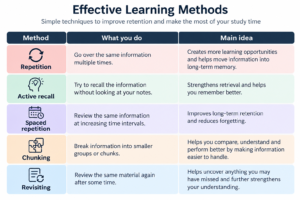
The most effective approach isn’t necessarily choosing one method.
You can combine them.
Repeat + retrieve + space it out.
How often should you repeat something to remember it?
There isn’t one perfect schedule that works for every person, subject or memory.
The ideal interval depends on factors such as:
- How difficult the material is
- How familiar you already are with it
- How long you need to remember it
- How well you can currently retrieve it
- The type of information you’re learning
A practical approach is to review information, then wait long enough that you have to make some effort to retrieve it.
For example:
First exposure → later that day → next day → several days later → next week → later review
These intervals are only a practical example—not a universal formula.
Spaced-learning research shows that the optimal gap depends partly on the desired retention interval and the material being learned.
A simple repetition strategy for studying
If you want to use repetition more effectively, try this:
1. Learn the information
Read or study it carefully the first time.
2. Close your notes
Don’t immediately look back.
3. Retrieve what you remember
Explain the concept or answer questions from memory.
4. Check your answer
Find what you missed.
5. Repeat later
Come back after some time has passed.
6. Increase the gap
As the information becomes easier to retrieve, allow more time between reviews.
7. Keep testing yourself
Don’t rely entirely on rereading.
This combines two of the most strongly supported learning strategies: spacing and retrieval practice.
What if you keep forgetting the same information?
If something refuses to stick, simply repeating it more times may not solve the problem.
Ask:
Did I understand it?
Information that’s poorly understood is harder to remember.
Was I paying attention?
Distraction can interfere with encoding.
Am I trying to retrieve it?
Recognition can create the feeling that you know something even when you can’t recall it independently.
Am I spacing my repetitions?
Repeated exposure in one sitting isn’t the same as spaced practice.
Am I connecting it to anything?
Meaningful associations can provide additional retrieval routes.
Am I sleeping enough?
Sleep is involved in memory consolidation and can influence learning and retention.
If the problem is attention rather than memory itself, simply repeating the material may not address the underlying issue.
Why repetition sometimes makes you feel like you know something when you don’t
This is an important trap.
Imagine you’ve read the same chapter four times.
The words look familiar.
You recognize the explanations.
It feels easy.
Then someone asks:
“Explain the three main ideas without looking.”
Suddenly, it’s much harder.
This difference between recognition and recall explains why familiarity can sometimes be misleading.
Repeated exposure can increase fluency—the feeling that information is easy to process—without guaranteeing that you’ll be able to produce the information independently later.
That’s why testing yourself is such an important complement to repetition.
Does repetition improve long-term memory?
It can, particularly when repetition is distributed over time and involves meaningful retrieval.
Research on spacing has consistently found that distributed repetitions can improve retention compared with massed repetitions, and major reviews identify spacing and retrieval practice as effective strategies for durable learning.
But repetition is only one part of memory.
Attention, encoding, prior knowledge, sleep, interference and retrieval conditions also influence whether information remains accessible.
Repetition and the forgetting curve
After learning something, memory doesn’t remain equally accessible forever.
Without additional exposure or retrieval, access to newly learned information can decline.
This general pattern is often described using the forgetting curve.
The important insight isn’t that everyone forgets at a fixed rate.
People differ, and different materials are forgotten at different rates.
Instead, the forgetting curve helps explain why timing matters:
If you never revisit information, it can become harder to retrieve.
Revisiting it later gives you another opportunity to retrieve and reinforce the knowledge.
This is one reason spaced learning works with—not against—the natural dynamics of forgetting.
Is repetition better than understanding?
Not necessarily.
Understanding and repetition serve different purposes.
If you understand a concept but never revisit it, you may eventually struggle to retrieve it.
If you repeat something without understanding it, you may memorize the surface information without developing a useful mental model.
The strongest learning often combines both:
Understand → retrieve → repeat → apply → revisit
This is particularly important for complex subjects where you need to use knowledge rather than simply recognize it.
What is the difference between repetition and rote memorization?
Rote memorization focuses heavily on remembering information through repeated exposure or rehearsal.
Repetition itself is broader.
You can repeat information while:
- Understanding it
- Retrieving it
- Applying it
- Explaining it
- Connecting it with other knowledge
The latter forms of repetition can create richer learning than simply repeating words until they feel familiar.
How to make repetition more effective
If your goal is long-term memory, focus on these principles:
Space it out
Avoid putting every repetition into one sitting.
Retrieve before reviewing
Try to remember the answer before looking at it.
Use meaningful examples
Connect abstract information to real situations.
Change the context
Practice using the knowledge in different situations.
Focus on difficult material
Spend more time retrieving what you actually forget.
Don’t confuse familiarity with mastery
Ask yourself whether you can produce the information without seeing it.
Give your brain time
Learning and memory are not instantaneous processes. Time between learning episodes can be important for durable retention.
These principles are consistent with the broader research literature on spacing and retrieval practice.
Frequently asked questions
Why does repetition help you remember information?
Repetition gives the brain multiple opportunities to encode and retrieve information. When repetitions are spaced out and involve active retrieval, they can improve long-term retention more effectively than repeated exposure in one sitting.
Is repetition good for memory?
Yes, but the type of repetition matters. Spaced repetition and retrieval practice generally support longer-lasting learning better than simply rereading information repeatedly.
Is repetition better than rereading?
Repeated retrieval is generally more useful for long-term retention than passive rereading alone. Rereading can increase familiarity, but retrieving information without looking requires you to actively access the memory.
How many times do you need to repeat something to remember it?
There is no universal number. The amount of repetition needed depends on the difficulty of the material, your prior knowledge, how well you can retrieve it, and how long you need to remember it.
Why does spaced repetition work?
Spacing repetitions over time can improve long-term retention compared with concentrating the same repetitions together. Several mechanisms have been proposed, including retrieval difficulty, contextual variability, consolidation and reconsolidation.
Does repetition make memories stronger?
Repeated learning and retrieval can improve later access to information, but memory strength is influenced by many factors besides repetition, including attention, meaning, interference and sleep.
Is cramming a form of repetition?
Yes. Cramming involves repeated exposure or practice, but the repetitions are concentrated closely together. It can produce strong short-term performance while generally being less effective for long-term retention than spaced practice.
What is the best way to repeat information?
For long-term learning, a strong approach is to space your reviews and actively retrieve the information before checking the answer. This combines the spacing effect with retrieval practice.
The bottom line
Repetition helps memory because learning isn’t usually a one-time event.
Each encounter with information gives you another opportunity to process it, connect it with existing knowledge, retrieve it and stabilize your memory.
But not all repetition is equally effective.
Reading the same information five times in a row may make it feel familiar. Spreading those repetitions across time and forcing yourself to retrieve the information can create much stronger conditions for long-term retention.
The simplest formula is:
Don’t just repeat it.
Retrieve it. Space it. Use it. Then come back to it later.
That’s what turns repetition from passive exposure into a more effective learning strategy.