
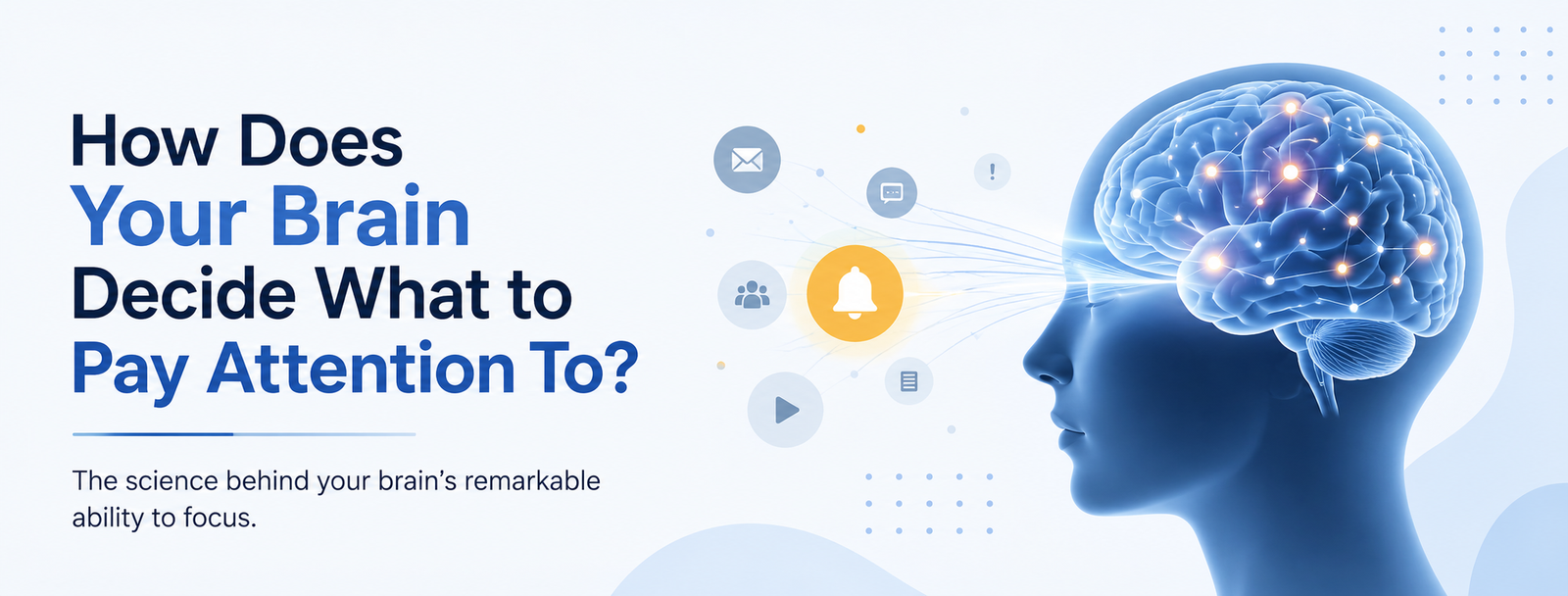
You sit down to work, open your laptop, and start reading. A notification appears. Someone starts talking nearby. Your phone vibrates. Suddenly, the sentence you were reading five seconds ago feels strangely difficult to follow.
Why?
Your brain is constantly receiving information from your surroundings, but it cannot give every signal the same amount of processing power. Instead, it continuously prioritizes some information while reducing the influence of other competing signals.
So, how does your brain decide what to pay attention to?
The short answer is that attention is influenced by a combination of your current goals, expectations, sensory information, memories, and the importance or salience of what is happening around you. This process, often described as selective attention, helps the brain prioritize information that is relevant to what you are trying to see, hear, remember, or accomplish. Research suggests that attention can be directed toward locations, objects, features, and information held in working memory.
Understanding this process can also explain why you sometimes become completely absorbed in a task—and why the same task can feel surprisingly difficult when you are tired, overwhelmed, or surrounded by distractions.
Your Brain Has to Choose What Matters
At any given moment, your senses are delivering a tremendous amount of information.
You may be looking at a screen, hearing traffic outside, feeling the chair beneath you, noticing movement in your peripheral vision, and thinking about something that happened earlier.
Your conscious mind cannot give all of those signals equal priority.
Attention helps solve this problem by selecting and prioritizing information. Neuroscience research describes attention as a mechanism that can increase the processing of information relevant to current behavior while reducing the influence of competing information.
This does not mean that everything outside your focus completely disappears.
Instead, the brain changes the relative priority of different information.
For example, when you are reading an important document, the words on the screen are highly relevant to your immediate goal. Background conversations may still be processed, but they generally receive less attention—until something makes them important enough to compete.
That distinction is central to understanding how the brain pays attention.
How Does Your Brain Decide What to Pay Attention To?
There isn’t a single switch in your brain that decides what you notice.
Instead, attention emerges from interactions among multiple neural systems. These systems respond to both what you want to focus on and what is happening around you.
A useful way to understand this is through two broad influences:
1. Goal-directed attention
You deliberately direct your attention based on what you are trying to accomplish.
If you are looking for your keys, your goal changes what you search for. If you are studying a particular chapter, information related to that topic becomes more relevant.
Research on attentional control suggests that brain systems representing behavioral goals can influence sensory processing, helping prioritize information that matches the task.
2. Stimulus-driven attention
Sometimes something captures your attention without you deliberately choosing it.
A loud crash, sudden movement, flashing notification, or unexpected sound can pull your attention away from your current activity.
This is useful because not every important event can be predicted in advance. Your brain needs a way to respond when something potentially significant changes in the environment.
Modern research therefore views attention as a dynamic interaction between goal-directed selection and incoming information.
What Is Selective Attention?
Selective attention is the ability to prioritize certain information while reducing the influence of competing information.
Imagine sitting in a crowded coffee shop while talking to a friend.
There may be dozens of conversations happening around you. You can hear many of them at some level, but you generally focus on the person speaking directly to you.
Your brain is effectively selecting information relevant to your current goal.
Researchers have studied this process across different sensory domains and found that attention can be directed toward locations, objects, features, and sensory information.
This helps explain why attention is much more flexible than simply “looking at something.”
You can focus on:
- A particular location
- A person’s face
- A specific color
- Someone’s voice
- A particular sound
- A word you’re searching for
- Information you’re holding in working memory
Attention is therefore better understood as a selection system than as a simple mental spotlight.
Your Goals Can Change What You Notice
Consider walking through an airport looking for someone you know.
Before you begin searching, the crowd is simply a collection of people.
But once you know what you’re looking for—perhaps a particular face, hairstyle, or item of clothing—your brain has a target.
Your goal changes the way you process the visual information around you.
Research has found that attentional signals can originate from brain regions associated with behavioral goals and influence sensory areas that process relevant features or objects.
This is one reason the same environment can feel completely different depending on what you are trying to find.
The room hasn’t changed.
Your attentional priorities have.
Your Brain Doesn’t Only Pay Attention to Places
For a long time, scientists paid considerable attention to spatial attention—the process of directing attention toward a particular location.
But your brain can also direct attention toward an object or category.
MIT researchers demonstrated this using overlapping images of faces and houses. Participants were instructed to focus on either faces or houses while their brain activity was measured using magnetoencephalography (MEG).
The research identified interactions involving the inferior frontal junction (IFJ) in the prefrontal cortex and visual areas associated with processing faces and places. The findings provided evidence for a neural circuit involved in shifting attention between different objects.
This is important because it shows that attention isn’t simply:
“Look over there.”
It can also be:
“Find that particular kind of thing.”
Your brain can use information about the target you’re searching for to guide processing toward relevant sensory information.
What Part of the Brain Controls Attention?
There isn’t one single “attention center.”
Attention involves distributed networks that include regions of the prefrontal cortex, parietal cortex, and sensory-processing areas, with different systems contributing depending on the type of task.
The prefrontal cortex is particularly important for higher-level cognitive control. It helps maintain task goals and coordinate information needed to perform an activity.
Parietal regions are also involved in directing and maintaining attention, particularly in relation to spatial selection.
Meanwhile, sensory areas process the information you’re actually seeing, hearing, or otherwise sensing.
The important point is that these systems don’t operate independently.
They communicate and influence one another.
Attention and Working Memory Work Together
Attention isn’t limited to information arriving through your senses.
Your brain can also prioritize information that you are already holding in mind.
Suppose someone tells you a phone number and asks you to remember it for a few seconds. You may mentally repeat the number while ignoring other information.
This involves working memory—the temporary maintenance and manipulation of information—and research suggests that attention and working memory are closely interconnected.
This relationship matters because your current mental goal can influence what information remains important even when the original stimulus is no longer present.
In practical terms, your brain doesn’t just ask:
“What am I seeing right now?”
It can also prioritize:
“What information do I need to keep in mind to complete this task?”
Why Do Distractions Capture Your Attention?
If you can deliberately control attention, why is it so easy to get distracted?
Because your brain has to balance goal-directed control with information arriving from the environment.
Imagine you’re writing an important email when your phone lights up.
Your goal says:
Finish the email.
The unexpected notification says:
Something has changed.
Your attentional system has to determine whether that new information deserves priority.
Some distractions are relatively easy to ignore. Others are much harder because they are unexpected, emotionally significant, highly noticeable, or connected to something you care about.
This competition is a normal part of attention rather than simply a sign of poor discipline. Research describes attention as a dynamic process in which goal-directed and stimulus-driven influences interact.
If you find that your ability to concentrate declines after prolonged mental work, it’s worth distinguishing ordinary attentional limits from broader attention fatigue.
What Is Attention Fatigue? Meaning, Symptoms, Causes & How to Recover
Understanding attention fatigue can provide useful context for why sustained mental demands may eventually make concentration feel more difficult.
Why Is It Sometimes So Hard to Focus?
Distraction isn’t the only reason concentration can become difficult.
Your ability to focus can be influenced by factors such as:
- Sleep and fatigue
- Stress
- Environmental distractions
- Task difficulty
- Motivation
- Competing goals
- Mental workload
- Constant interruptions
- Repetitive tasks
Attention also changes over time. A task that requires sustained concentration can become progressively harder to maintain, particularly when you are tired or repeatedly switching between competing demands.
If you’re interested in the broader reasons concentration can become difficult, see:
Why Is It So Hard to Focus? Causes & Ways to Improve Focus
That article can go deeper into the everyday factors that influence concentration, while this article focuses primarily on the neuroscience behind attentional selection.
What Happens to Attention When You’re Tired?
Sleep is particularly important for sustained attention.
Research examining sleep deprivation has found that inadequate sleep can impair vigilant or sustained attention. In other words, maintaining a consistent level of alertness over time becomes more difficult when you’re sleep deprived.
This can show up in ordinary situations.
You might:
- Reread the same paragraph
- Lose track of a conversation
- Make more mistakes on repetitive tasks
- Struggle to stay engaged during a long meeting
- Find yourself checking your phone more often
That doesn’t mean every concentration problem is caused by poor sleep. Attention is affected by many interacting factors.
But adequate sleep is one of the basic conditions that supports normal cognitive performance.
And if you notice that your focus repeatedly declines after working for an extended period, you may want to explore the specific reasons behind that pattern:
Why Do You Lose Focus After Working for a While? 9 Reasons and How to Fix It
Can You Train Your Brain to Focus Better?
There is no single technique that makes the brain permanently immune to distraction.
However, you can change the conditions in which attention has to operate.
One of the simplest strategies is to reduce unnecessary competition.
Give yourself one clear goal
A specific objective provides your attention with a clear target.
Instead of “work on the project,” try defining the next concrete task you need to complete.
Reduce unnecessary interruptions
Every notification or interruption creates an opportunity for another stimulus to compete with your current goal.
Turning off nonessential notifications can reduce these unnecessary attentional shifts.
Make distractions harder to access
If a distraction is constantly within reach, your brain repeatedly has to decide whether it deserves attention.
Creating physical or digital distance from unnecessary distractions can make sustained work easier.
Work with your energy levels
Demanding cognitive work becomes harder when you’re severely tired. Prioritizing adequate sleep supports sustained alertness and attention.
Take breaks before attention completely collapses
You don’t need to wait until you are completely unable to concentrate before taking a break.
A short pause can give you an opportunity to step away from the task and return with a clearer attentional target.
The goal isn’t to force your brain to focus indefinitely.
It is to create conditions in which focusing on the right thing becomes easier.
Why You Suddenly Notice Things That You Weren’t Looking For
Have you ever bought a particular car and then started noticing the same model everywhere?
Or learned a new word and suddenly heard it several times in the same week?
Your brain hasn’t necessarily started encountering more of those things.
Instead, your expectations and goals can change what information receives priority.
Research into attention shows that goal-related signals can influence sensory processing, while working memory can also help maintain representations of what you’re currently searching for.
Once something becomes relevant, your brain becomes better positioned to detect it.
This is another example of why attention isn’t simply a passive recording of everything around you.
Your brain is constantly selecting.
Attention Is More Than “Trying to Concentrate”
It’s tempting to think of concentration as a matter of willpower.
But neuroscience presents a more complicated picture.
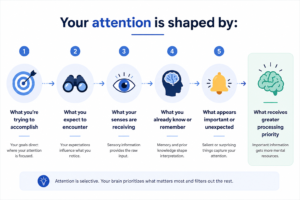
This selection process is happening continuously.
Sometimes you deliberately direct it.
Sometimes something in the environment redirects it.
And sometimes your ability to maintain it is affected by your current cognitive and physical state.
So, How Does Your Brain Decide What to Pay Attention To?
Your brain doesn’t make one simple decision and then stay focused on it.
Instead, attention is a continuous process of prioritization.
Goal-directed systems help you focus on information that supports what you’re trying to accomplish. Sensory and attentional networks process incoming information, while unexpected or salient events can compete for priority. Working memory can also help maintain information that remains relevant to the current task.
Multiple brain regions work together to make this possible.
That is why you can follow one conversation in a crowded room, search for a specific face in a crowd, remember a phone number long enough to use it, or suddenly turn your attention toward an unexpected sound.
The next time you find yourself distracted, it may therefore be more useful to ask:
What is competing for my attention right now?
Your brain isn’t failing simply because something else caught your attention.
It’s doing what it was designed to do: continually deciding which information matters most in the moment.
Frequently Asked Questions
What is selective attention?
Selective attention is the process of prioritizing certain information while reducing the influence of competing information. It can operate across different sensory systems and can be directed toward locations, objects, features, and other relevant information.
What part of the brain controls attention?
There is no single brain region responsible for all forms of attention. Attention involves interacting networks that include areas of the prefrontal and parietal cortex as well as sensory-processing regions.
Why does the brain get distracted?
Distraction can occur when unexpected or salient information competes with your current goal. Attention involves both goal-directed control and responses to incoming environmental information.
Does sleep affect attention?
Yes. Research indicates that sleep deprivation can impair sustained or vigilant attention. Adequate sleep is therefore an important part of maintaining normal alertness and cognitive performance.
Can you improve your ability to focus?
You cannot eliminate every distraction, but you can make sustained attention easier by setting clear goals, reducing unnecessary interruptions, managing your environment, taking appropriate breaks, and getting adequate sleep.
Is attention the same as concentration?
Not exactly. Attention is a broader cognitive process that includes selecting and prioritizing information. Concentration generally refers to maintaining attention on a particular task or source of information over time.
Sources & Further Reading
1. MIT McGovern Institute for Brain Research — How the Brain Pays Attention
MIT researchers describe neural mechanisms involved in shifting attention between different objects, including interactions between the inferior frontal junction and visual-processing areas.2. Yantis, S. — The Neural Basis of Selective Attention
A review of research examining how attentional signals originating from goal-related brain regions influence sensory processing.3. Nobre, K. & van Ede, F. — Attention in Flux
A contemporary review examining attention as a dynamic process involving prioritization, selection, routing, and timing.4. Driver, J. — A Selective Review of Selective Attention Research
A broad review tracing the development of research into selective processing of sensory information.5. Ku, Y. et al. — Selective Attention and Working Memory
Research examining the close relationship between attentional selection and working memory.









One Comment