
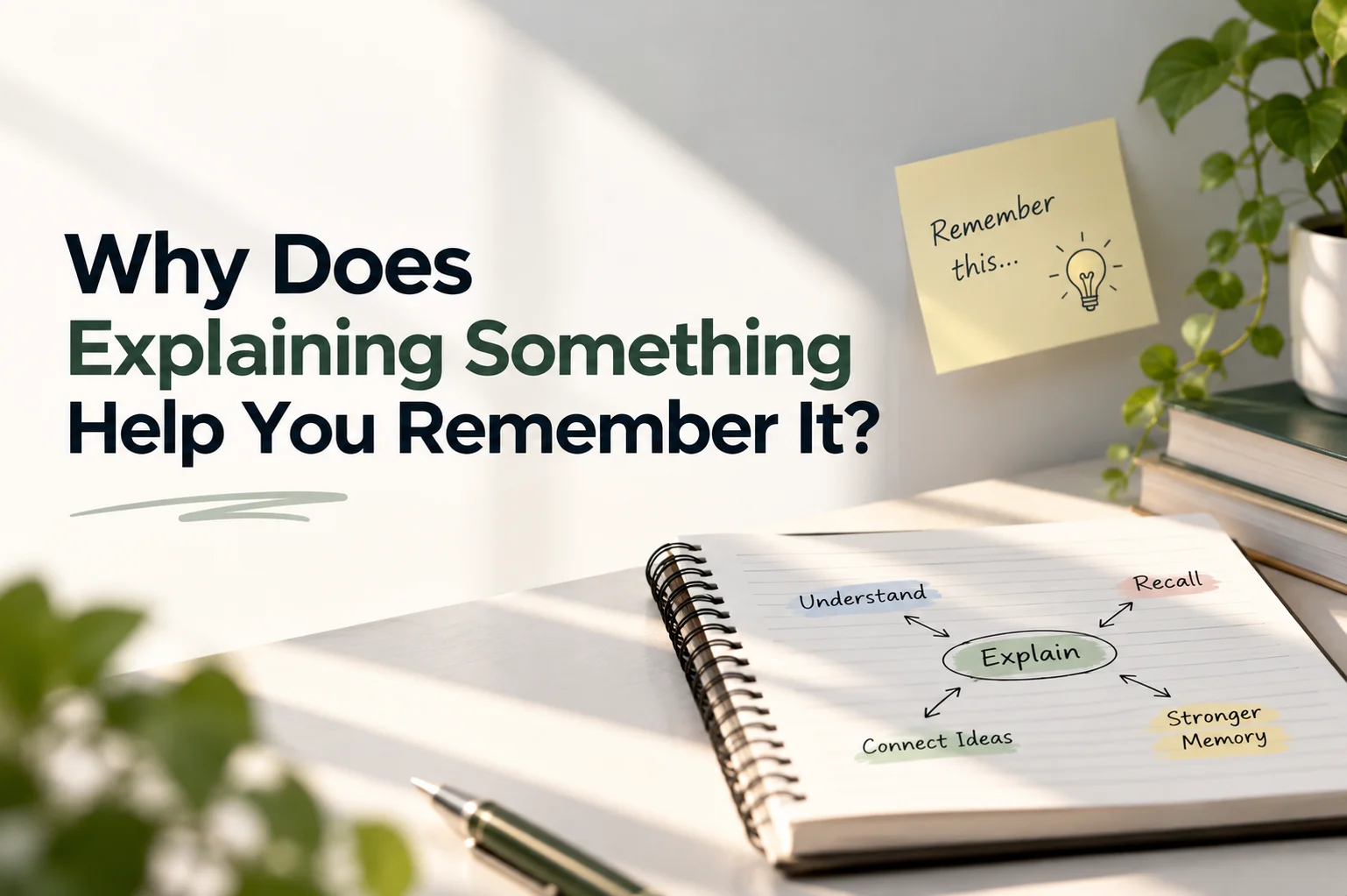
Have you ever tried to study something repeatedly, only to forget it a few hours later? Then, when you explain the same concept to a friend, describe it in your own words, or teach it to someone else, it suddenly becomes easier to remember.
This happens because explaining something makes you do more than simply read or recognize information. It encourages you to retrieve what you know, organize your thoughts, connect ideas, and identify gaps in your understanding.
Instead of allowing information to passively enter your mind, you actively work with it. That extra mental effort can make learning more meaningful and help you remember information for longer.
This technique is often called learning by explaining or learning by teaching. It can be useful for students preparing for exams, professionals learning new skills, and anyone trying to understand a complicated subject.
But why does explaining something help you remember it? And how can you use this technique without spending hours repeating everything you learn?
Let’s explore the science behind it and the practical ways you can put it to use.
Why Does Explaining Something Help You Remember It?
Explaining something improves learning because it encourages several mental processes that support memory. You must recall information, organize it into a logical sequence, connect it with what you already know, and put it into words that make sense.
Research supports this approach. A 2024 study published in Learning and Instruction found that participants who explained a science lesson to themselves or another person performed better on retention tests than participants who simply studied the material again. Explaining to another person also improved performance on tasks that required applying knowledge to new situations.
Read the research on explaining and memory.
Here are the main reasons the technique works.
1. Explaining Forces You to Retrieve Information From Memory
One of the biggest advantages of explaining something is that you must actively recall what you have learned.
When you reread a textbook or highlight a paragraph, the information is already in front of you. Recognizing it can create the feeling that you understand it, even when you would struggle to recall it independently.
Explaining removes that support.
Imagine you have just learned how photosynthesis works. You close your textbook and try to explain the process without looking at your notes.
You might remember that plants use sunlight, but struggle to explain the roles of water, carbon dioxide, and glucose. That struggle reveals which parts of the information you can actually retrieve.
This process is known as retrieval practice. It involves bringing previously learned information back to mind instead of merely reviewing it.
Retrieval practice is valuable because it strengthens your ability to access information later. Research on learning by teaching suggests that the effort involved in recalling information to provide an explanation can be an important part of its learning benefit.
The more you practise retrieving what you have learned, the easier it may become to access that knowledge in a future discussion, assignment, or exam.
How to use it: After studying a topic, close your notes and explain the main idea aloud. Start with what you remember, then check your notes to identify anything you missed.
2. It Helps You Understand Ideas Instead of Memorizing Words
Memorizing a definition and understanding its meaning are two different things.
You might remember a sentence exactly as it appears in a textbook without knowing how to explain it in everyday language. When you try to describe the same idea in your own words, you have to process what it actually means.
This is where explaining becomes particularly useful.
For example, suppose you are learning about inflation. You could memorize the definition: a general increase in the prices of goods and services over time.
But if you try to explain inflation to someone unfamiliar with economics, you might say:
“When prices rise across the economy, the same amount of money buys fewer things than it did before. If your usual grocery shopping costs more but your income stays the same, your purchasing power has fallen.”
This explanation connects the formal definition with a familiar experience.
By translating an idea into language you understand, you move beyond remembering words and begin understanding the relationships behind them.
That distinction matters when you encounter a question phrased differently from the one you studied or need to apply a concept to a new situation.
How to use it: After learning a definition, explain what it means without repeating the original wording. Include an everyday example that demonstrates the concept.
3. It Helps You Connect New Information With Existing Knowledge
New information is often easier to remember when it connects with something you already understand.
Explaining a concept encourages you to build these connections. You may compare it with a familiar experience, relate it to another subject, or identify how one idea leads to another.
Consider learning about how sleep affects memory.
Instead of memorizing isolated facts about sleep, you might explain that sleep supports processes involved in consolidating newly learned information. You could connect this with your own experience of studying something one evening and recalling it more comfortably the following day.
The connection gives the information a meaningful context.
Psychologists often discuss a related process called elaborative encoding. Broadly, it involves adding meaning to new information by connecting it with existing knowledge, examples, and relationships.
Research on self-explanation also suggests that explaining how information makes sense and how different ideas relate can support learning.
However, connections need to be accurate. A familiar comparison can make a concept easier to understand, but an incorrect analogy can also create confusion.
How to use it: When learning something new, ask yourself three questions:
- What does this remind me of?
- How does it connect with something I already know?
- Can I think of a real-world example?
Use your answers to build a short explanation rather than memorizing disconnected facts.
4. It Reveals Gaps in Your Understanding
One of the most useful things about explaining a topic is that it shows you where your knowledge becomes uncertain.
You may feel confident while reading a chapter because the author’s explanation is clear. But when you attempt to explain the same material independently, you might discover that you cannot describe how two steps connect or why a particular result occurs.
This is not a sign that the technique has failed. It is valuable feedback.
For example, imagine you understand that exercise can improve cardiovascular fitness. However, when someone asks how regular exercise affects the heart and circulation, you can explain only part of the process.
You now have a specific learning gap to address.
Instead of rereading the entire chapter, you can revisit the section that explains the mechanism, clarify the confusing part, and attempt your explanation again.
This makes studying more targeted. You spend less time reviewing material you already understand and more time addressing the parts that need attention.
It also helps distinguish between familiarity and mastery. Feeling that something looks familiar is not the same as being able to explain it accurately without assistance.
How to use it: Pay attention to the moments when your explanation becomes vague, repetitive, or incomplete. Write down the exact question you cannot answer, find a reliable explanation, and then try again without looking at the source.
5. It Organizes Information Into a Clear Structure
A good explanation rarely consists of unrelated facts. It usually has a logical sequence.
You might begin with a definition, describe how something works, explain why it matters, and finish with an example. Creating this structure helps you organize what you know.
Suppose you are explaining why plants need sunlight.
Rather than listing facts randomly, you could organize your explanation like this:
- Plants need energy to grow.
- They capture light energy through chlorophyll.
- They use that energy during photosynthesis.
- Photosynthesis helps them produce sugars from carbon dioxide and water.
- Those sugars support growth and other biological processes.
The sequence connects individual facts into a coherent explanation.
This is important because understanding relationships between ideas can make information easier to retrieve. If you forget one detail, the overall structure may help you reconstruct it.
Organizing information can also help you see which facts are central and which are supporting details.
This does not mean every topic needs a complicated outline. Often, a simple explanation of what something is, how it works, and why it matters is enough to create a useful structure.
How to use it: Arrange your explanation around three questions: What is it? How does it work? Why does it matter?
6. Teaching Encourages You to Think From Another Person’s Perspective
Explaining something to another person introduces an additional challenge: you must consider what the listener already knows and what they might find confusing.
You cannot assume that the other person understands the terminology or the steps that seem obvious to you.
You have to make decisions about what to explain, which examples to use, and how to present the information in a way that makes sense.
This encourages you to examine the topic more carefully.
A 2022 review published in Frontiers in Psychology examined the role of retrieval practice in learning by teaching. It discussed how learners may benefit from having to recall information and develop explanations for someone else. The review also highlighted that the benefits depend on how the explaining activity is carried out; teaching is not automatically more effective in every situation.
Read the review on learning by teaching.
You do not need a real audience to benefit from this approach. You can pretend that you are teaching a beginner, record yourself explaining a concept, or write an explanation for someone unfamiliar with the subject.
The key is to make the explanation clear, accurate, and understandable rather than simply repeating what you read.
How to use it: Imagine explaining the topic to a curious 12-year-old. Avoid unnecessary jargon, define unfamiliar terms, and use examples to make difficult ideas easier to follow.
7. Explaining Helps You Apply What You Have Learned
Remembering a fact is useful, but understanding how to apply it is often even more valuable.
Suppose you have learned the formula for calculating percentage change. You might remember the formula well enough to reproduce it in an exam.
However, explaining why the formula works and walking through a practical example helps you understand when and how to use it.
The same principle applies to professional skills, scientific concepts, language learning, and everyday problem-solving.
When you explain an idea, you often have to describe the conditions under which it works, the steps involved, and the reasons behind the outcome. This can help you transfer your knowledge to situations that look different from your original learning material.
Research comparing explaining activities with simple restudying has found benefits for both retention and transfer in some settings. The size of the benefit depends on the task and the way the explanation is produced.
How to use it: After explaining a concept, create a new example that was not included in your notes. Explain how the concept applies to that example and why.
How to Use the Explain-to-Remember Technique
You do not need to become a teacher or spend hours writing detailed explanations. A simple routine can help you incorporate this technique into your existing study habits.
Step 1: Learn the Topic First
Read a short section, watch a lesson, or study a specific concept. Make sure you have enough initial understanding to begin explaining it.
You do not need to master every detail before moving forward.
Step 2: Put Your Notes Away
Close the textbook or switch away from the lesson. Removing the original material encourages you to retrieve information independently.
If you get stuck, resist the urge to check immediately. Try to recall the idea first.
Step 3: Explain It in Your Own Words
Speak aloud or write a short explanation as though you were helping a beginner understand the topic.
Focus on the main idea, how it works, why it matters, and a practical example.
Avoid simply reciting memorized sentences.
Step 4: Identify What You Could Not Explain
Notice where you hesitate, skip steps, or rely on vague statements.
Ask yourself whether you genuinely understand the concept or are just familiar with its terminology.
Make a short list of the questions that remain unanswered.
Step 5: Check Your Explanation Against a Reliable Source
Return to your notes or textbook and correct any mistakes. Add the missing information, but avoid copying entire paragraphs without processing them.
The goal is an accurate explanation that makes sense to you.
Step 6: Explain It Again Without Help
Try a second explanation using what you have learned from checking your work.
Aim for clarity rather than perfection. You should be able to describe the core idea and its important relationships without depending entirely on your notes.
Step 7: Review It Again Later
Do not assume that one successful explanation guarantees long-term memory.
Return to the topic after a delay, such as the following day, and attempt to explain it again. Review it again over subsequent days if the information is important.
Combining explanation with spaced review and retrieval practice can make your learning routine more effective than relying on one long study session.
The Best Ways to Explain Something for Better Memory
Different explanation methods can work in different situations. Choose the one that makes you actively recall and process the information.
| Method | How to use it | Best for |
|---|---|---|
| Explain aloud | Describe the topic without looking at your notes | Quick revision and checking understanding |
| Teach someone | Walk another person through the concept and answer questions | Complex topics and identifying unclear steps |
| Record yourself | Give a short explanation, then listen for gaps or errors | Practising presentations and verbal explanations |
| Write a short summary | Reconstruct the main idea in your own words | Organizing information and creating revision notes |
| Use the Feynman technique | Explain simply, identify gaps, review, and explain again | Making difficult concepts easier to understand |
The Feynman technique is a popular practical method built around explaining ideas in simple language and identifying gaps in understanding. It is not a guarantee of mastery, but it can provide a useful structure for active learning.
For more demanding topics, you can combine these approaches. For example, explain a concept aloud, write down the parts you struggled with, and return to the material for a focused review.
Does Explaining Something Work Better Than Rereading?
Explaining can be more useful than rereading when your goal is to test whether you can recall and understand information independently.
Rereading has a place in learning. It can introduce unfamiliar material, clarify mistakes, and help you notice details you missed earlier.
The problem arises when rereading becomes your only study method.
Repeated exposure can make information feel familiar without showing whether you can retrieve it or apply it. Explaining requires you to produce an answer instead of simply recognizing one.
Research on learning by explaining supports its usefulness in many contexts, but the results are not identical across all studies. The format matters: explaining aloud, explaining to another person, writing an explanation, and simply repeating a passage are not necessarily equivalent activities.
The strongest practical approach is to use both methods for different purposes:
- Reread to understand: Use the source to learn the topic and clarify unfamiliar ideas.
- Explain to test yourself: Close the source and reconstruct the information.
- Review to correct mistakes: Check what you missed and improve your explanation.
- Retrieve again later: Revisit the topic after a delay to strengthen recall over time.
In other words, do not stop reading altogether. Use reading to build understanding and explaining to check whether that understanding is available when you need it.
Common Mistakes to Avoid When Using This Technique
Explaining is useful, but a few mistakes can reduce its effectiveness.
1. Reading While Pretending to Explain
If you keep your notes open and simply turn sentences into slightly different words, you may not be testing your independent recall.
Try to explain the core idea from memory first. Use your notes afterward to check accuracy.
2. Making the Explanation Too Complicated
Using technical terminology does not automatically mean you understand a subject well.
Start with a simple explanation, then add technical details where they are necessary. If you cannot explain the basic idea clearly, identify which part needs further study.
3. Ignoring Incorrect Explanations
A confident explanation can still be wrong. If you invent a connection or rely on an inaccurate analogy, you may reinforce a misunderstanding.
Check important claims against reliable textbooks, course materials, or credible research sources.
4. Explaining Once and Never Reviewing
A successful explanation demonstrates what you can retrieve at that moment. It does not prove that you will remember everything weeks later.
Schedule another attempt after a delay, especially for material you need to retain long-term.
5. Spending Too Much Time Perfecting Your Words
The goal is not to deliver a flawless lecture. It is to identify what you understand, what you do not understand, and how the ideas connect.
A short, accurate explanation followed by a focused review may be more useful than spending an hour polishing a long summary.
What If You Struggle to Focus While Studying?
Explaining a topic requires attention. If your mind keeps wandering, you may find it difficult to recall what you have learned or organize your thoughts into a clear explanation.
Start with a smaller section instead of trying to explain an entire chapter. Put your phone away, remove unnecessary distractions, and work in a short, manageable session.
If your concentration regularly fades after working for a while, read our guide on why you lose focus after working for a while to explore possible reasons and practical ways to manage them.
It can also help to recognize when you are mentally exhausted rather than simply unmotivated. Our article on signs you need a mental break discusses common signs that you may need to step away and recharge.
The important thing is to adapt your learning method to your current capacity. A clear, five-minute explanation can be more productive than forcing yourself through a long session when you cannot concentrate.
Frequently Asked Questions
1. Why does explaining something help you remember it?
Explaining encourages active recall, helps you organize information, and connects new ideas with existing knowledge. It also reveals gaps in your understanding, giving you a chance to correct them. These processes can make information easier to retrieve and apply later.
2. Is explaining something better than reading it repeatedly?
Explaining can be more effective for checking understanding and practising recall because you must produce information independently. Reading remains useful for learning unfamiliar material and correcting errors. Combining reading, explaining, feedback, and spaced review is a practical approach to learning.
3. Do you have to explain something to another person to remember it?
No. You can explain a concept aloud to yourself, record a short audio explanation, or write it in your own words. Research has found benefits from both self-explanation and explaining to others in certain learning settings, although their effects can vary depending on the task and method.
4. How often should you explain a topic to remember it?
Start by explaining the topic after learning it, then try again after a delay, such as the following day. Continue reviewing at spaced intervals based on how well you can recall the information and how long you need to retain it. There is no single schedule that works best for every topic.
Final Thoughts
Explaining something helps you remember it because it changes the way you interact with information. Instead of passively reviewing words, you actively retrieve ideas, organize them, connect them with what you already know, and identify what still needs work.
You do not need to explain every detail perfectly. In fact, the moments when you struggle to describe a concept can be among the most useful parts of the process because they show you where further learning is needed.
The next time you study something important, try this simple experiment: close your notes and explain the main idea in your own words. Check what you missed, correct your understanding, and try again later.
If you can explain an idea clearly without relying on your notes, you have a much better indication of what you truly understand—and what you may be able to remember when you need it.