A NexGen Extracts Consumer Education & Safety Guide
Delta-9 THC is the reference point for nearly every cannabis conversation. Whether people are comparing Delta-8, THCA flower, HHC, or emerging cannabinoids, Delta-9 remains the benchmark for potency, psychoactivity, and overall experience.
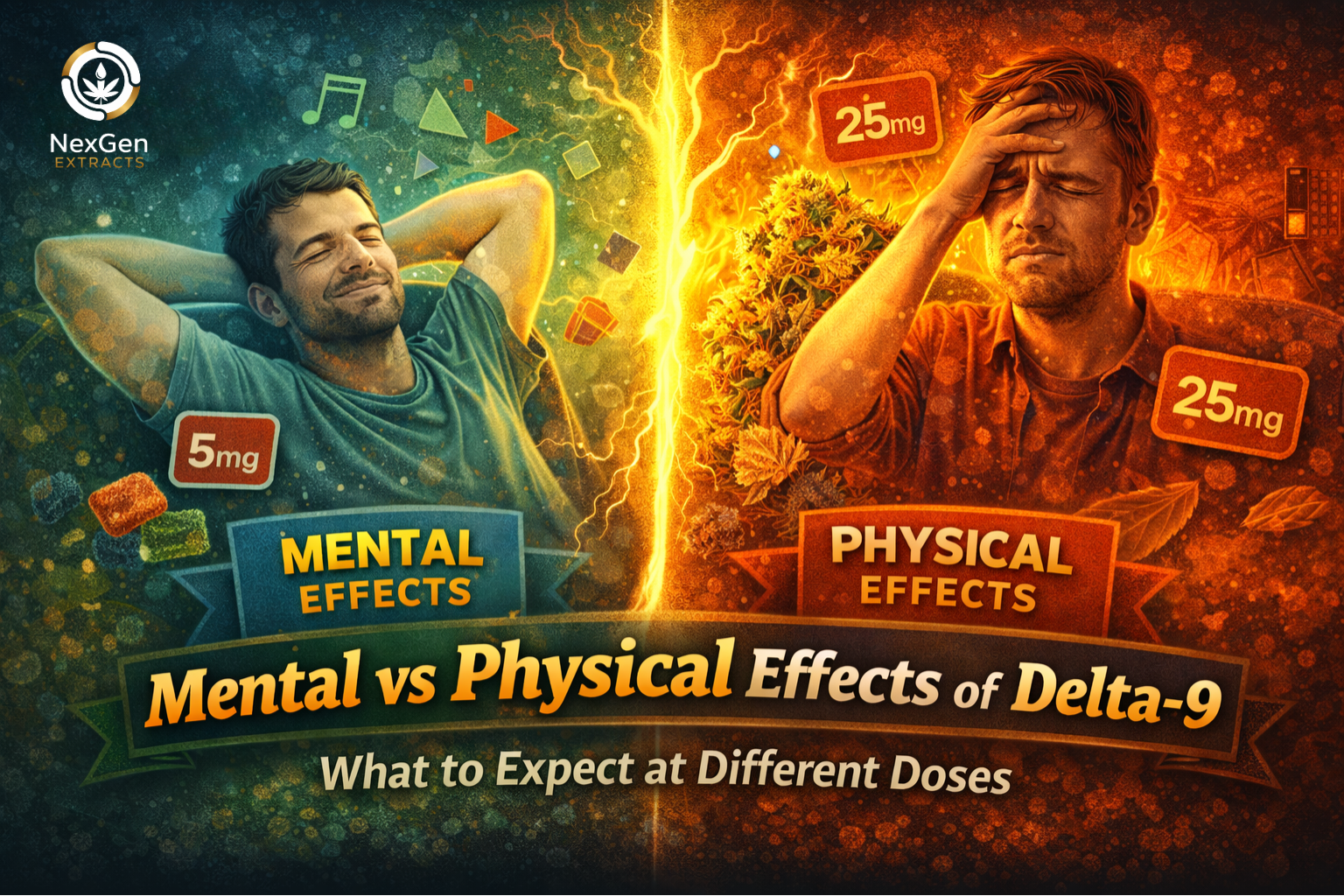
Yet most misunderstandings around Delta-9 do not come from the compound itself. They come from dose confusion. At low doses, Delta-9 can feel calm and functional. At higher doses, it can become mentally intense, physically heavy, or uncomfortable. The difference is not subtle—it is structural.
This guide breaks down mental vs physical effects of Delta-9 THC at different dose ranges, explains how those effects compare to other cannabinoids, places Delta-9 within the wider market, and clarifies who should avoid THCA flower due to higher risk.
What Delta-9 THC Does in the Body (Plain English)
Delta-9 THC interacts primarily with CB1 receptors in the brain and nervous system. These receptors influence:
- mood
- perception
- memory
- coordination
- stress response
- appetite
Because CB1 receptors are concentrated in both the brain and body, Delta-9 affects mental and physical states simultaneously. Which side dominates depends largely on dose, tolerance, and individual sensitivity.
Low Dose Delta-9: Subtle Mental Shift, Light Physical Ease
Low doses are often misunderstood because they do not match social-media stereotypes of being “high.”
Mental effects at low doses
- mild mood uplift
- reduced mental tension
- increased sociability
- clearer emotional perspective
- gentle creativity
Many users describe low-dose Delta-9 as feeling like “mental exhale” rather than intoxication.
Physical effects at low doses
- slight muscle relaxation
- softened body awareness
- reduced physical stress
- minimal coordination impairment
At this range, mental effects usually outweigh physical ones. People often remain functional, conversational, and alert.
Who prefers this range:
- professionals
- social users
- experienced consumers seeking control
- individuals sensitive to THC
Moderate Dose Delta-9: Balanced Mind-Body Shift
This is the range most people think of when they imagine cannabis effects.
Mental effects at moderate doses
- noticeable euphoria
- enhanced sensory perception
- altered time awareness
- deeper introspection
- emotional amplification
Thoughts may feel more abstract or nonlinear. Focus shifts inward, and external stimuli (music, visuals, conversation) feel richer.
Physical effects at moderate doses
- deeper muscle relaxation
- warmth or heaviness in limbs
- increased appetite
- slower reaction time
At this level, mental and physical effects are balanced. This is where Delta-9 feels immersive but still manageable for most experienced users.
Who prefers this range:
- evening users
- creative activities
- social relaxation
- people with established THC tolerance
High Dose Delta-9: Physical Dominance and Mental Overload
High doses are where Delta-9’s reputation becomes polarized.
Mental effects at high doses
- racing or looping thoughts
- anxiety or paranoia
- confusion or disorientation
- impaired short-term memory
- emotional sensitivity
For some users, the mind becomes overstimulated rather than relaxed.
Physical effects at high doses
- strong body heaviness
- couch-lock sensation
- impaired coordination
- dizziness or nausea
- fatigue or sedation
At high doses, physical effects often overpower mental enjoyment. The experience can feel overwhelming rather than pleasant, especially in unfamiliar environments.
Who often struggles at this range:
- new users
- people with anxiety sensitivity
- those expecting relaxation but encountering intensity
Why Dose Changes the Experience So Dramatically
Delta-9 does not scale linearly. Small increases can create disproportionate changes in effect.
Key factors include:
- individual endocannabinoid balance
- metabolism speed
- product format (edibles vs inhalation)
- tolerance level
- emotional state at time of use
This is why “one person’s perfect dose” can be another person’s uncomfortable experience.
Mental vs Physical Effects: Edibles vs Inhalation
Inhaled Delta-9 (smoking or vaping)
- faster onset
- easier dose control
- mental effects appear first
- physical effects build gradually
Edible Delta-9
- delayed onset
- stronger body effects
- longer duration
- harder to correct overconsumption
Edibles often shift the experience toward the physical side, especially at moderate to high doses.
Delta-9 Compared to Other Cannabinoids
Understanding Delta-9 is easier when viewed alongside alternatives.
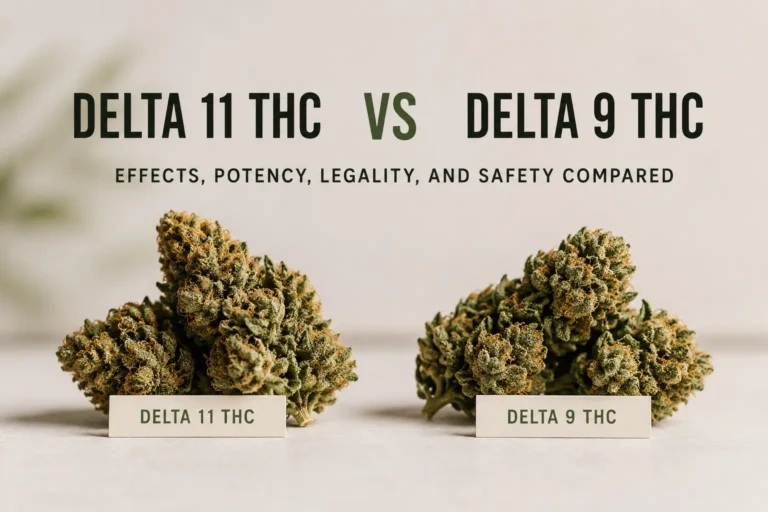
Delta-9 vs Delta-8
- Delta-9: stronger mental effects, higher intensity
- Delta-8: smoother, more body-focused, less head pressure
Delta-8 is often preferred by users who dislike Delta-9’s mental intensity.
Delta-9 vs THCA Flower
- raw THCA is non-intoxicating
- heated THCA converts into Delta-9 THC
- effects after heating can feel similar or identical
This makes THCA flower particularly risky for certain groups.
Delta-9 vs CBD
- CBD does not intoxicate
- CBD often reduces mental stimulation
- Delta-9 produces noticeable psychoactive effects
CBD is often chosen by people who want physical calm without mental alteration.
Who Should Avoid THCA Flower (High-Risk Groups)
Because THCA flower converts into Delta-9 THC when heated, it carries many of the same risks, sometimes without users realizing it.
People who should avoid THCA flower entirely
- individuals with a history of psychosis or schizophrenia
- people with severe anxiety or panic disorders
- pregnant or breastfeeding individuals
- those with serious heart conditions
- adolescents and young adults with developing brains
People who should use extreme caution
- individuals taking prescription medications
- people highly sensitive to THC
- first-time cannabinoid users
- those with mood instability
THCA flower is often misunderstood as “safe because it’s legal,” which can lead to accidental overexposure.
Delta-9’s Place in the Wider Cannabinoid Market
Delta-9 remains:
- the most studied cannabinoid
- the standard reference for potency
- the basis for legal cannabis markets
Other cannabinoids—Delta-8, HHC, THCA, THCP—are often defined in relation to Delta-9 rather than on their own terms.
As the market matures, consumers increasingly choose cannabinoids based on desired effect profile, not hype.
Choosing the Right Experience: Practical Guidance
- If you want mental clarity with mild relaxation, low-dose Delta-9 or Delta-8 may be appropriate.
- If you want balanced immersion, moderate Delta-9 fits best.
- If you want heavy physical relaxation, higher doses may deliver—but with increased risk.
- If you want no intoxication, CBD remains the safest option.
Understanding dose prevents disappointment and discomfort.
Why Education Matters More Than Potency
Most negative Delta-9 experiences are not caused by the cannabinoid itself, but by:
- poor dose awareness
- unrealistic expectations
- misunderstanding edible onset
- ignoring personal sensitivity
Education transforms Delta-9 from unpredictable to intentional.
Final Thoughts
Delta-9 THC is neither purely mental nor purely physical—it is both, with dose acting as the dial that shifts dominance. At low doses, it can feel light and functional. At moderate doses, immersive and balanced. At high doses, physically heavy and mentally intense.
THCA flower complicates this landscape because it can deliver Delta-9-like effects under a different name and legal framework, increasing risk for vulnerable groups.
At NexGen Extracts, informed consumption starts with understanding how dose shapes experience. When expectations align with reality, Delta-9 becomes a tool rather than a gamble—and safety becomes part of the culture, not an afterthought.
About the Author