If you’ve recently come across Delta 11 THC products, you’re probably asking the same questions many cannabis consumers are asking:
What is Delta 11 THC? Is Delta 11 stronger than Delta 9? And is it even a real cannabinoid or just another marketing term?
The growing popularity of hemp-derived cannabinoids has introduced consumers to compounds beyond traditional Delta-9 THC. While Delta-8 and HHC have become relatively familiar names, Delta 11 THC remains one of the most misunderstood cannabinoids on the market.
Part of the confusion comes from the fact that Delta 11 is often discussed alongside 11-hydroxy-THC, a powerful THC metabolite produced by the body. Some brands use these terms interchangeably, while others describe them as completely different compounds. As a result, many consumers struggle to understand what they’re actually buying.
Delta 11 THC is often marketed as a more potent alternative to Delta-9 THC, but research remains limited. Delta-9 THC is the primary psychoactive cannabinoid in cannabis, while Delta 11 products are typically hemp-derived formulations associated with stronger body-focused effects. Whether Delta 11 is stronger than Delta 9 depends on the product, dosage, and individual response.
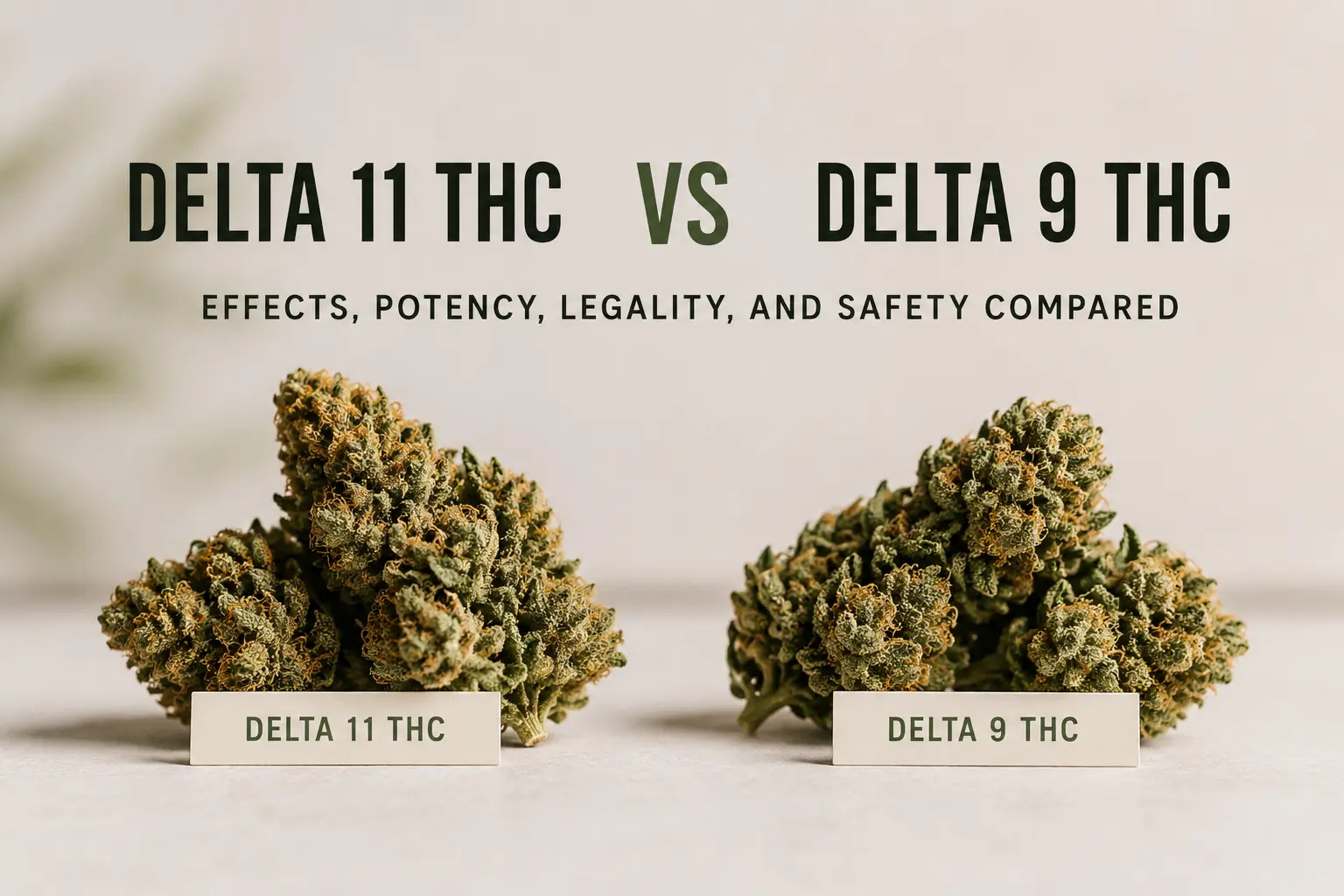
In this guide, we’ll break down the differences between Delta 11 vs Delta 9, explain the relationship between delta 11 thc and 11 hydroxy thc, compare their effects, potency, legality, and safety, and help you understand which experience may be right for you.
Delta 11 THC vs Delta 9 THC at a Glance
| Feature | Delta 11 THC | Delta 9 THC |
|---|---|---|
| Psychoactive? | Yes | Yes |
| Potency | Often reported as very strong | Industry standard |
| Research | Limited | Extensive |
| Drug Test Risk | High | High |
| Natural Occurrence | Trace amounts | Abundant |
| Legal Status | State-dependent | State-dependent |
| Best For | Experienced users | Most cannabis consumers |
What Is Delta 11 THC?
One of the biggest misconceptions in the cannabinoid industry is that Delta 11 THC is a naturally abundant cannabinoid found in cannabis plants.
In reality, delta 11 occurs in extremely small quantities and is rarely found in meaningful concentrations naturally. Most commercial Delta 11 products are created through cannabinoid conversion processes involving hemp-derived cannabinoids.
Because research on Delta 11 remains limited, there is still much scientists do not know about its pharmacology, long-term safety profile, and exact interaction with the body’s endocannabinoid system.
What we do know is that users frequently report Delta 11 products producing:
- Strong psychoactive effects
- Deep physical relaxation
- Longer-lasting experiences
- Higher perceived potency than Delta-8 THC
- Intense body sensations
These reports have fueled interest among consumers looking for an alternative to traditional Delta-9 products.
Wait, Is Delta 11 the Same Thing as 11-Hydroxy-THC?
This is where most consumers get confused.
If you’ve searched for what is delta 11, you’ve probably encountered references to:
- 11 hydroxy thc
- 11-hydroxy-thc
- 11 hydroxy delta 9 thc
While the names sound similar, they are not exactly the same thing.
Understanding 11-Hydroxy-THC
11-Hydroxy-THC is a metabolite created when your liver processes Delta-9 THC.
For example:
- You consume a THC edible.
- The edible passes through your digestive system.
- The liver converts Delta-9 THC into 11-hydroxy-delta-9-thc.
- This metabolite enters the bloodstream and crosses the blood-brain barrier efficiently.
This conversion is one of the main reasons THC edibles often feel much stronger than smoking or vaping cannabis.
Many experts believe that the intense effects associated with edibles are largely driven by the production of 11 hydroxy thc rather than Delta-9 THC itself.
Why Are So Many People Searching “Is Delta 11 Stronger Than Delta 9?”
The short answer is:
It depends on whether you’re referring to Delta 11 THC products or 11-hydroxy-THC.
When discussing 11-hydroxy-thc, most researchers agree that it produces stronger psychoactive effects than Delta-9 THC because it is metabolized differently and may cross into the brain more effectively.
This is why a 10mg THC edible can sometimes feel significantly stronger than a 10mg THC vape.
When discussing commercial Delta 11 products, user reports often suggest stronger effects than Delta-8 THC and, in some cases, effects comparable to Delta-9 THC. However, scientific research remains limited, making definitive potency comparisons difficult.
Delta 11 vs Delta 9: Key Differences at a Glance
| Feature | Delta 11 THC | Delta 9 THC |
|---|---|---|
| Natural Abundance | Extremely rare | Primary cannabinoid in cannabis |
| Research Available | Limited | Extensive |
| Psychoactive Effects | Strong, body-focused | Balanced mental and physical effects |
| Consumer Awareness | Emerging | Well-established |
| Product Availability | Growing | Widely available |
| Scientific Understanding | Limited | Decades of research |
While Delta-9 remains the benchmark cannabinoid, Delta 11 products continue gaining popularity among consumers seeking stronger or more novel experiences.
Will Delta 11 THC Show Up on a Drug Test?
One of the most common concerns among consumers comparing delta 11 vs delta 9 is whether Delta 11 can trigger a positive drug test result.
The short answer is yes.
Most workplace and standard drug tests are not designed to identify specific THC variants. Instead, they look for THC metabolites that the body produces after processing cannabinoids. Because Delta 11 THC products can be psychoactive and are metabolized similarly to other THC compounds, using them may result in a positive drug test.
This is an important point for consumers who assume that hemp-derived cannabinoids are automatically drug-test safe. In reality, the source of the cannabinoid matters far less than how your body processes it.
If you’re subject to workplace testing, athletic screening, military requirements, or legal compliance programs, it’s safest to assume that both Delta 11 THC and Delta 9 THC could trigger a positive result.
Key Takeaways
- Delta 11 THC may show up on a drug test.
- Most tests detect THC metabolites rather than specific cannabinoids.
- Hemp-derived does not mean drug-test safe.
- If passing a drug test is important, avoid psychoactive THC products altogether.
How Does Delta 11 THC Interact With the Endocannabinoid System?
To understand the differences between Delta 11 THC and Delta 9 THC, it helps to understand how cannabinoids work inside the body.
Humans have a complex cell-signaling network known as the endocannabinoid system (ECS). This system plays an important role in regulating mood, sleep, appetite, memory, stress response, pain perception, and overall balance within the body.
The ECS contains two primary receptor types:
CB1 Receptors
CB1 receptors are found primarily in the brain and central nervous system. These receptors are largely responsible for the psychoactive effects associated with THC products, including euphoria, altered perception, relaxation, and intoxication.
CB2 Receptors
CB2 receptors are found throughout the immune system and peripheral tissues. They are more commonly associated with inflammation, immune function, and overall physiological regulation.
When cannabinoids enter the body, they interact with these receptors in different ways. Delta-9 THC is known to bind strongly to CB1 receptors, which is why it produces noticeable psychoactive effects.
Researchers believe Delta 11 THC may also interact with CB1 receptors, although the exact mechanisms are not yet fully understood due to limited scientific data. This uncertainty is one reason why more research is needed before scientists can accurately compare Delta 11 THC and Delta 9 THC at a molecular level.
Understanding the role of the endocannabinoid system helps explain why different cannabinoids can produce unique effects, even when they share similar chemical structures.
Concerned About Potency? Here’s How Delta 11 and Delta 9 Feel Different
For many users, potency isn’t just about how “high” they get.
It’s about:
- How quickly effects begin
- How long they last
- Whether the experience feels uplifting or sedating
- How functional they remain throughout the experience
Delta 9 THC Effects
Delta-9 THC is often associated with:
- Euphoria
- Creativity
- Enhanced sensory perception
- Mood elevation
- Increased appetite
- Social stimulation
Depending on the strain and dosage, Delta-9 can feel energizing, relaxing, or somewhere in between.
Delta 11 THC Effects
Consumers commonly describe Delta 11 THC as:
- More physically relaxing
- Heavier on the body
- Longer lasting
- More sedating
- Potentially overwhelming at higher doses
Many users compare the experience to a strong indica-like effect, although individual experiences vary significantly.
Why Do Edibles Sometimes Feel Much Stronger Than Smoking Delta 9?
This question leads directly back to 11 hydroxy delta 9 thc.
When Delta-9 THC is inhaled, it enters the bloodstream directly through the lungs.
When consumed as an edible, the liver transforms part of that THC into 11-hydroxy-THC, a metabolite believed to produce more intense and longer-lasting psychoactive effects.
As a result:
- Smoking may peak within minutes.
- Edibles may take 30–120 minutes to activate.
- Edibles often last significantly longer.
- Edibles frequently feel stronger despite containing similar THC amounts.
Understanding this distinction helps explain why discussions about Delta 11 and 11-hydroxy-THC often become intertwined.
What Does Current Research Say About Delta 11 THC?
As interest in hemp-derived cannabinoids continues to grow, many consumers are looking for scientific answers about Delta 11 THC. Unfortunately, one of the biggest challenges is the lack of published research specifically focused on this cannabinoid.
Unlike Delta-9 THC, which has been studied for decades, Delta 11 THC remains relatively unexplored in scientific literature. Researchers still have limited information regarding its pharmacology, long-term safety profile, metabolism, and potential therapeutic applications.
Currently, much of what consumers know about Delta 11 comes from anecdotal reports, manufacturer descriptions, and comparisons to other cannabinoids. While these experiences can provide useful insights, they should not be considered a substitute for controlled clinical studies.
Another important limitation is the lack of human trials. Scientists have not yet conducted enough research to determine how Delta 11 THC affects different populations, interacts with medications, or influences cognitive and physical performance over extended periods.
As cannabinoid research expands, experts hope to gain a better understanding of how Delta 11 interacts with the body’s endocannabinoid system, how its effects compare to Delta-9 THC, and whether it offers unique benefits or risks.
For now, consumers should approach Delta 11 THC with realistic expectations. While early user reports suggest potent psychoactive effects, more research is needed before definitive conclusions can be made about its safety, effectiveness, and long-term use.
Worried About Side Effects? Here’s What You Should Know
While many consumers are interested in Delta 11 because of its reported potency, it’s equally important to understand the potential side effects before trying any THC product.
Like Delta 9 THC, Delta 11 THC interacts with the body’s endocannabinoid system and may produce unwanted effects, particularly at higher doses or in inexperienced users.
Some of the most commonly reported side effects include:
Anxiety and Paranoia
Higher doses of THC can sometimes cause feelings of anxiety, nervousness, or paranoia. Individuals who are sensitive to THC may be more likely to experience these effects.
Increased Heart Rate
Some users report a temporary increase in heart rate after consuming THC products. This effect is typically short-lived but can feel uncomfortable for some individuals.
Dry Mouth and Dry Eyes
Dry mouth, often called “cottonmouth,” is one of the most common side effects associated with psychoactive cannabinoids. Dry or irritated eyes may also occur.
Dizziness
Strong THC products can occasionally lead to dizziness, especially in users with low tolerance or when consumed on an empty stomach.
Impaired Coordination
Both Delta 11 THC and Delta 9 THC can affect reaction time, balance, and coordination. Users should avoid driving or operating machinery while under the influence.
Delayed Onset With Edibles
Many consumers make the mistake of taking an additional dose before the first one has fully taken effect. Because edible products can take 30 minutes to 2 hours to activate, patience is essential.
Safety Tip
If you’re new to Delta 11 THC, start with a low dose and wait for the full effects before considering additional consumption. Individual responses can vary significantly based on body chemistry, tolerance, and product formulation.
Is Delta 11 Legal?
The legality of Delta 11 products depends on:
- How the cannabinoid was produced
- The source material used
- Federal hemp regulations
- Individual state laws
Because regulations continue evolving, consumers should always review current state laws and verify third-party laboratory testing before purchasing any cannabinoid product.
Some states have specifically restricted hemp-derived intoxicating cannabinoids regardless of their federal status.
Which One Should You Choose?
If you’re seeking a cannabinoid with decades of research, predictable effects, and widespread availability, Delta-9 THC remains the most established option.
If you’re interested in exploring emerging cannabinoids and potentially stronger body-focused experiences, Delta 11 products may be worth researching further—but caution is warranted due to limited scientific data.
For new users, lower doses and products backed by transparent lab testing are generally the safest approach.
Delta 11 vs Delta 9: Which One Is Right for You?
Choosing between Delta 11 THC and Delta 9 THC ultimately comes down to your experience level, desired effects, and personal preferences.
Choose Delta 11 THC If:
You may prefer Delta 11 if:
- You already have experience with THC products.
- You’re looking for a stronger or more intense experience.
- You enjoy deep physical relaxation.
- You’re interested in exploring newer hemp-derived cannabinoids.
- You have a higher THC tolerance and want something different from traditional products.
Many users describe Delta 11 as producing heavier body effects and a longer-lasting experience compared to some other cannabinoids.
Choose Delta 9 THC If:
Delta 9 may be the better option if:
- You’re new to THC.
- You want effects that are more predictable and well-studied.
- You prefer a cannabinoid with decades of research behind it.
- You’re looking for a balanced combination of mental and physical effects.
- You want access to a wider variety of products and dosage options.
The Bottom Line
For most consumers, Delta 9 THC remains the benchmark cannabinoid because of its established history, predictable effects, and extensive research. However, experienced users seeking stronger or more body-focused effects may find Delta 11 THC appealing.
Whichever option you choose, responsible dosing and purchasing from brands that provide third-party lab testing should always be a priority.
Final Thoughts: Delta 11 vs Delta 9
The conversation around delta 11 vs delta 9 is still evolving. While Delta-9 THC remains the gold standard for psychoactive cannabis effects, Delta 11 THC has generated significant curiosity because of its reported potency and unique experience profile.
At the same time, consumers should understand the important distinction between delta 11 thc and 11-hydroxy-thc. The latter is a metabolite created by the body and is largely responsible for the powerful effects many people experience from THC edibles.
As research continues, we will gain a clearer understanding of how Delta 11 compares to Delta-9 in terms of safety, effectiveness, and long-term use. Until then, education, responsible dosing, and third-party-tested products remain essential.
There is no universal winner in the Delta 11 vs Delta 9 debate. Delta 9 THC remains the more researched and widely available cannabinoid, while Delta 11 appeals to consumers seeking stronger or more unique experiences. The better option ultimately depends on your tolerance, goals, and experience level.
Frequently Asked Questions
What is Delta 11 THC?
Delta 11 THC is a lesser-known cannabinoid often marketed as a potent alternative to Delta-9 THC. Research remains limited, and many commercial products are hemp-derived formulations rather than naturally abundant cannabis compounds.
Is Delta 11 stronger than Delta 9?
Many users report stronger body-focused effects from Delta 11 products, but scientific research has not conclusively proven that Delta 11 is more potent than Delta-9 THC.
Does Delta 11 get you high?
Yes. Delta 11 THC is psychoactive and may produce euphoric, relaxing, and intoxicating effects similar to other THC cannabinoids.
Is Delta 11 legal?
Delta 11 legality depends on federal hemp regulations and individual state laws. Consumers should always check local regulations before purchasing cannabinoid products.
Can Delta 11 fail a drug test?
Yes. Delta 11 THC may produce THC metabolites that can trigger a positive drug test result.
Is Delta 11 the same as 11-hydroxy-THC?
No. Although the terms are often confused, 11-hydroxy-THC is a metabolite created when the body processes Delta-9 THC, whereas Delta 11 THC is discussed as a separate cannabinoid product category.
The information in this article is for educational purposes only and should not be considered medical or legal advice. Because cannabinoid regulations and research continue to evolve, consumers should consult qualified healthcare professionals and review local laws before using THC products.
Sources
- National Institutes of Health (NIH)
- National Center for Biotechnology Information (NCBI)
- FDA Cannabis and Cannabis-Derived Products
- Journal of Cannabis Research
About the Author