
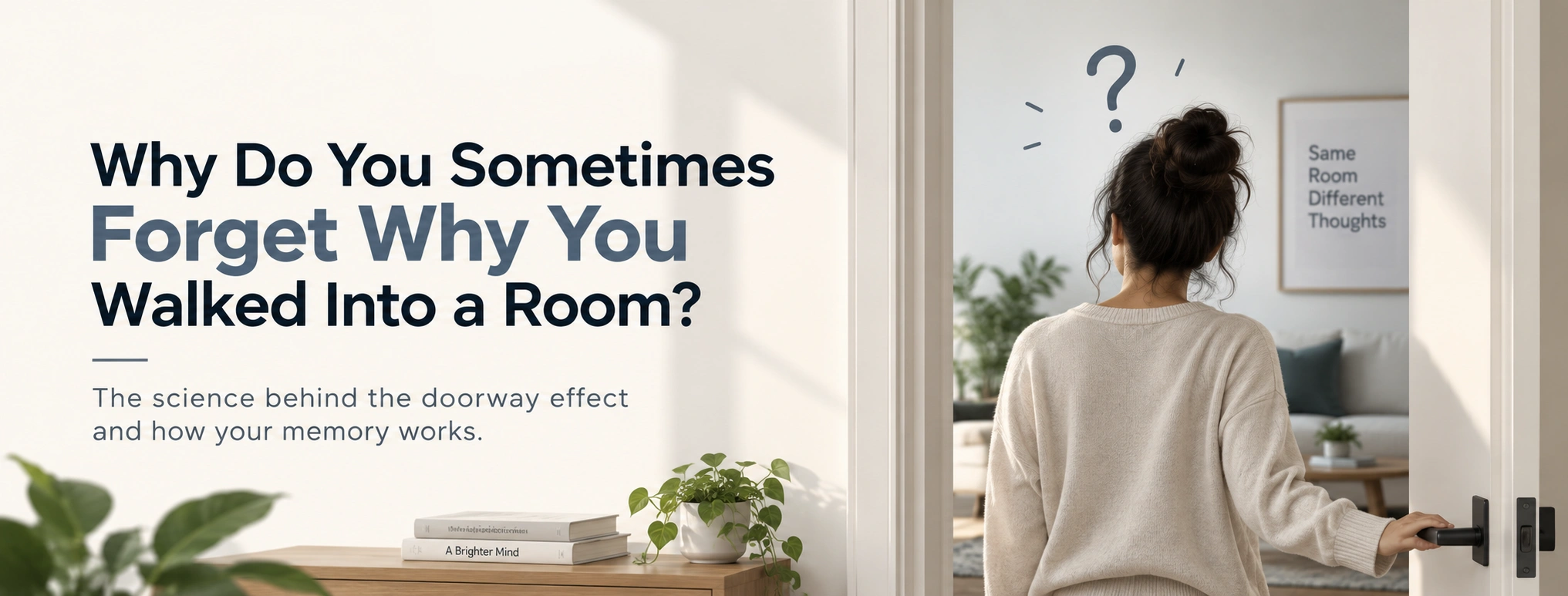
You walk into the kitchen and suddenly stop.
You know you came there for something. You were just thinking about it a few seconds ago. But now, standing in the middle of the room, you have absolutely no idea what it was.
So you walk back to where you were before—and suddenly remember.
This surprisingly common experience has a name: the doorway effect.
Researchers have found that crossing a boundary between places can sometimes affect how easily we access information from the previous situation. But the explanation is more interesting than simply saying that “doors make you forget.”
Your brain is constantly organizing your experience into separate events. Moving into a new room can signal that one event has ended and another has begun. That change in context may make information associated with the previous event temporarily less accessible.
And importantly, walking through a doorway does not automatically cause memory loss. Research suggests that the effect depends on factors such as attention, working-memory demands and how the information is represented.
What Is the Doorway Effect?
The doorway effect describes a temporary difficulty remembering information or intentions after moving from one location or situation to another.
For example, imagine you are sitting in your bedroom thinking:
“I need to take my charger from the living room.”
You get up, walk toward the living room, cross the doorway—and suddenly think:
“Why am I here?”
The same thing can happen when you:
- Open the refrigerator and forget what you wanted
- Walk upstairs to get something and forget what it was
- Enter your office and lose your train of thought
- Switch between tasks and forget what you were about to do
- Move from one computer window or activity to another and lose track of your original intention
The doorway isn’t necessarily the direct cause. Instead, it can act as a boundary between two events or contexts.
Why Does Walking Into Another Room Make You Forget?
One useful way to understand this is through event segmentation.
Your daily experience is continuous. You don’t consciously think of every second as a separate event. Instead, your brain organizes that continuous stream into meaningful episodes.
For example:
Making coffee → checking your phone → answering an email → leaving the kitchen → sitting at your desk
Each transition can represent a change in what you’re doing and what information is currently relevant.
A doorway can be one of the physical signals associated with such a transition.
When your surroundings change, your brain has to update its representation of the current situation. Information that was important in the previous situation may become less relevant to what you’re doing now.
This is one reason researchers study event boundaries when investigating memory.
Research has shown that spatial boundaries can influence how information is organized and remembered, including the order in which objects were encountered.
Your Brain Isn’t Simply “Deleting” the Memory
One of the biggest misconceptions about the doorway effect is that your brain literally erases the thought the moment you cross a threshold.
That’s not necessarily what is happening.
A better way to think about it is accessibility.
The information may still exist in memory, but the cues that helped you access it may have changed.
Think about the charger example.
While you’re sitting in your bedroom, several things are connected:
Bedroom → getting ready → charger → living room
Your current surroundings and thoughts help keep the intention active.
Once you move into the living room, however, your attention may shift toward something else:
Living room → television → phone → dinner → another thought
The original intention can temporarily fall out of focus.
This distinction matters because forgetting and being unable to immediately retrieve something are not always the same thing.
Your Memory Depends on Context
Memory isn’t stored and retrieved completely independently of your surroundings.
The physical environment, your current thoughts, your goals and other contextual information can all contribute to what is accessible at a particular moment.
That’s why returning to the previous room sometimes helps.
You haven’t necessarily “recovered” a deleted memory. You may simply have recreated some of the cues that were present when the intention was active.
The same principle can explain why a familiar place can suddenly remind you of something you had completely forgotten.
Your surroundings can act as retrieval cues.
What Happens to Your Working Memory?
Another piece of the puzzle is working memory—the limited mental workspace you use to temporarily hold information while thinking and acting.
Suppose you are trying to remember:
- Get your wallet
- Reply to a message
- Call your friend
- Turn off the stove
- Buy groceries
- Find your headphones
You can keep some of these intentions active, but your attention is constantly shifting.
When you move between environments, the brain also has to update what is currently relevant.
Research on event boundaries suggests that these transitions can influence the information maintained in working memory. A 2024 study found that crossing a visual event boundary could impair memory for recently encountered information even when participants were actively trying to maintain it.
This doesn’t mean every doorway causes your working memory to reset. It means that event boundaries can influence what information remains readily accessible.
Is the Doorway Really the Cause?
Here’s where the science gets interesting.
The popular explanation makes it sound as though crossing a doorway automatically triggers forgetting.
The evidence is more complicated.
A 2021 study specifically tested the doorway effect across virtual and real-world conditions and did not find significant doorway-related forgetting across its experiments. However, under higher working-memory demands, participants showed greater susceptibility to interference after crossing a doorway.
That suggests the doorway may not be a universal “forgetting switch.”
Instead, the effect may become more noticeable when your memory is already under pressure.
For example, you’re much more likely to lose track of why you entered a room when you’re:
- Distracted
- Thinking about several things
- Switching between tasks
- In a hurry
- Mentally tired
- Trying to remember several instructions
- Responding to notifications while moving around
So if you walk into a room and forget why you’re there, the doorway may be only one part of the story.
The Doorway Effect May Actually Be Useful
Forgetting isn’t always a design flaw.
Your brain has to constantly decide what information is relevant and what can be deprioritized.
Imagine carrying every detail from the previous task into every new situation.
You would quickly become overwhelmed.
Event segmentation allows experience to be organized into manageable episodes. Researchers have proposed that event boundaries can help separate one situation from another, reducing interference between events.
In that sense, temporarily reducing access to information from a previous event may sometimes be useful.
The problem occurs when the information you wanted to keep—like why you entered the room—is exactly the information that becomes less accessible.
Why Do You Sometimes Remember the Moment You Go Back?
This is one of the strangest parts.
You walk back into your bedroom and suddenly think:
“Oh! My charger!”
Why?
Because the previous environment can restore some of the contextual cues associated with your original intention.
Your surroundings can help reconstruct the mental state you had a few moments earlier.
This is one reason environmental context can influence memory retrieval.
You don’t necessarily need to physically return, either. Sometimes simply retracing your thoughts can help:
“What was I doing before I got up?”
“What was I looking at?”
“What was I thinking about?”
Those questions can recreate some of the cues associated with the forgotten intention.
It’s Not Just Doorways
The same basic problem can occur without walking through a physical doorway.
A change in activity can create an event boundary too.
For example:
Switching browser tabs
You’re researching a topic and open another tab to check something. Thirty seconds later, you’ve forgotten what you originally wanted to search.
Picking up your phone
You unlock your phone to send a message, see a notification, open another app and suddenly forget the original task.
Being interrupted
You’re about to say something, someone asks you a question, and the original thought disappears.
Changing tasks
You stop working on one task to answer an email and then struggle to remember what you were doing when you return.
Event boundaries can be triggered by changes in goals, environments and ongoing activity—not just doors. Modern research on event segmentation considers a wide range of internal and external changes that can divide continuous experience into separate events.
How to Stop Forgetting Why You Entered a Room
You don’t need to fight your brain. A few simple strategies can make your intention easier to retrieve.
1. Say the goal out loud
Before leaving the room, say:
“I’m going to the kitchen to get my water bottle.”
Putting the intention into words gives your attention a clearer target.
2. Carry a reminder
If you’re going to another room for something specific, take an object related to the task.
Going to get your charger?
Take your phone.
Going to get a notebook?
Carry your pen.
The object can become a reminder of what you intended to do.
3. Reduce task switching
If you’re already distracted by notifications, conversations and several unfinished tasks, you’re more likely to lose track of your original goal.
Finish or pause one task before immediately jumping into another.
4. Use environmental cues
Leave the thing you need somewhere visible if possible.
For example, if you need to take your documents with you when you leave, put them next to your keys.
The environment then becomes part of your reminder system.
5. Retrace your steps
If you’ve already forgotten, don’t immediately try to force the answer.
Instead, ask:
“What was I doing immediately before I came here?”
Then mentally or physically retrace the previous step.
This can restore contextual cues that help trigger retrieval.
Does the Doorway Effect Mean You Have a Bad Memory?
Usually, no.
Occasionally forgetting why you entered a room is a normal everyday experience. The phenomenon itself does not mean that your memory is deteriorating.
In fact, research suggests that the doorway effect is more complicated than the popular explanation that “doors make your brain forget.” Some experiments have reproduced boundary-related memory effects, while others have not found the same effect under different conditions.
What matters is the broader pattern.
An occasional “Why did I come in here?” moment is very different from persistent memory problems that interfere with everyday activities.
If you are experiencing frequent or worsening memory difficulties that affect work, studying, daily tasks or your ability to function normally, it is worth discussing them with a qualified healthcare professional.
Frequently Asked Questions
What is the doorway effect?
The doorway effect is the term commonly used for temporary difficulty remembering information or intentions after moving between environments. Researchers study it as part of a broader phenomenon involving event boundaries, context changes and memory updating.
Why do I forget why I walked into a room?
Moving into a new environment can mark a change in the current event, while your attention may also shift to new information. If your original intention was only weakly maintained, the combination can make it temporarily difficult to retrieve.
Does walking through a doorway actually erase memory?
No. The evidence does not support the idea that a doorway literally erases memories. Research suggests that event boundaries can influence memory accessibility and working-memory contents, but the effect is not universal.
Why do I remember what I wanted when I return to the previous room?
Returning to the previous environment can restore contextual cues associated with your original thought, making the intention easier to retrieve.
Can this happen without walking through a doorway?
Yes. Similar memory slips can occur when you switch tasks, change contexts, get interrupted or move between digital environments.
Is the doorway effect a sign of dementia?
An occasional doorway-effect experience is not, by itself, evidence of dementia or another memory disorder. Persistent or worsening memory problems that interfere with daily life are different and should be discussed with a healthcare professional.
The Bigger Lesson About Memory
The next time you walk into a room and suddenly think, “Why am I here?”, don’t assume your memory has failed.
Your brain may simply be doing something it does all day long: organizing a continuous stream of experience into separate events, updating what matters in the current situation and shifting your attention toward what comes next.
Sometimes that system works so efficiently that it temporarily hides the one thing you actually wanted to remember.
And that’s what makes the doorway effect so interesting.
It isn’t just a strange quirk of forgetting. It’s a small everyday example of how attention, context, working memory and event boundaries interact to shape what we can remember from one moment to the next.
Sources & Further Reading
- Radvansky, G. A., Krawietz, S. A., & Tamplin, A. K. — Walking through doorways causes forgetting: Further explorations (2011), Quarterly Journal of Experimental Psychology.
- Horner, A. J., Bisby, J. A., Wang, A., Bogus, A., & Burgess, N. — The role of spatial boundaries in shaping long-term event representations (2016), Cognition.
- McFadyen, J. et al. — Doorways do not always cause forgetting: a multimodal investigation (2021), BMC Psychology.
- Pu, Y. et al. — Event boundaries shape temporal organization of memory by resetting temporal context (2022), Nature Communications.
- Ongchoco, J. D. K. & Xu, Y. — Visual event boundaries trigger forgetting despite active maintenance in visual working memory (2024), Journal of Vision.
- DuBrow, S. — Events and Boundaries, Oxford Handbook of Human Memory (2024).
- Nolden, S. et al. — Prediction error and event segmentation in episodic memory (2024), Neuroscience & Biobehavioral Reviews.