
Have you ever read an entire page, listened to a lecture, or learned someone’s name—only to forget it a few minutes later?
You may understand something while studying, but the moment you close your book and try to explain it, your mind goes blank. This can be frustrating, especially when you are preparing for an exam, learning a new skill, or trying to remember important information.
Forgetting something you just learned does not necessarily mean you have a poor memory. Often, the information was not fully processed, your working memory was overloaded, or you had not yet practiced retrieving it. Stress, fatigue, distractions, and interference from other information can also make new knowledge harder to remember.
The good news is that understanding how memory works can help you learn more effectively. By improving your attention, using active recall, spacing out your study sessions, and making meaningful connections, you can give important information a better chance of staying accessible.
In this article, we will explore why you forget things shortly after learning them, what happens inside the memory system, and practical ways to improve information retention.
Why Do You Forget Things You Just Learned?
Forgetting information shortly after learning it can happen for several reasons:
- You did not pay enough attention when the information was presented.
- Your working memory was handling too much information at once.
- You recognized the material but did not learn it deeply enough to recall it independently.
- Similar information interfered with the new memory.
- You did not practice retrieving what you learned.
- Stress, fatigue, or poor sleep affected your ability to learn or remember.
- You tried to memorize information without connecting it to meaning.
One important distinction is that understanding something in the moment is not the same as being able to remember it later.
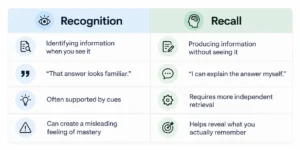
When you read a paragraph, the information may feel familiar because you have just seen it. But familiarity does not necessarily mean that you can reproduce the idea without help.
For example, you might recognize the correct answer in a multiple-choice question but struggle to explain it from memory. This difference between recognition and recall is one reason passive studying can feel more effective than it actually is.
To understand why this happens, it helps to look at the basic stages of memory.
How Does Memory Work?
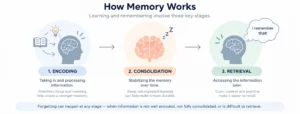
Memory is not a single activity. Learning and remembering involve several connected processes: encoding, consolidation, storage, and retrieval.
1. Encoding: How information enters memory
Encoding is the process of processing incoming information so that it can form a memory.
Imagine that someone introduces themselves to you at a party. You hear their name, look at their face, and try to connect the two. If you pay attention, the information has a better chance of being encoded.
But what if you are distracted by your phone, thinking about an upcoming meeting, or worrying about something else?
You may hear the person’s name without processing it sufficiently. A few seconds later, you cannot remember it—not necessarily because the memory disappeared, but because it may never have been encoded strongly in the first place.
Common signs of weak encoding include:
- Forgetting instructions immediately after hearing them.
- Reading a paragraph without understanding its main point.
- Losing track of a conversation because your attention was elsewhere.
- Forgetting a person’s name moments after being introduced.
- Watching an educational video but remembering very little of its content.
How to improve encoding
Give new information your attention when you first encounter it. Put away unnecessary distractions, slow down when a concept is difficult, and try to understand what the information means.
After reading a short section, ask yourself:
“What is the main idea, and how would I explain it in my own words?”
This simple question encourages active processing instead of merely looking at the words.
2. Consolidation: How new memories become more stable
After information has been encoded, memory can become more stable through a process called consolidation.
Consolidation involves changes that help newly acquired information become more durable. Sleep is an important part of many memory-consolidation processes, although its effects depend on the type of learning and the circumstances.
For example, you might learn a new concept during the day and find that you can recall it more easily after a night of sleep. Sleep does not guarantee that everything you study will be remembered, but it can support the stabilization of newly learned information.
Memory consolidation is not an instant event. It can involve processes that occur over time, and later learning and retrieval can also influence how memories are maintained.
3. Storage: Maintaining information over time
Storage refers broadly to maintaining information so that it can potentially be accessed later.
Not every memory is stored with the same strength or level of detail. Information that is meaningful, well-encoded, and revisited may become easier to retain, while information learned casually may be more difficult to access.
The brain does not store every experience in exactly the same way. Different types of memory involve different systems and processes.
4. Retrieval: Bringing information back
Retrieval is the process of accessing information that you learned previously.
Suppose you studied the definition of a scientific term yesterday. Today, your teacher asks you to explain it, but you cannot remember the answer immediately. After seeing a related diagram or hearing the first few words of the definition, the information comes back.
This is an example of how retrieval cues can help you access a memory.
Sometimes, information is difficult to retrieve even when some form of memory for it remains. This is why forgetting and permanent loss of information are not always the same thing.
1. You May Not Have Paid Enough Attention
Attention is one of the foundations of learning. If your mind is somewhere else when information is presented, the material may not be encoded effectively.
Consider this example:
You are studying a chapter while checking messages, switching between browser tabs, and thinking about an unrelated problem. You finish the chapter but cannot explain what you read.
It may feel as though your memory failed. However, the problem may have started earlier, during the initial learning process.
Why distractions matter
Every time you shift attention between tasks, you may lose some of the mental resources needed to process new information. This is especially relevant when the material is complex or unfamiliar.
Distractions can include:
- Phone notifications.
- Social media.
- Background conversations.
- Unrelated browser tabs.
- Television or entertainment.
- Frequent interruptions from other people.
- Worrying or thinking about several unrelated tasks.
What to do
Before learning something important:
- Put your phone on silent or use an appropriate focus mode.
- Close unnecessary apps and browser tabs.
- Choose one clear learning goal.
- Work in a space with manageable distractions.
- Pause periodically to explain what you have learned.
You do not need perfect concentration for every second of a study session. The aim is to give important information enough focused attention to be processed meaningfully.
2. Your Working Memory May Be Overloaded
Working memory helps you temporarily hold and manipulate information while you think, solve problems, read, or follow instructions.
It has limited capacity. When too many unfamiliar details compete for attention, some information may be lost or processed less effectively.
An everyday example
Imagine that someone gives you five instructions:
- Send an email.
- Call a client.
- Update a spreadsheet.
- Book an appointment.
- Share a document.
Before you write anything down, a message arrives. You respond, return to the instructions, and remember only two tasks.
This does not automatically mean your long-term memory is poor. The information may not have been maintained successfully in working memory.
How working-memory overload affects studying
You may experience overload when you:
- Try to memorize too many new terms at once.
- Read a complicated explanation without taking time to process it.
- Attempt to follow several instructions simultaneously.
- Study difficult material while constantly switching tasks.
- Try to remember every detail before understanding the main idea.

Ways to reduce the load
Break information into smaller units. Learn a few related concepts at a time instead of attempting to memorize an entire chapter at once.
Use external supports. Write down instructions, create a checklist, or use a diagram rather than relying entirely on temporary mental storage.
Connect ideas. Group related facts into meaningful categories.
Pause and summarize. After a short section, explain what you understood before moving forward.
Remove unnecessary interruptions. A quieter, more focused learning environment can make it easier to process unfamiliar information.
The goal is to make learning manageable—not to force yourself to remember everything at once.
3. Familiarity Is Not the Same as Learning
One of the most common learning mistakes is confusing recognition with recall.
When you reread a chapter several times, the words become familiar. The material may feel easier, and you may believe you know it well.
But when you close the book and try to explain the subject without looking, you may discover that you remember much less than expected.
Recognition vs. recall
Try this learning test
Read a short section of a textbook for five minutes. Then close it and answer:
- What was the main idea?
- What were the most important details?
- Can I explain the topic without using the original wording?
- Can I give a real-world example?
- What part do I still find confusing?
If you cannot answer, do not immediately reread the entire section. First, identify which part is missing from your memory.
This approach helps you distinguish between genuine understanding and familiarity.
4. Similar Information Can Interfere With New Memories
Sometimes, information is difficult to remember because other information competes with it. This is called interference.
Interference is especially relevant when you learn similar names, facts, languages, formulas, or procedures.
Proactive interference
Proactive interference occurs when previously learned information makes it harder to remember newer information.
For example, you have used the same password for years. After changing it, you repeatedly type the old password when logging in.
Your previous habit interferes with the new information.
Retroactive interference
Retroactive interference occurs when newly learned information makes it harder to remember something you learned earlier.
For instance, you learn one set of foreign-language vocabulary in the morning and another set of similar words in the afternoon. The newer material may compete with the earlier material when you try to recall it.
How to reduce interference
- Separate similar topics when possible.
- Use clear examples that distinguish related concepts.
- Compare similar ideas directly.
- Practice each topic independently before mixing them.
- Explain how two similar concepts are different.
- Avoid memorizing several nearly identical lists without understanding them.
For example, if you are learning two similar scientific terms, write down what each means, how they differ, and where each is used.
The objective is not to avoid similar information. It is to create stronger distinctions between competing memories.
5. You May Not Have Practiced Retrieving the Information
Reading, watching, and listening expose you to information. Retrieval practice requires you to bring that information back without looking at the original material.
This difference matters.
Research reviews have found that practicing retrieval can improve later retention across different types of learning material and learners. Retrieval practice is also commonly called the testing effect or retrieval-based learning.
Example: Learning a definition
Suppose you learn:
Photosynthesis is the process through which plants use light energy to help produce chemical energy.
A passive approach is to read the definition several times.
An active approach is to close your notes and ask:
“What is photosynthesis, and what role does light play in the process?”
Try to answer from memory. Then check your notes and correct any mistakes.
The effort involved in retrieving the answer helps you identify what you know and what you still need to learn.
Practical retrieval-practice methods
- Close your textbook and summarize the lesson.
- Use flashcards that ask questions instead of showing only definitions.
- Solve practice problems without immediately viewing the solution.
- Explain the concept aloud.
- Write down everything you remember on a blank page.
- Ask a friend to quiz you.
- Create your own questions after completing a chapter.
Retrieval may feel more difficult than rereading, but that difficulty can be useful. It gives you an opportunity to practice accessing information rather than simply recognizing it.
6. Cramming Can Make Learning Feel Better Than It Is
Studying the same information repeatedly in one sitting can make it feel familiar. This may help with immediate performance, but it does not always produce strong long-term retention.
Spaced practice means distributing learning and review across separate sessions rather than completing all the studying at once.
Research on spacing and retrieval practice supports distributing learning opportunities over time as an effective way to improve retention. The best schedule depends on the difficulty of the material, how much you already know, and when you need to use the information.
Example of spaced learning
Instead of studying a topic for two hours only once, you could try:
- Monday: Learn the topic and write a short summary.
- Tuesday: Recall the main ideas without looking at your notes.
- Thursday: Answer practice questions.
- Sunday: Explain the topic again and review weak areas.
The sessions do not have to be long. What matters is returning to the information and attempting to retrieve it after some time has passed.
Why spacing helps
When you return to material after a delay, you may need to work harder to recall it. That effort can provide useful retrieval practice and help reveal what needs further study.
Do not interpret difficulty as proof that the strategy is failing. If you can retrieve the information and correct your mistakes, the process may be contributing to stronger learning.
7. You May Not Have Connected the Information to Meaning
Information is often easier to remember when you understand how it relates to something you already know.
Compare two ways of learning a concept.
Memorizing without context
You repeat the statement:
“The mitochondria is the powerhouse of the cell.”
You may remember the phrase temporarily without understanding what mitochondria do.
Learning through meaning
You learn that mitochondria are structures inside many cells that help produce usable energy for cellular activities. You connect the concept to the energy needs of living cells.
The second approach gives the information more context and creates additional ways to think about it.
Meaningful learning does not guarantee perfect memory, but it can make information easier to explain and retrieve.
Use elaboration
After learning a new concept, ask:
- Why is this true?
- How does it work?
- What is an example?
- How does it relate to something I already know?
- How is it different from a similar concept?
- What would happen if one part of the process changed?
For example, after learning about evaporation, connect it to wet clothes drying, water leaving a puddle, or cooling caused by sweat.
The more clearly you understand an idea, the more useful connections you may have when trying to remember it later.
8. Stress and Fatigue Can Affect Learning
Your ability to learn and retrieve information can vary depending on your physical and mental state.
Stress
Stress can interfere with attention and working memory, particularly when you are trying to learn or retrieve information under pressure.
For example, you may understand a topic while studying but struggle to recall it during a stressful examination.
Stress does not affect every person or task in the same way, but it can make focused learning more difficult.
Fatigue
When you are tired, it may become harder to maintain attention, process new information, and stay engaged with a demanding task.
You might read the same paragraph repeatedly without retaining its meaning.
Sleep
Sleep supports important memory processes, including the consolidation of many recently learned memories. Research indicates that the effects of sleep can vary according to the type of memory, the learning task, and other circumstances.
If you regularly sacrifice sleep to study, you may be making learning more difficult than necessary.
Practical steps
- Maintain a consistent sleep schedule.
- Avoid studying when you are too exhausted to process information effectively.
- Take breaks during demanding learning sessions.
- Reduce unnecessary interruptions.
- Use a brief review session instead of relying entirely on last-minute cramming.
Sleep and stress management support learning, but they do not replace attention, understanding, or retrieval practice.
9. The Learning Environment Can Influence Recall
The circumstances in which you learn can sometimes provide cues that help you remember information later.
For example, you might study in a quiet room and then find it more difficult to concentrate in a noisy classroom. A change in surroundings may influence your attention and the cues available during retrieval.
However, this does not mean that you must study in the exact place where you will take an exam or perform a task.
One useful strategy is to practice recalling information in different settings and formats.
Try varying your learning conditions
- Study at your desk and review the topic somewhere else.
- Explain a concept aloud instead of always reading it.
- Solve questions in different formats.
- Apply the same idea to different examples.
- Practice retrieving information without relying on the exact layout of your notes.
This can help you learn the information itself rather than depending too heavily on one set of environmental cues.
10. You May Need Better Retrieval Cues
A retrieval cue is a detail, association, or prompt that helps you access information from memory.
Imagine that you forget the name of a movie but remember the lead actor, the storyline, or the place where you watched it. One of those details may help you retrieve the title.
When learning new information, meaningful cues can make later recall easier.
Ways to create useful cues
- Connect a new name with a person’s face or a distinctive detail.
- Associate a scientific concept with a real-world example.
- Group related facts into meaningful categories.
- Create a mental image of something difficult to visualize.
- Use a question that reminds you what you need to remember.
- Compare a new idea with something familiar.
For example, when learning the term “osmosis,” connect it to the movement of water across a selectively permeable membrane and an example involving plant cells.
The cue should help you understand the concept, not merely create a random association.
11. Multitasking Can Weaken the Learning Process
Multitasking often involves switching attention between activities rather than processing all of them deeply at the same time.
If you are watching a lecture, replying to messages, and browsing social media, you may miss important information before it is adequately encoded.
This can create a frustrating experience: you spend an hour studying but remember very little.
How to make learning more focused
Before beginning a session:
- Put your phone away or activate an appropriate focus mode.
- Close unrelated browser tabs.
- Choose one specific learning goal.
- Keep only the necessary materials nearby.
- Take notes that help you understand the material.
- Test yourself before ending the session.
A shorter period of focused learning may be more useful than a longer session filled with interruptions.
12. What to Do When You Forget Something You Just Learned
If you forget a concept a few minutes after learning it, do not immediately assume that you need to start over.
Instead, use a simple process to identify what happened.
Step 1: Try to recall the information
Close your notes and explain what you remember in your own words.
Give yourself a moment to retrieve the information before looking at the answer.
Step 2: Identify the problem
Ask yourself:
- Did I forget the entire idea?
- Do I remember the general concept but not the details?
- Do I recognize the answer but struggle to produce it?
- Was I distracted when I first learned it?
- Am I confusing it with a similar concept?
- Did I understand the material in the first place?
Step 3: Review only the missing part
Return to the relevant section of your notes or textbook. Focus on the information you could not recall instead of automatically rereading everything.
Step 4: Explain it in a new way
Use an example, comparison, diagram, or short explanation in your own words.
Step 5: Test yourself again
Close the material and attempt to retrieve the information once more.
Step 6: Schedule another review
Return to the concept later that day, the next day, or after a longer interval. Adjust the timing according to how well you can remember it.
This process helps you distinguish between a weak initial understanding, an attention problem, and information that needs more retrieval practice.
13. A Practical Study Plan for Better Memory Retention
Here is a simple example of how to learn a new topic and revisit it over time.
During the first session
- Read or listen to the material carefully.
- Break the topic into manageable sections.
- Identify the main ideas.
- Connect unfamiliar concepts to examples.
- Close your notes and explain what you learned.
Later the same day
- Try to recall the main ideas without looking.
- Check your answers.
- Correct misunderstandings.
- Write down any questions that remain.
The next day
- Use practice questions or flashcards.
- Explain the topic in your own words.
- Focus on information that was difficult to retrieve.
A few days later
- Test yourself again.
- Mix questions from related topics.
- Apply the concept to a new example.
The following week
- Review the information briefly.
- Check whether you can still explain it without relying on your notes.
You can adjust the schedule based on the complexity of the subject and how well you remember it. The main principle is to combine active recall with spaced practice.
14. Common Study Mistakes That Make Forgetting More Likely
Rereading without testing yourself
Rereading can help you understand difficult material, but it may not reveal whether you can recall the information independently.
Highlighting too much
Highlighting can help organize important material. However, highlighting entire pages may not require enough active thinking to support strong learning.
Studying only once
A single exposure may be sufficient for simple information, but complex concepts often benefit from repeated learning and retrieval.
Cramming before an exam
Cramming may help with short-term familiarity or immediate performance, but spaced learning is generally more useful for long-term retention.
Studying while constantly distracted
Frequent interruptions can reduce the attention available for encoding new information.
Avoiding difficult questions
If you only review information that feels easy, you may not discover which concepts you cannot retrieve independently.
Memorizing without understanding
Facts that are disconnected from meaning may be harder to explain, apply, or retrieve later.
15. How to Tell Which Memory Problem You Are Experiencing
Not every forgetting experience has the same cause. The following guide can help you think about what may have happened.
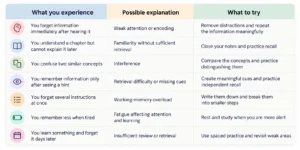
These are possible explanations, not a diagnostic test. A single experience can involve several factors at once.
16. When Is Forgetfulness a Reason to Seek Help?
Occasional forgetfulness is common. People forget names, instructions, appointments, or information they have recently encountered.
However, it may be appropriate to speak with a qualified healthcare professional if memory difficulties:
- Persistently interfere with school, work, or everyday activities.
- Are becoming noticeably worse.
- Make it difficult to manage familiar responsibilities.
- Occur alongside other concerning changes in thinking or behavior.
- Begin suddenly or occur with other new symptoms.
Memory difficulties can have many possible causes, including sleep problems, stress, medication effects, and medical or neurological conditions. A healthcare professional can help determine whether further evaluation is appropriate.
This article discusses ordinary learning and memory difficulties. It is not a substitute for an individual medical assessment.
Frequently Asked Questions
Why do I forget what I studied immediately?
You may not have processed the information deeply enough during the initial learning stage. Distractions, working-memory overload, confusion with similar material, and a lack of retrieval practice can also contribute.
Why do I understand something but forget it later?
Understanding a concept in the moment does not guarantee that you can retrieve it later. You may need stronger connections, more practice, or spaced review to make the information easier to access.
Is forgetting something I just learned normal?
Yes. Forgetting is a normal part of memory. How easily you forget depends on the material, your attention, the learning conditions, prior knowledge, and other factors.
How can I remember what I study for longer?
Use focused learning, meaningful explanations, active recall, spaced practice, adequate sleep, and feedback on mistakes. These methods help you move beyond familiarity toward more durable learning.
Is rereading a good way to remember information?
Rereading can help you understand difficult material, but it should not be your only strategy. Combine it with recalling the information without looking and applying it to questions or examples.
How long does it take for something to become a long-term memory?
There is no fixed amount of time that applies to every memory. Memory stabilization and retention depend on the type of information, how it was learned, prior knowledge, sleep, and later retrieval.
Does forgetting mean my memory is getting worse?
Not necessarily. Occasional forgetfulness is normal. Persistent, worsening, or disruptive memory problems should be discussed with a qualified healthcare professional.
Does active recall work better than rereading?
Research supports retrieval practice as an effective learning strategy for improving later retention. Rereading can still be useful for initial understanding, but attempting to recall information without looking helps you practice accessing it.
Final Thoughts
Forgetting something you just learned can be frustrating, but it does not automatically indicate a poor memory.
Sometimes the information was not fully encoded. Sometimes working memory was overloaded or similar information interfered with it. In other cases, you understood the material but did not practice retrieving it.
The most useful response is to identify what happened instead of simply studying harder.
Give new information your attention. Connect it to meaning. Close your notes and practice recalling what you learned. Review it across multiple sessions, and use feedback to correct gaps.
The goal is not to remember every detail you encounter. It is to develop learning habits that help important information remain accessible when you need it.
Sources and further reading
- Carpenter, S. K., Pan, S. C., & Butler, A. C. (2022). The science of effective learning with spacing and retrieval practice. Nature Reviews Psychology, 1, 496–511. Reviews evidence for spacing, retrieval practice, and how learners judge their own learning.
- McDermott, K. B. (2021). Practicing Retrieval Facilitates Learning. Annual Review of Psychology, 72, 609–633. Reviews the role of retrieval practice in improving later retention.
- Karpicke, J. D., & Blunt, J. R. (2011). Retrieval practice produces more learning than elaborative studying with concept mapping. Science, 331(6018), 772–775. Examines retrieval practice and learning outcomes.
- Cowan, N. (2014). Working Memory Underpins Cognitive Development, Learning, and Education. Educational Psychology Review, 26, 197–223. Discusses working memory and its role in learning and cognitive performance.
- Diekelmann, S., Wilhelm, I., & Born, J. (2009). The whats and whens of sleep-dependent memory consolidation. Sleep Medicine Reviews, 13(5), 309–321. Reviews how sleep can support the consolidation of different types of memory.
- Cognitive Train. Why Do We Forget?. The competitor article that inspired this topic and provides a broad overview of memory failure.