Generative AI is a type of artificial intelligence that can create new content based on instructions, questions, or prompts provided by users. Unlike traditional AI systems that are primarily designed to classify information, make predictions, or identify patterns, generative AI can produce text, images, videos, audio, computer code, and other forms of digital content.
In simple terms, generative AI learns patterns from large amounts of data and uses those patterns to generate new outputs that resemble the information it learned from.
For example, you can ask a generative AI tool to:
- Write a blog post
- Create an image from a text description
- Summarize a long document
- Generate computer code
- Write an email
- Create a marketing campaign
- Produce music or audio
- Analyze information
- Create or edit videos
Popular generative AI applications have made this technology accessible to businesses, students, marketers, developers, designers, and everyday users.
How Does Generative AI Work?
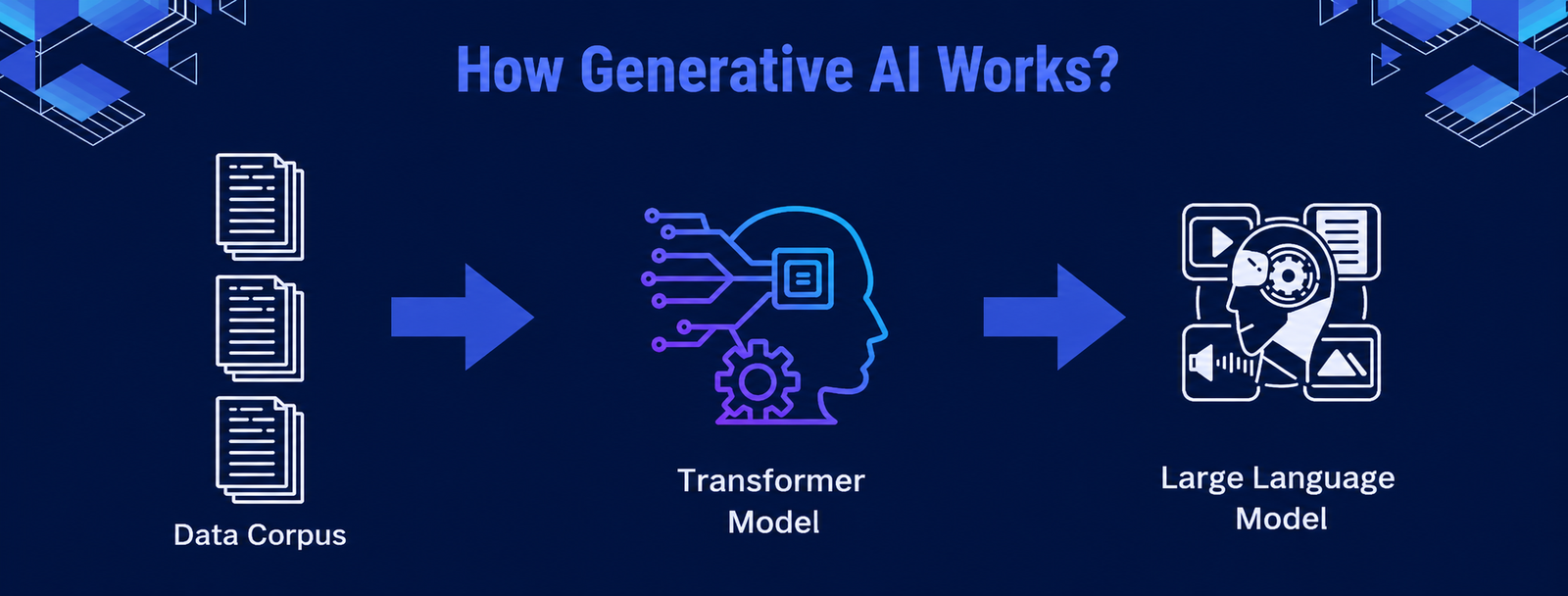
The easiest way to understand how generative AI works is to think about it as a system that learns patterns from enormous datasets and then uses those learned patterns to produce an output.
Generative AI generally involves several important stages, including training, tuning, prompting, generation, and evaluation.
1. Data Collection and Training
The first step is training the AI model.
Generative AI models are trained using very large datasets. Depending on the model, these datasets may contain text, books, websites, images, audio, videos, software code, or other forms of information.
During training, the model analyzes the relationships and patterns within the data. For example, a language model learns how words commonly relate to one another and how sentences are structured.
For an AI image model, the system can learn relationships between visual elements, objects, colors, shapes, styles, and text descriptions.
The goal isn’t simply to memorize individual pieces of content. Instead, the model develops mathematical representations of patterns and relationships within the training data.
2. Neural Networks Process the Data
Modern generative AI relies heavily on deep learning and neural networks.
Neural networks contain layers of mathematical operations that transform input information into increasingly useful representations. Large models can contain billions of adjustable parameters that are modified during training.
These parameters help the model recognize complex relationships in its training data.
For example, a language model can learn that certain words frequently appear together and that the meaning of a word can change depending on the surrounding context.
3. Transformers and Self-Attention
One of the most important technologies behind modern generative AI is the Transformer architecture.
Transformers were introduced in the influential 2017 research paper Attention Is All You Need. They use an attention mechanism that allows models to evaluate relationships between different parts of an input sequence.
This is particularly important for language.
Consider the sentence:
“The company launched a new product because it wanted to reach more customers.”
To understand the sentence properly, an AI model needs to understand how different words and phrases relate to each other.
The transformer’s self-attention mechanism helps the model determine which parts of the input are important when processing a particular token. This ability is one reason transformer-based models became extremely effective for natural language processing and generation.
4. The Model Generates an Output
Once the model has been trained, a user can provide a prompt.
For example:
Prompt:
“Write a 500-word article explaining digital marketing.”
The model processes the prompt and predicts an appropriate sequence of tokens to construct a response.
In a language model, a token might represent a complete word, part of a word, punctuation, or another unit of text. The model repeatedly predicts what should come next based on the prompt and the context available to it.
The result is generated one step at a time until the model reaches an appropriate stopping point.
What Are Foundation Models?
Foundation models are large AI models trained on broad datasets that can serve as the basis for many different applications.
Large language models, or LLMs, are one important type of foundation model. They are designed primarily around language and can perform tasks such as text generation, translation, summarization, and question answering.
Foundation models can also support other types of content generation, including:
- Text
- Images
- Audio
- Video
- Code
- Multimodal content
This means one underlying model can potentially support many different AI-powered applications.
Types of Generative AI
Generative AI isn’t limited to text generation. Different models are designed to create different types of content.
1. Text Generation AI
Text-generating models can produce human-like written content from natural-language prompts.
Common applications include:
- Blog writing
- Email drafting
- Content summaries
- Product descriptions
- Research assistance
- Customer support
- Copywriting
- Translation
Large language models are particularly important in this category.
2. AI Image Generation
Image-generation models can create images based on text prompts.
For example, a user could request:
“Create a futuristic city at sunset with autonomous vehicles and flying cars.”
The model can generate an image matching the requested concept.
Many modern image-generation systems use diffusion-based approaches. Diffusion models learn to generate content by progressively transforming noisy representations into meaningful outputs.
3. AI Video Generation
Generative AI can also create and modify videos.
Potential applications include:
- Advertising
- Product demonstrations
- Social media content
- Educational videos
- Visual effects
- Animation
- Storytelling
4. AI Audio and Music Generation
Generative AI can produce speech, sound effects, music, and other forms of audio.
Businesses can use these technologies for voice applications, while creators can experiment with AI-assisted music and sound production.
5. AI Code Generation
Generative AI can assist developers by generating code based on natural-language instructions.
For example, a developer could describe a website feature and ask an AI coding assistant to create an initial implementation.
This can speed up development, although generated code should still be reviewed and tested by qualified developers.
What Is the Difference Between Traditional AI and Generative AI?
Traditional AI and generative AI can both learn from data, but their typical objectives are different.
Traditional AI is often used for tasks such as:
- Classification
- Prediction
- Fraud detection
- Recommendation systems
- Image recognition
- Risk analysis
Generative AI focuses on creating new content.
For example, a traditional AI model might determine whether an email is spam. A generative AI model could write a response to that email.
Another example is image recognition. Traditional computer vision may identify a dog in a photograph, while a generative AI model could create a completely new image of a dog based on a text prompt.
Google describes generative AI as going beyond traditional AI’s emphasis on classification and prediction by generating new content based on learned patterns.
What Are the Applications of Generative AI?
Generative AI is being adopted across numerous industries because it can automate or accelerate content-intensive tasks.
Marketing
Marketing teams can use generative AI for:
- Blog outlines
- Social media posts
- Advertising copy
- Email campaigns
- Product descriptions
- Keyword research assistance
- Content ideation
Healthcare
Potential applications include medical documentation assistance, research support, patient communication, and analysis of complex information. However, healthcare applications require appropriate safeguards and professional oversight.
Education
Students and educators can use generative AI for explanations, brainstorming, study materials, lesson planning, and personalized learning assistance.
Software Development
Developers can use AI tools to generate code, explain existing code, identify potential bugs, write documentation, and create test cases.
Customer Service
Generative AI can power conversational assistants that answer questions, summarize conversations, and help customer-support teams respond more efficiently.
E-Commerce
Online businesses can use generative AI to create product descriptions, marketing content, personalized recommendations, customer-service responses, and promotional materials.
What Are the Benefits of Generative AI?
Generative AI offers several potential advantages.
Increased Productivity
AI can automate repetitive content-related tasks and help people complete work more quickly.
Faster Content Creation
Instead of starting with a blank page, writers and marketers can use AI to generate ideas, outlines, drafts, and variations.
Personalization
Generative AI can produce content tailored to different audiences, customer segments, or communication styles.
Improved Accessibility
AI-powered tools can translate, summarize, explain, and transform information into different formats.
Creative Assistance
Generative AI can act as a brainstorming partner for designers, writers, developers, marketers, and other creative professionals.
What Are the Limitations of Generative AI?
Despite its capabilities, generative AI isn’t perfect.
One major limitation is hallucination. An AI model can sometimes generate information that sounds convincing but is factually incorrect. Google defines hallucination as the production of plausible-looking but incorrect output.
Other challenges include:
- Inaccurate information
- Bias in generated content
- Privacy concerns
- Copyright and intellectual-property questions
- Security risks
- High computational requirements
- Lack of human judgment
- Inconsistent outputs
For important decisions, AI-generated information should therefore be reviewed and verified rather than accepted automatically.
Techniques such as grounding and retrieval-augmented generation (RAG) can connect AI responses to external or organization-specific sources, helping improve reliability and reduce hallucinations.
Is Generative AI the Future?
Generative AI is likely to remain an important part of the technology landscape as models become more capable and increasingly integrated into everyday software.
The technology is moving beyond simple chatbots and content-generation tools toward systems capable of working across multiple types of information and interacting with external tools.
Businesses are already exploring generative AI for productivity, customer experience, software development, marketing, research, and automation.
However, the most effective approach is not necessarily to replace humans with AI. Instead, organizations can use AI to augment human expertise, allowing people to focus more on strategy, creativity, decision-making, and tasks requiring judgment.
Frequently Asked Questions About Generative AI
What is generative AI in simple words?
Generative AI is technology that learns patterns from large amounts of data and uses those patterns to create new content such as text, images, audio, video, and code.
How does generative AI work?
Generative AI works by training deep-learning models on large datasets. After training, the model processes a user’s prompt and generates an output based on patterns and relationships learned during training.
Is ChatGPT generative AI?
Yes. ChatGPT is an example of a generative AI application that can generate text and perform a wide range of language-based tasks.
Can generative AI create images?
Yes. Specialized generative AI models can create images from text prompts and can also perform tasks such as image editing and transformation.
Is generative AI always accurate?
No. Generative AI can produce incorrect or misleading information, including outputs that sound confident despite being factually wrong. Important information should be verified.
Conclusion
Generative AI is one of the most significant developments in modern artificial intelligence. Instead of simply analyzing or classifying existing information, generative AI can create new text, images, audio, video, software code, and other content.
The technology works through sophisticated machine-learning architectures, including neural networks and transformers. Models are trained on large datasets to learn patterns and relationships, and they subsequently use those learned patterns to generate outputs based on user prompts.
As generative AI continues to evolve, its impact will extend across marketing, education, healthcare, software development, entertainment, e-commerce, and many other industries. The key to using it effectively will be combining AI’s speed and scalability with human creativity, critical thinking, fact-checking, and expertise.