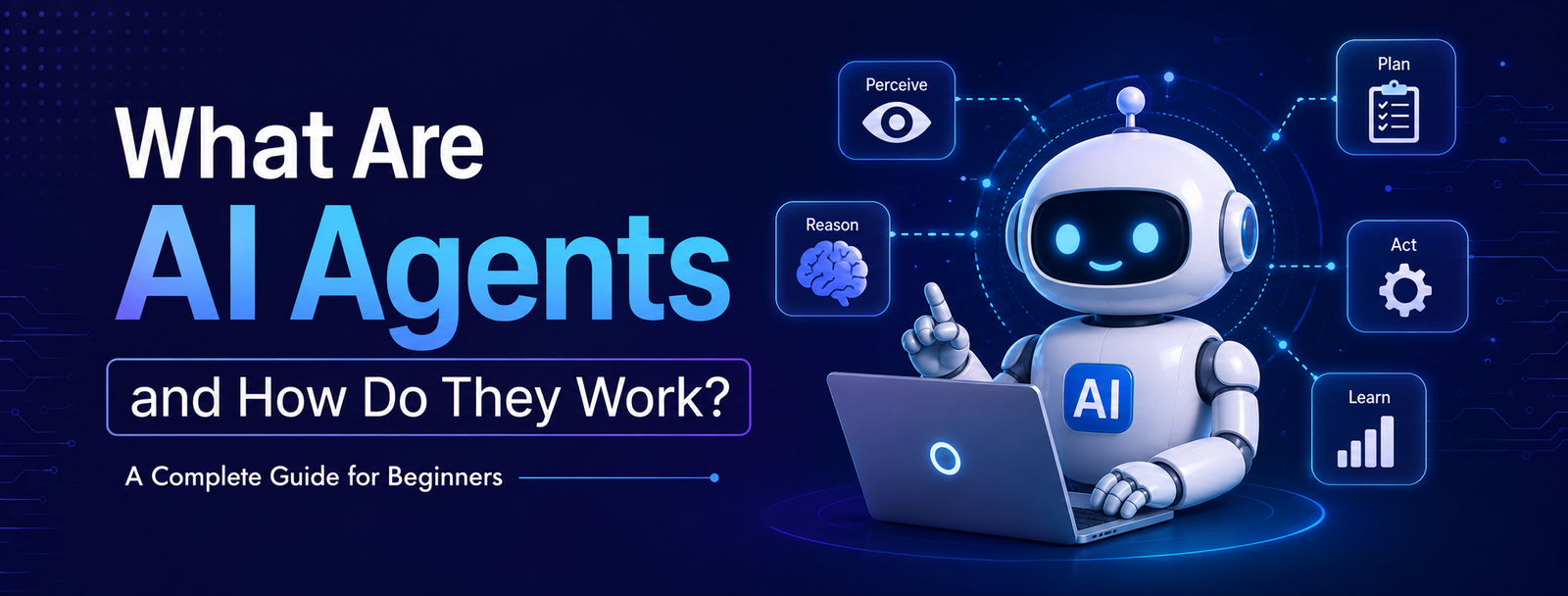
Artificial intelligence has evolved rapidly from simple rule-based software and chatbots to systems that can reason, plan, make decisions, and perform tasks with limited human intervention. One of the most important developments in this evolution is the rise of AI agents.
But what are AI agents and how do they work? In simple terms, AI agents are intelligent software systems designed to understand a goal, determine the steps required to achieve it, use available tools and information, and take actions to complete the task.
Unlike traditional chatbots that mainly respond to questions, AI agents can potentially handle multi-step workflows, interact with external systems, retrieve information, make decisions, and adjust their approach based on what happens during the task. Google Cloud describes AI agents as systems that use reasoning, planning, memory, and tools to pursue goals and complete tasks on behalf of users.
As businesses increasingly explore automation and agentic AI, understanding how these systems work is becoming important for marketers, developers, business owners, and technology professionals.
In this guide, we’ll explain what AI agents are, how AI agents work, their components, types, benefits, real-world applications, limitations, and the future of AI agents.
What Are AI Agents?
An AI agent is a software system that uses artificial intelligence to understand an objective, reason about the best way to accomplish it, and perform actions using available tools and data.
A traditional AI application may provide an answer when you give it a prompt. An AI agent goes further by determining what needs to happen next.
For example, imagine telling an AI agent:
“Find the best flight for my business trip next week, compare prices, check my calendar, and prepare the booking details.”
Instead of simply giving you travel suggestions, an AI agent could potentially:
- Understand your destination and travel requirements.
- Check your calendar for suitable dates.
- Search available flights.
- Compare prices and schedules.
- Apply your preferences.
- Present the best options.
- Take further action after receiving appropriate authorization.
This ability to work toward a goal through multiple steps is what makes AI agents different from conventional AI tools.
AI agents typically combine an AI model with instructions, memory, tools, external data, and an orchestration layer that manages how the different components work together.
How Do AI Agents Work?
So, how do AI agents work?
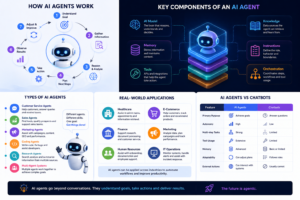
At a high level, an AI agent operates through a continuous cycle of:
Perceive → Reason → Plan → Act → Observe → Adjust
The exact architecture can vary, but the basic concept is that the agent receives a goal, understands the available information, decides what to do, performs an action, observes the result, and determines the next step.
1. Understand the Goal
The first step is understanding what the user or system wants to accomplish.
For example:
Goal: “Increase sales from our online store.”
This is a broad objective. An AI agent needs to interpret the goal and determine what actions could contribute to achieving it.
Depending on its configuration, it might analyze:
- Website traffic
- Conversion rates
- Customer behavior
- Advertising campaigns
- Product performance
- Search rankings
- Sales data
The agent converts the high-level objective into smaller tasks.
2. Gather Information
An AI agent needs relevant information before making decisions.
It can retrieve information from sources such as:
- Databases
- Websites
- APIs
- Business software
- Knowledge bases
- Documents
- CRM systems
- Analytics platforms
This is where grounding becomes important.
Grounding connects the AI system to relevant and verifiable information rather than relying solely on what the underlying model already knows. Retrieval-augmented generation (RAG), for example, allows agents to retrieve information from external sources before generating responses or taking actions.
3. Reason About the Problem
Once the agent has information, it needs to determine what should happen next.
This is generally handled by an AI model, often a large language model (LLM).
The model can analyze the available context and determine:
- What information is relevant?
- What task should happen first?
- Which tool should be used?
- What information is missing?
- Does the current result satisfy the objective?
- Should the plan change?
This reasoning capability is one of the major differences between AI agents and traditional automation.
4. Create a Plan
Complex goals often need to be divided into multiple steps.
For example, an AI marketing agent might receive the goal:
“Improve organic traffic to our website.”
It could break the objective into tasks such as:
- Analyze current organic traffic.
- Identify high-potential keywords.
- Analyze competitors.
- Identify content gaps.
- Prioritize topics.
- Create content briefs.
- Recommend internal links.
- Monitor rankings.
- Analyze performance.
- Recommend further optimization.
The agent doesn’t necessarily need to follow a rigid sequence. Depending on the system design, it can adapt its plan based on new information.
Modern agent architectures use orchestration to manage multi-step processes, including which tools to use and in what order.
5. Use Tools to Take Action
One of the most important characteristics of an AI agent is its ability to use tools.
An AI model by itself primarily generates information. Tools allow an agent to interact with the outside world.
Tools can include:
- Search engines
- APIs
- Databases
- CRM systems
- Email platforms
- Payment systems
- Spreadsheets
- Analytics software
- Code execution environments
- Business applications
For example, an AI customer-service agent could retrieve a customer’s order information from a database and then initiate an approved workflow.
Google Cloud identifies tools as capabilities that allow agents to interact with external systems, retrieve information, manipulate data, and perform actions.
6. Observe the Result
After an AI agent performs an action, it needs to understand what happened.
For example:
Action: Search for available flights.
Result: Only three flights meet the required criteria.
The agent can then evaluate those results and determine its next step.
This creates an iterative loop:
Reason → Act → Observe → Reason Again
This type of loop is commonly associated with agent architectures such as ReAct, where reasoning and actions are combined with observations from tools.
7. Adjust the Plan
The environment can change while an agent is working.
A website may return different information. A product may become unavailable. An API may fail. A customer may provide additional instructions.
A capable AI agent can use the new information to modify its approach.
This adaptability is one of the reasons AI agents are useful for complex workflows.
Instead of following only:
IF X → DO Y
an agent can work toward:
“Achieve this goal using the best available approach.”
Key Components of an AI Agent
An AI agent isn’t simply an LLM. Several components typically work together to create an effective agent.
1. AI Model
The AI model acts as the reasoning engine or “brain” of the agent.
It interprets instructions, processes context, evaluates information, and helps determine what actions should be taken.
Large language models are commonly used because they can understand natural language and perform complex reasoning tasks.
2. Instructions and Role
Agents need clear instructions.
For example, a customer-service agent could be instructed to:
- Be professional.
- Follow company policies.
- Never reveal confidential information.
- Verify customer information.
- Escalate sensitive issues to a human.
- Use approved tools only.
Well-defined instructions help establish the agent’s responsibilities and boundaries.
3. Memory
Memory allows an AI agent to maintain relevant information across interactions or throughout a task.
There can be different forms of memory, including:
- Short-term memory
- Long-term memory
- Conversation history
- Task state
- User preferences
- Transaction records
Memory can help an agent avoid repeatedly asking for information and maintain context during complex workflows. Google Cloud describes working memory, long-term knowledge, and transactional memory as important parts of agent data architecture.
4. Tools
Tools give agents the ability to interact with external systems.
For example, a sales agent could potentially use:
CRM + Email + Calendar + Analytics + Database
The AI model decides when and how those tools should be used based on the task.
5. Knowledge and Grounding
Agents need reliable information to make useful decisions.
Knowledge sources can include:
- Company documents
- Product catalogs
- FAQs
- Internal databases
- Websites
- Customer records
- Research databases
RAG and other grounding approaches can help agents retrieve relevant information dynamically.
6. Orchestration
Orchestration coordinates the entire workflow.
It determines how the model, tools, memory, data, and actions work together.
For complex workflows, orchestration is especially important because the agent may need to perform many actions in sequence.
AI Agents vs Traditional Chatbots
AI agents and chatbots are often confused, but they aren’t exactly the same.
| Feature | Traditional Chatbot | AI Agent |
|---|---|---|
| Primary purpose | Answer questions | Achieve goals |
| Autonomy | Low | Higher |
| Decision-making | Limited | More advanced |
| Tool usage | Limited | Extensive |
| Multi-step tasks | Limited | Strong capability |
| Memory | Often limited | Can use multiple memory systems |
| External actions | Limited | Can interact with systems |
| Adaptability | Usually limited | Can adjust plans |
A chatbot might answer:
“What is my order status?”
An AI agent could potentially:
Check the customer’s account → locate the order → check shipping status → identify a delay → provide an explanation → initiate an approved support workflow.
Google Cloud similarly distinguishes agents from simpler bots and assistants based on autonomy, complexity, and their ability to perform tasks.
AI Agents vs Generative AI
Another common question is:
Are AI agents the same as generative AI?
No.
Generative AI is primarily designed to create content, including:
- Text
- Images
- Audio
- Video
- Code
AI agents can use generative AI as their reasoning engine but add additional capabilities such as planning, tool use, memory, orchestration, and autonomous action.
For example:
Generative AI:
“Write a marketing campaign.”
AI Agent:
“Create a marketing campaign, analyze previous campaign performance, identify the target audience, prepare the campaign assets, schedule approved content, monitor results, and recommend adjustments.”
Agentic AI therefore focuses more heavily on goal-oriented execution than simple content generation.
Types of AI Agents
AI agents can be categorized in several ways.
1. Customer Service Agents
These agents can assist customers with:
- Questions
- Orders
- Returns
- Product recommendations
- Support requests
- Account-related workflows
2. Sales Agents
Sales AI agents can help:
- Find prospects
- Research companies
- Qualify leads
- Update CRM records
- Schedule meetings
- Personalize outreach
3. Marketing Agents
Marketing agents can assist with:
- Keyword research
- Competitor analysis
- Content planning
- Campaign analysis
- SEO recommendations
- Performance reporting
4. Coding Agents
Coding agents can help developers:
- Generate code
- Analyze repositories
- Identify bugs
- Write tests
- Refactor code
- Explain technical problems
5. Research Agents
Research agents can search through large amounts of information, compare sources, summarize findings, and organize research.
6. Multi-Agent Systems
Instead of one agent handling everything, multiple specialized agents can collaborate.
For example:
Research Agent → SEO Agent → Content Agent → Analytics Agent
Each agent can specialize in a particular function while an orchestration layer coordinates the workflow.
Google Cloud notes that multi-agent systems can use multiple specialized agents to handle more complex objectives.
Real-World Applications of AI Agents
AI agents have potential applications across almost every industry.
Healthcare
AI agents can assist with administrative workflows, information retrieval, appointment coordination, and documentation, subject to appropriate human oversight and regulatory requirements.
E-Commerce
Agents can help customers discover products, answer questions, analyze orders, and support returns.
Finance
AI agents can assist with research, document processing, customer support, and operational workflows, with appropriate controls for sensitive financial decisions.
Marketing
Marketing teams can use agents for research, content workflows, campaign monitoring, SEO analysis, and reporting.
Human Resources
AI agents can assist with employee onboarding, documentation, scheduling, and internal knowledge retrieval.
IT
IT agents can monitor systems, analyze alerts, retrieve documentation, and assist with incident-response workflows.
Enterprise AI agents are increasingly being connected with software, databases, and business systems to participate in real operational workflows.
Benefits of AI Agents
The growing interest in AI agents comes from several potential benefits.
Increased Productivity
Agents can automate repetitive and time-consuming workflows, allowing employees to focus on higher-value activities.
Faster Operations
AI agents can perform certain tasks continuously and process information quickly.
Better Scalability
Organizations can use automated agents to handle increasing volumes of routine requests.
Multi-Step Automation
Unlike simple automation scripts, agents can potentially coordinate multiple steps dynamically.
Personalized Experiences
Agents can use relevant context and memory to provide more personalized interactions.
Improved Decision Support
By combining models with business data and tools, agents can help teams analyze information and identify possible actions.
Challenges and Limitations of AI Agents
Despite their potential, AI agents aren’t perfect.
1. Hallucinations
AI models can sometimes generate incorrect information. Connecting agents to reliable data sources and implementing verification mechanisms can reduce this risk, but it does not eliminate it completely.
2. Security Risks
An agent with access to external systems can create risks if permissions aren’t carefully controlled.
3. Incorrect Actions
An agent may misunderstand a task or use the wrong tool.
For high-impact operations, human approval and strict guardrails are important.
4. Cost
Complex agents can make multiple model calls and tool calls, potentially increasing infrastructure and usage costs.
5. Data Privacy
Organizations must carefully manage sensitive information, access permissions, authentication, and data retention.
6. Monitoring
AI agents can behave differently from traditional deterministic software. Production systems therefore need monitoring, testing, evaluation, logging, and security controls.
The Future of AI Agents
AI agents are moving from experimental demonstrations toward practical business applications.
The future is likely to involve increasingly sophisticated systems where humans and AI agents work together.
Instead of using dozens of disconnected software applications manually, users may increasingly interact with AI systems that coordinate multiple services behind the scenes.
For example, a business owner could say:
“Analyze this month’s sales performance and identify three ways we can increase revenue next month.”
An AI agent could potentially analyze business data, identify trends, research relevant opportunities, create recommendations, and prepare an action plan.
Multiple specialized agents could then collaborate to execute different parts of the workflow.
This represents a broader shift from AI that provides answers toward AI that helps accomplish objectives.
Are AI Agents the Future of Business Automation?
AI agents are likely to become an important part of business automation because they combine several capabilities that traditionally existed separately.
They can combine:
AI reasoning + data + memory + tools + automation + decision-making
However, successful AI agent deployment requires more than simply connecting an LLM to a few APIs.
Businesses need:
- Clear objectives
- Reliable data
- Strong security
- Appropriate permissions
- Human oversight
- Monitoring
- Testing
- Evaluation
- Well-designed workflows
The most valuable AI agents will not necessarily be the ones with the highest level of autonomy. They will be the ones that can reliably solve useful business problems while operating within clearly defined boundaries.
Frequently Asked Questions About AI Agents
What is an AI agent in simple terms?
An AI agent is software that can understand a goal, reason about how to achieve it, use tools and information, and perform multiple actions with varying levels of human supervision.
How do AI agents work?
AI agents generally work through a cycle of understanding a goal, gathering information, reasoning, planning, taking action, observing the result, and adjusting their approach.
What is the difference between AI agents and chatbots?
Chatbots primarily respond to conversations, while AI agents are designed to pursue goals and can perform multi-step tasks using tools and external systems.
Do AI agents use ChatGPT?
Some AI agents can use large language models similar to those behind ChatGPT as their reasoning engine. However, an AI agent is a broader system consisting of a model plus tools, memory, instructions, orchestration, data, and action capabilities.
Can AI agents work without humans?
Some agents can perform tasks autonomously, but the appropriate level of human involvement depends on the use case. High-risk or sensitive actions should generally include appropriate human approval and safeguards.
Are AI agents the same as agentic AI?
Not exactly. AI agents are individual systems designed to perform tasks or achieve goals, while agentic AI generally refers to systems and architectures that emphasize autonomous planning, decision-making, and action.
Conclusion
So, what are AI agents and how do they work?
AI agents are intelligent software systems that combine AI models with reasoning, planning, memory, tools, data, and orchestration to accomplish goals. Instead of simply generating an answer to a prompt, an AI agent can determine what needs to happen, perform actions, evaluate the results, and continue working toward the desired outcome.
The fundamental workflow can be summarized as:
Understand → Gather → Reason → Plan → Act → Observe → Adapt
As AI technology continues to evolve, AI agents are expected to play an increasingly important role in customer service, marketing, sales, software development, research, operations, and business automation.
For organizations, the biggest opportunity isn’t simply asking “What can AI do?” but asking:
“Which business processes can an AI agent reliably improve or automate?”
That shift—from AI as a tool for generating answers to AI as a system for accomplishing goals—could become one of the defining developments in the next stage of artificial intelligence.