A NexGen Extracts Consumer Safety & Market Guide
Delta-8 THC has earned a reputation as a smoother, more approachable alternative to traditional cannabis. Gummies, vapes, and tinctures are widely available, and many consumers see Delta-8 as a “lighter” option compared to Delta-9 THC. That perception, however, can create a dangerous gap in understanding—especially for people who take prescription or over-the-counter medications.
The most important conversation around Delta-8 is not about flavor or potency. It is about interactions. Like other cannabinoids, Delta-8 affects how the body processes medications. These interactions are not always obvious, and they are rarely discussed on product labels or social media.
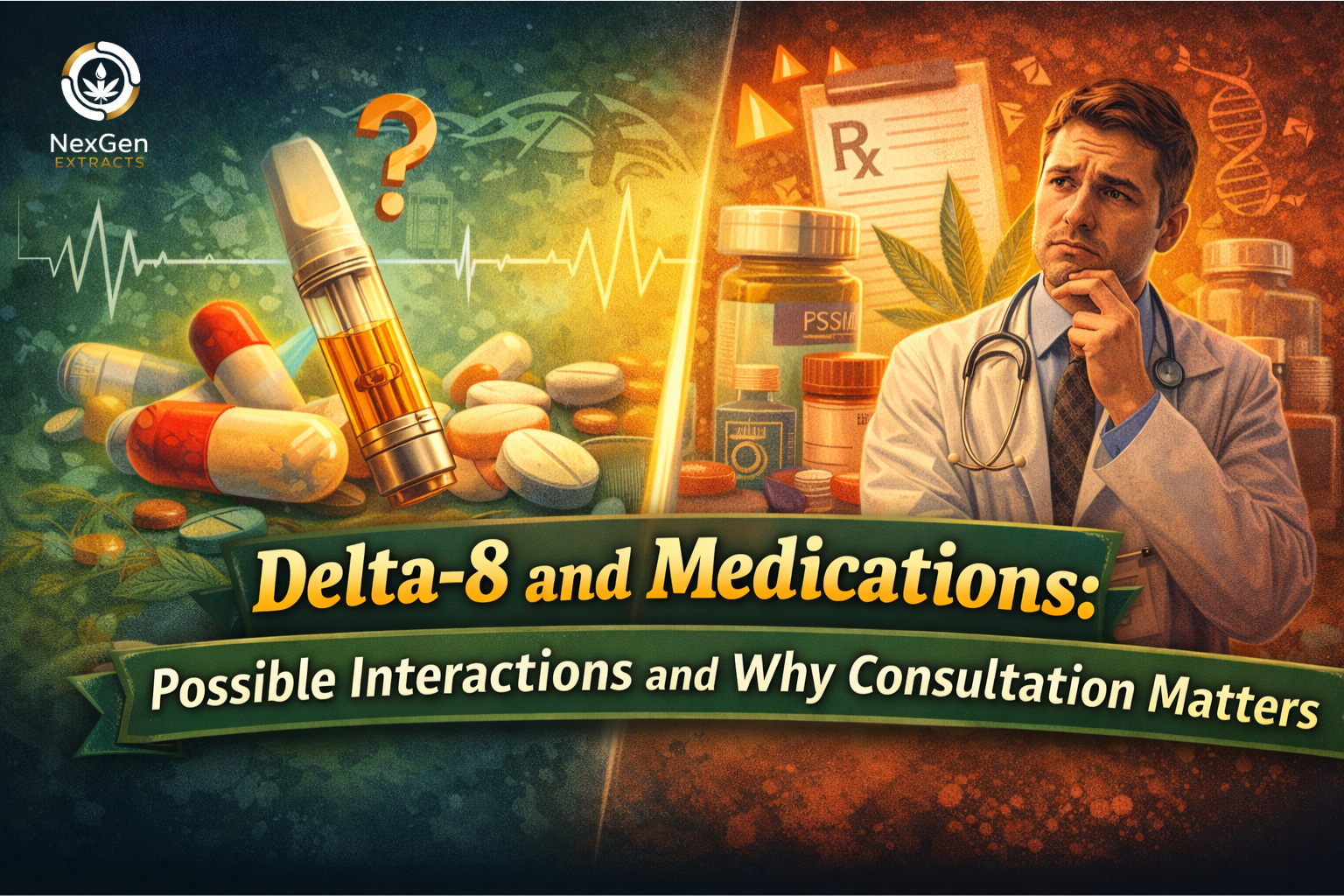
This article explains what Delta-8 is, how it interacts with medications, what current research suggests, how Delta-8 compares to Delta-9 and other cannabinoids, and why medical consultation is not optional—it is essential.
Understanding Delta-8 THC at a Basic Level
Delta-8 tetrahydrocannabinol is a psychoactive cannabinoid found naturally in very small amounts in cannabis. Most commercial Delta-8 is produced by converting hemp-derived CBD into Delta-8 through chemical processes.
Structurally, Delta-8 is nearly identical to Delta-9 THC. The difference lies in the position of a double bond, which often results in effects that feel milder or more body-focused. Despite this, Delta-8 still interacts with the same cannabinoid receptors in the brain and body.
This similarity is the foundation of both its appeal and its risk.
Why Medication Interactions Matter More Than Most People Realize
Many consumers assume that if a product is hemp-derived or widely sold, it must be low-risk. That assumption does not hold when medications are involved.
Drug interactions occur when one substance changes how another is:
- absorbed
- metabolized
- distributed
- eliminated
Cannabinoids, including Delta-8, can influence these processes—sometimes significantly.
The issue is not that Delta-8 is inherently unsafe. The issue is that its interaction profile is still poorly understood, and many users take medications that rely on the same metabolic pathways.
How Delta-8 Is Processed in the Body
Delta-8 is metabolized primarily in the liver. The liver uses a group of enzymes known as the cytochrome P450 (CYP450) system to break down many substances, including prescription medications.
This system also metabolizes:
- Delta-9 THC
- CBD
- certain antidepressants
- blood thinners
- anti-seizure medications
- heart medications
- pain medications
When Delta-8 enters the system, it can compete with or inhibit these enzymes, potentially altering medication levels in the bloodstream.
Potential Medication Categories Affected by Delta-8
Research on Delta-8 specifically is limited, but existing cannabinoid research allows us to identify areas of concern.
Antidepressants and anti-anxiety medications
Selective serotonin reuptake inhibitors (SSRIs), benzodiazepines, and other mood-related medications are commonly metabolized through CYP450 enzymes.
Possible concerns include:
- increased sedation
- intensified side effects
- unpredictable mood changes
- delayed medication clearance
Combining Delta-8 with these medications may amplify drowsiness or cognitive impairment.
Blood thinners and cardiovascular medications
Medications that regulate blood pressure or prevent clotting require precise dosing.
Potential risks include:
- increased bleeding risk
- altered heart rate
- blood pressure fluctuations
Even small changes in medication metabolism can have serious consequences in this category.
Pain medications and opioids
Delta-8 is sometimes used by consumers seeking pain relief. However, combining cannabinoids with pain medications may:
- intensify sedation
- impair coordination and breathing
- increase risk of dependency behaviors
This is especially important for individuals using long-term pain management therapies.
Anti-seizure and neurological medications
Some epilepsy and neurological medications are highly sensitive to metabolic interference.
Possible outcomes include:
- reduced medication effectiveness
- increased side effects
- breakthrough symptoms
In these cases, even minor changes in blood concentration matter.
Sleep medications and sedatives
Delta-8 is often marketed as relaxing or sleep-supportive. Combined with sleep aids, it may:
- cause excessive drowsiness
- increase next-day grogginess
- impair alertness and reaction time
This combination raises safety concerns, especially around driving or work-related tasks.
Why “Milder Than Delta-9” Does Not Mean “Interaction-Free”
One of the most common misconceptions is that Delta-8’s milder reputation reduces its interaction risk. This is not supported by pharmacology.
Delta-8 and Delta-9:
- interact with similar receptors
- are metabolized through similar liver pathways
- can affect medication clearance in comparable ways
The difference is intensity, not mechanism. A substance can feel gentler and still interfere with medications.
Delta-8 vs Delta-9 vs Other Cannabinoids in Medication Context
Delta-8 vs Delta-9 THC
Delta-9 THC has been studied more extensively, and its potential for drug interactions is better documented. Delta-8 likely shares many of these interaction risks, but with fewer formal studies to guide clinicians and consumers.
Delta-8 vs CBD
CBD is non-intoxicating but is actually more strongly associated with CYP450 inhibition in some studies. This means CBD can significantly raise medication levels in the blood.
Delta-8 may not be as potent an inhibitor as CBD, but it still carries interaction potential—especially when used regularly or in high doses.
Delta-8 vs HHC and newer cannabinoids
Emerging cannabinoids have even less research available. As novelty increases, certainty decreases. Delta-8 sits in a middle ground: widely used, but not yet fully understood.
The Role of Dosage and Frequency
Medication interactions are rarely binary. They depend on:
- how much Delta-8 is used
- how often it is used
- the formulation (gummies vs vapes)
- individual metabolism
Occasional low-dose use may carry less risk than daily high-dose consumption. However, without guidance, consumers often escalate dosing unintentionally—especially with edibles.
Why Consultation Matters More Than Ever
Medical consultation does not mean asking permission. It means:
- sharing information
- identifying potential risks
- adjusting timing or dosage
- preventing avoidable complications
Healthcare providers are increasingly familiar with cannabinoid use. Honest conversation allows them to give better advice, even if they do not “prescribe” Delta-8.
Avoiding disclosure creates unnecessary risk.
Delta-8 in the Wider Market: Education Lagging Behind Access
Delta-8 occupies a unique position in the cannabinoid market:
- widely available
- loosely regulated in many areas
- often marketed without strong safety context
As access has expanded, education has not kept pace. This creates a gap where consumers self-manage complex interactions without sufficient information.
Responsible brands focus on transparency and encourage informed decision-making rather than minimizing concerns.
Signs That a Medication Interaction May Be Occurring
Consumers should pay attention to:
- unusual fatigue or confusion
- stronger-than-expected medication effects
- dizziness or coordination problems
- mood changes
- changes in heart rate or blood pressure
If symptoms appear after introducing Delta-8, discontinuing use and consulting a professional is the safest step.
The Research Reality: What We Know and What We Don’t
Current research suggests:
- Delta-8 shares metabolic pathways with Delta-9
- cannabinoids can influence medication processing
- individual variability is high
- long-term interaction data is limited
This uncertainty does not mean panic is warranted. It means caution is justified.
Practical Guidelines for Consumers
While not medical advice, general safety-oriented practices include:
- avoiding Delta-8 when starting new medications
- starting with low doses if use occurs
- spacing cannabinoids and medications apart in time
- monitoring changes carefully
- seeking professional input when in doubt
These steps reduce risk but do not replace consultation.
Final Thoughts
Delta-8 THC exists at the intersection of accessibility and uncertainty. Its popularity has grown faster than the research needed to fully understand its interaction profile. For individuals taking medications, this makes awareness and consultation essential—not optional.
Delta-8 is not harmless, nor is it inherently dangerous. Like all psychoactive substances, its safety depends on context, dosage, individual biology, and interaction with other compounds.
As the cannabinoid market matures, the most trusted voices will be those that emphasize education over hype. Understanding how Delta-8 may interact with medications is a critical part of responsible use—and a conversation worth having before assumptions create avoidable risks.
About the Author